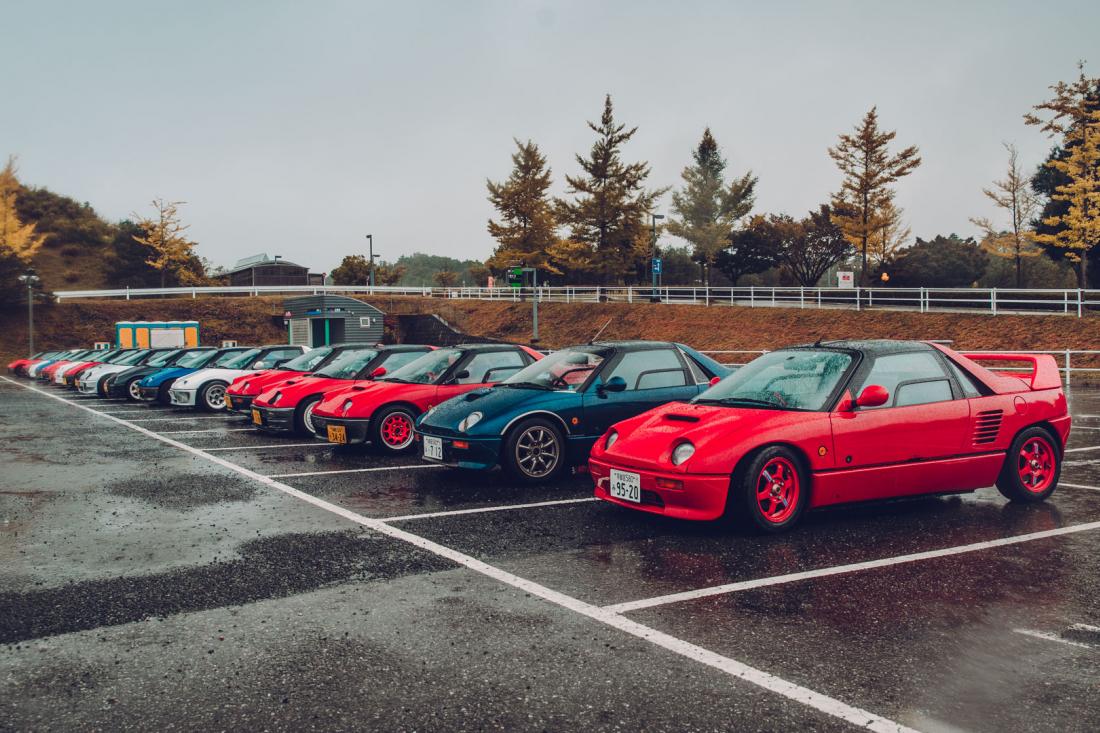
Two factory sub-variants matter to collectors: the Mazdaspeed-equipped car (redesigned hood, rear wing, ceramic muffler, optional strut bars, optional mechanical LSD) and the M2 1015 (50 units announced in 1994, fog lights integrated into the bonnet, restyled front bumper, three colors — white, black, silver — and only about half the announced run actually sold; M2 broke up the unsold cars for parts). The M2 1014 was a single Tokyo Motor Show one-off and is not a buyable variant. The Suzuki Cara (chassis PG6SS) shares the AZ-1's body, drivetrain and subframe with cosmetic changes — different grille, factory fog lights, Suzuki badges — and was produced from 1993 to 1995 in much smaller numbers (around 530 units cited in Wikipedia).
Buyer's guide
Mazda Autozam az 1 PG6SA — Buyer's Guide & Specs
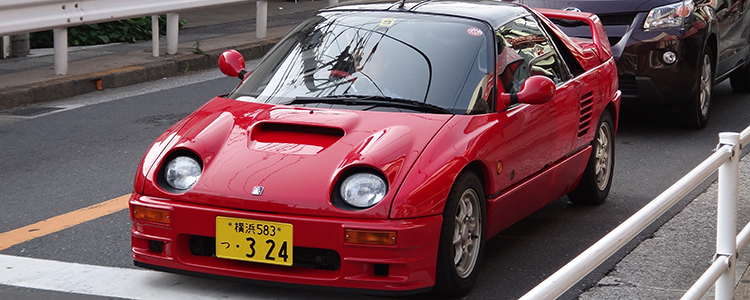
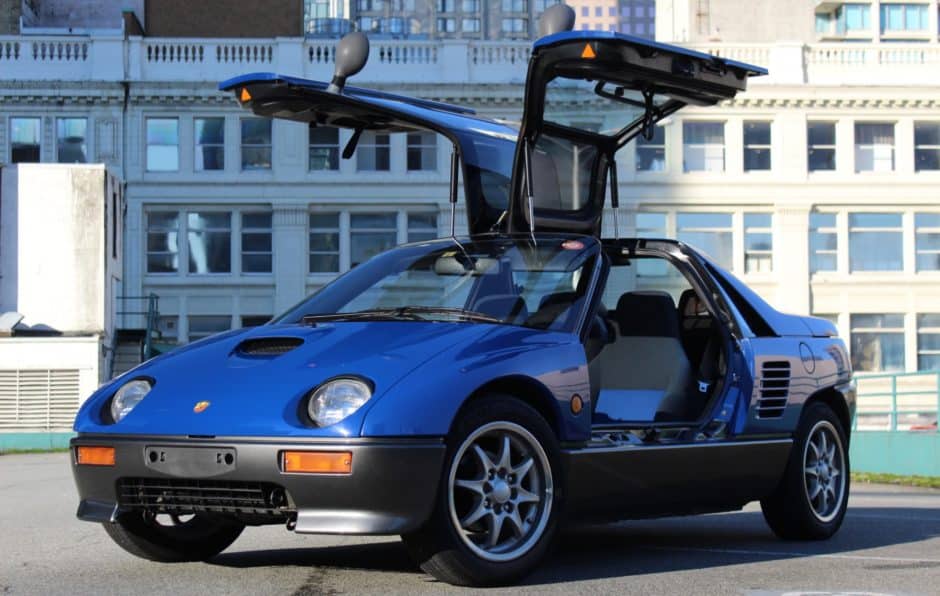
The PG6SA Autozam AZ-1 is the only chassis code Mazda used for the model: a single-generation mid-engine kei coupe produced from October 1992 to October 1995. The drivetrain is Suzuki's F6A 657 cc turbocharged three-cylinder, transversely mounted ahead of the rear axle, driving the rear wheels through a five-speed manual gearbox. There was no automatic option. Curb weight is approximately 720 kg, the body uses plastic composite panels bolted to a steel monocoque, and the gullwing doors hinge from a roof rail braced by the cant rails — a structural arrangement that limits roof flex and is the reason the AZ-1 has no factory convertible variant.
Looking to buy?
Browse Mazda Autozam az 1 listings →
Key Takeaways
The AZ-1 only had one chassis, the PG6SA, built from October 1992 to October 1995. What changed across the run wasn't the platform, it was the sub-variants. Mazdaspeed-equipped AZ-1s got factory aero and sport parts, the limited M2 1015 added fog lights in the bonnet, and the Suzuki Cara was the badge-engineered AZ-1 sold through Suzuki dealers.
- Mid-engine kei with gullwing doors; true collectible
- Originality drives value; mods often reduce price
- Rust and accident repairs are the biggest risks
- Parts scarcity raises ownership cost and downtime
- Import demand keeps prices firm despite cycles
- Low miles help, but condition/history matter more
Technical Specifications
Every AZ-1 runs the same drivetrain. The F6A 657cc turbocharged three-cylinder makes the kei-limit 64 PS, sends power through a 5-speed manual, and drives the rear wheels. There was no automatic option and no other engine option on the AZ-1.
Engine Options
| Engine | Displacement | Power | Boost | Notes |
|---|---|---|---|---|
| F6A | 0.657L | 64 PS @ 6500rpm (estimated) | estimated ~10-11 psi | Kei limit output; intercooled turbo (est.) |
| F6A | 0.657L | 63 hp @ 6500rpm (estimated) | estimated ~10-11 psi | Alt unit conversion; same JIS rating (est.) |
Transmission Options
| Type | Ratios | Availability | Notes |
|---|---|---|---|
| 5-speed Manual | 3.416/2.045/1.333/1.000/0.795 | All AZ-1 trims | Ratios estimated; factory 5MT only |
| Final drive | 4.300 | All AZ-1 trims | Estimated final drive |
Livability
- Headroom
- 36.0"
- Helmet fit is tight; tall drivers hit roof/door
- Rear Seats
- None
- Two-seat only; no occasional rear perch
- Cargo
- 3.5 cu ft
- Tiny frunk + behind seats; weekend bag max
Variants & Trims
The AZ-1 came in a base trim plus the Mazdaspeed package and the limited M2 1015 special edition. The Suzuki Cara is the badge-engineered sibling, mechanically identical with a different nose. The trim levels listed as Type A through Type L cover equipment packages and option content rather than mechanical differences.
| Generation | Trim | Engine | Key Features |
|---|---|---|---|
| PG6SA (1992-1994) | Autozam AZ-1 (Std) | F6A 657cc I3 Turbo (DOHC 12V) | Gullwing doors, mid-engine RWD, 5MT, alloy wheels |
| PG6SA (1992-1994) | Autozam AZ-1 (L) | F6A 657cc I3 Turbo (DOHC 12V) | Std + added comfort trim, audio, interior upgrades |
| PG6SA (1992-1994) | Autozam AZ-1 (M2 1015) | F6A 657cc I3 Turbo (DOHC 12V) | M2-tuned parts, unique trim, limited-run equipment |
| PG6SA (1992-1994) | Autozam AZ-1 Mazdaspeed | F6A 657cc I3 Turbo (DOHC 12V) | Mazdaspeed aero, wheels, sport parts, limited |
| PG6SA (1992-1994) | Autozam AZ-1 (Type A) | F6A 657cc I3 Turbo (DOHC 12V) | Std equipment package, 5MT, midship layout |
| PG6SA (1992-1994) | Autozam AZ-1 (Type B) | F6A 657cc I3 Turbo (DOHC 12V) | Equipment package variant, interior/option differences |
| PG6SA (1992-1994) | Autozam AZ-1 (Type C) | F6A 657cc I3 Turbo (DOHC 12V) | Equipment package variant, option content differences |
| PG6SA (1992-1994) | Autozam AZ-1 (Type D) | F6A 657cc I3 Turbo (DOHC 12V) | Equipment package variant, option content differences |
| PG6SA (1992-1994) | Autozam AZ-1 (Type E) | F6A 657cc I3 Turbo (DOHC 12V) | Equipment package variant, option content differences |
| PG6SA (1992-1994) | Autozam AZ-1 (Type F) | F6A 657cc I3 Turbo (DOHC 12V) | Equipment package variant, option content differences |
| PG6SA (1992-1994) | Autozam AZ-1 (Type G) | F6A 657cc I3 Turbo (DOHC 12V) | Equipment package variant, option content differences |
| PG6SA (1992-1994) | Autozam AZ-1 (Type H) | F6A 657cc I3 Turbo (DOHC 12V) | Equipment package variant, option content differences |
| PG6SA (1992-1994) | Autozam AZ-1 (Type I) | F6A 657cc I3 Turbo (DOHC 12V) | Equipment package variant, option content differences |
| PG6SA (1992-1994) | Autozam AZ-1 (Type J) | F6A 657cc I3 Turbo (DOHC 12V) | Equipment package variant, option content differences |
| PG6SA (1992-1994) | Autozam AZ-1 (Type K) | F6A 657cc I3 Turbo (DOHC 12V) | Equipment package variant, option content differences |
| PG6SA (1992-1994) | Autozam AZ-1 (Type L) | F6A 657cc I3 Turbo (DOHC 12V) | Equipment package variant, option content differences |
Should You Buy a Mazda Autozam az 1 PG6SA?
The AZ-1 trades practicality for theater. You get gullwing doors, a mid-engine kei layout that doesn't exist anywhere else, and a car that feels like a scaled-down supercar. You give up cabin space, parts availability, and any pretense of usability on a long drive.
Why You'll Love It
- True mid-engine balance MR layout delivers kart-like turn-in and rotation; unique among kei cars.
- Gullwing-door theater Iconic doors and canopy styling create supercar vibes at kei scale.
- Strong collector demand Limited supply and global JDM interest keep liquidity high for clean cars.
- Lightweight performance feel Modest power feels lively due to ~720 kg curb weight and short gearing.
- Simple, analog driving No driver aids; direct steering and pedals reward skilled inputs.
- Kei running costs (some) Small tires and basic consumables can be affordable vs larger sports cars.
- Community knowledge base Enthusiast forums and importers document common fixes and parts sources.
Why You Might Not
- Rust is common and costly Sills, floors, rear subframe areas; repairs are labor-heavy and value-killing.
- Parts scarcity and delays Trim, glass, door hardware, and interior bits can be hard to source.
- Heat management challenges Mid-engine bay runs hot; cooling system health is critical in traffic.
- Tiny cabin and entry/exit Tall/broad drivers struggle; gullwings need space and good struts.
- Turbo F6A needs care Boost leaks, aging hoses, and oiling neglect can shorten turbo/engine life.
- Accident history is frequent Many were driven hard; check chassis alignment and repaired fiberglass panels.
- Modifications can hurt value Non-original wheels, aero, swaps reduce collector appeal unless period-correct.
- Highway comfort is limited Short wheelbase, noise, and gearing make long trips tiring.
Who Should NOT Buy This
- Drivers over 6'1" or broad-shouldered
- Anyone needing rear seats or child-seat capability
- People without indoor storage (leaks/rust risk)
- Owners who can't wrench or lack kei specialists
- Anyone expecting modern crash safety
- Daily commuters in heavy traffic or hot climates
- Buyers needing easy parts availability locally
- People who hate squeaks, rattles, and cabin noise
- Those wanting strong A/C and quick defogging
- Drivers who park in low garages (gullwing clearance)
- Anyone on a tight budget for surprise repairs
- Track-day users unwilling to upgrade cooling
- Buyers who require automatic transmission
- People who need highway passing power at low RPM
- Rust-belt residents without rust-proofing plans
- Anyone needing high ground clearance
- Owners who can't tolerate frequent maintenance
- People expecting dealership-level diagnostics/support
- Those who must pass strict emissions inspections
- Anyone uncomfortable with right-hand drive
Common Issues & Solutions
The AZ-1 isn't unreliable, but it is old, complex, and built in tiny numbers. Most of the trouble traces back to rust, cooling, or aging turbo plumbing. None of these are surprising on a 30-year-old turbocharged kei car, but they all cost more to fix on an AZ-1 because parts are scarce.
| Issue | Cause | Solution | Est. Cost |
|---|---|---|---|
| Overheating in traffic | Weak fans, clogged rad, air pockets, old hoses | New rad, fans/relays, bleed properly, replace hoses | $400-1200 |
| Head gasket failure | Overheating, detonation from lean boost, old coolant | MLS gasket, head skim, studs, fix cooling/AFR | $1200-2500 |
| Turbocharger oil smoke | Worn seals/bearings, coked oil from heat soak | Rebuild/replace turbo; add proper cooldown habits | $600-1600 |
| Boost leaks / low boost | Aged couplers, cracked hoses, loose clamps | Pressure test; replace hoses/couplers; proper clamps | $150-600 |
| Detonation under boost | Heat soak, bad fuel, overboost, weak ignition | Lower boost, fix IC fan/ducting, plugs/coils, tune | $200-1500 |
| Intercooler fan failure | Dead motor, relay, wiring corrosion, broken switch | Replace fan/relay; clean grounds; verify temp trigger | $150-500 |
| Timing belt overdue | Age neglect; low-mile imports still time out | Belt, tensioner, idlers, water pump, seals | $500-1200 |
| Water pump leak/noise | Old pump bearings/seal; contaminated coolant | Replace pump with timing service; flush coolant | $450-1100 |
| Oil leaks (top end) | Hardened cam cover gasket, PCV issues | Gasket/half-moons; service PCV; clean breathers | $150-450 |
| Rear main seal leak | Age, crankcase pressure, worn seal lip | Seal replacement during clutch; fix PCV | $700-1400 |
| Low oil pressure hot | Worn bearings/pump; thin oil; overheating history | Gauge verify; rebuild bottom end if confirmed | $2500-6000 |
| 2nd/3rd gear synchro grind | Worn synchros from hard shifts/old oil | Rebuild trans; quality gear oil; replace worn hubs | $1200-2500 |
| Clutch slip | Worn disc, oil contamination, higher boost | Clutch kit; resurface flywheel; fix oil leaks | $700-1500 |
| Clutch master/slave leak | Aged seals; moisture-contaminated fluid | Replace master/slave; flush with fresh DOT4 | $200-500 |
| CV boot tears / clicking | Age, heat, lowered suspension angles | Reboot or replace axle; align ride height | $200-700 |
| Wheel bearing noise | Age, water ingress, track heat | Replace hub/bearing; inspect knuckle wear | $250-700 |
| Brake caliper seizure | Corrosion, old fluid, torn dust boots | Rebuild/replace calipers; flush fluid; new hoses | $300-900 |
| Brake hard line rust | Road salt; trapped moisture under clips | Replace lines; inspect all unions; undercoat properly | $400-1200 |
| Steering rack leak/play | Torn boots, seal wear, contamination | Rebuild/replace rack; new boots; align | $600-1400 |
| Rear subframe corrosion | Salt exposure; thin factory coating | Replace/repair subframe; treat and cavity wax | $800-2500 |
| Floor/sill rust perforation | Water ingress from doors; trapped moisture | Cut/weld metal; fix seals/drains; rust-proof | $1500-6000 |
| Gullwing door sag | Hinge wear, cracked mounts, weak struts | Rebuild hinges/mounts; replace struts; align doors | $400-2000 |
| Door water leaks | Flattened seals, misalignment, blocked drains | New seals; adjust hinges/latches; clear drains | $200-1200 |
| Pop-up headlight issues | Worn gears, tired motors, sticky linkages | Service linkage; replace gears/motor; clean grounds | $200-800 |
| Charging/voltage problems | Weak alternator, corroded grounds, old battery | Alternator rebuild; renew grounds; proper battery | $250-700 |
| Random misfire under load | Old coils/leads, plug gap, poor grounds, boost leak | Ignition refresh; correct plugs/gap; fix leaks/grounds | $150-800 |
| Heater core leak | Corrosion from old coolant; age cracks | Replace heater core; flush system; new hoses | $600-1400 |
| A/C not cold | Leaks, dead compressor, incorrect refrigerant conversion | Leak test; replace drier/seals; recharge correctly | $400-1200 |
| Fuel pump weak/clogged | Tank rust/debris; old pump; stale fuel | Clean tank; new pump/filter; flush lines | $300-900 |
| Exhaust manifold cracks | Heat cycling; thin aftermarket headers | Weld/replace manifold; new studs; proper support | $300-1200 |
| Engine mount collapse | Age/heat; increased torque from mods | Replace mounts; avoid solid mounts for street | $250-800 |
| Cooling system air locks | Mid-engine plumbing; improper bleeding procedure | Vacuum fill/bleed; verify thermostat and cap | $100-400 |
Differences between JDM & USDM
The Autozam AZ-1 was never officially exported and has no USDM equivalent. Mazda did not certify it for North American sale at any point during its 1992–1995 production run — the kei format itself sits outside FMVSS scope, and the car's gullwing doors, RHD-only configuration, and 657 cc turbocharged drivetrain were not engineered for export. Every AZ-1 in the United States arrived via the 25-year FMVSS exemption (49 CFR 591), which began legalizing the earliest October 1992 cars in late 2017 and finished with the final October 1995 examples in late 2020. Canadian buyers had a 15-year window open from 2007 onward and built up a longer ownership history; many US-market AZ-1s today were originally imported into Canada or arrived directly from Japan after the US 25-year date. Driving position is RHD throughout; no factory LHD conversion exists.
Pre-Purchase Inspection Checklist
Walk this list before you transfer money. The Critical items on an AZ-1 are rust and crash damage. Everything else can be priced into the deal, but a bent subframe or rotten floorpan turns a $30,000 AZ-1 into a parts donor.
Critical Priority
- Rust: sills Inspect rocker/sill seams for bubbling & soft spots
- Rust: floorpans Lift mats; check floorpans for patches & pinholes
- Crash structure Check front rails for kinks; measure panel gaps
- Rear subframe Inspect rear subframe for rust, cracks, bent mounts
- Susp mount points Inspect strut tops & control arm mounts for cracks
- Compression test Warm compression; big spread suggests ring/valve issues
- Cooling system Pressure test; check radiator, cap, hoses, heater lines
- Radiator fans Confirm both fans cycle; overheating is catastrophic
- Oil pressure Verify hot idle pressure; low = worn pump/bearings
- Timing belt Confirm belt/water pump date; inspect for cracks
- Brake lines Check hard lines for rust; flex lines for cracks
- VIN/ID plates Match chassis plate, stamped VIN, import paperwork
High Priority
- Rust: rear arches Check rear arch lips & inner tubs for rust/repairs
- Rust: front trunk Check frunk corners & drain areas for rust
- Rust: rear bay Inspect engine bay seams & rear panel for corrosion
- Front crossmember Check crossmember for rust & tow/impact damage
- Door hinges Check gullwing hinges for play, cracks, binding
- Door seals Check seals for tears; look for water tracks inside
- Roof gutters Inspect roof channels for cracks & blocked drains
- Windshield frame Check A-pillars for rust; look for glass replacement
- Engine cold start Listen for top-end tick; watch smoke on start
- Turbo condition Check shaft play & oil in inlet; boost response on road
- Boost leaks Inspect intercooler hoses for oil, splits, loose clamps
- Intercooler fan Verify fan runs; heat soak kills power & raises knock
- Coolant quality Look for rust/sludge; check overflow for oil sheen
- Oil leaks Check cam cover, turbo feed/return, rear main area
- Water pump Check weep hole stains; listen for bearing noise
- Fuel system Smell for fuel; inspect lines, filter, injector seals
- Fuel tank rust Check tank straps/neck; rust flakes clog pump/filter
- Ignition system Inspect coils/leads; misfire under boost is common
- ECU mods Check for piggybacks/boost controllers; verify safe tune
- Exhaust cracks Check manifold/downpipe for cracks & missing studs
- Transmission Test 2nd/3rd synchros; grind = rebuild soon
- Clutch slip Full-boost pull in 3rd; watch RPM flare
- Driveshafts/CVs Check CV boots; click on lock; vibration on accel
- Brakes Inspect caliper sliders, seized pistons, pad taper
- Steering rack Check for leaks & play; torn boots let grit in
- Alignment wear Uneven tire wear suggests bent arms/subframe shift
- Battery/charging Check alternator output; low voltage causes ECU issues
- Heater core Check sweet smell/fogging; leaks soak carpets
- Interior leaks Check damp carpets behind seats & footwells
- Seat rails Check for looseness; floor rust often starts here
- Service records Look for timing belt, coolant, brake fluid history
Medium Priority
- Door struts Confirm doors stay up; struts not weak or leaking
- Rear hatch glass Check for delam, leaks, and trim fitment
- Underbody panels Confirm undertrays present; missing = heat/water issues
- Catalyst status Confirm cat present if required; check for rattles
- Clutch hydraulics Check master/slave leaks; pedal feel consistent
- Wheel bearings Listen for hum; check play; rear bearings take heat
- Shocks/struts Check for leaks; bounce test; AZ-1 hates cheap coils
- Bushings Inspect trailing arm & control arm bush cracks
- Wheels/tires Verify correct stagger; mismatched sizes upset handling
- Ground points Inspect engine/body grounds; corrosion causes misfires
- Fusebox Check for melted terminals; old relays cause no-start
- Lighting Test pop-ups, signals, brake lights; check stalks
- A/C function Confirm compressor engages; check for converted refrigerant
- Cluster warning Verify all warning lamps work; missing bulbs hide faults
Low Priority
- HVAC blower Verify all speeds; resistor failures are common
- Spare keys Confirm 2 keys; lock sets are annoying to source
Generation History
AZ-1 (PG6SA) (1992-1994)
- 657cc F6A turbo; 64 PS kei limit
- Mid-engine RWD; 5MT standard
- Gullwing doors; aluminum door frames
- Autozam brand; Mazda dealer channel
- Lightweight ~720 kg; sharp steering feel
- Limited production; niche halo kei sports
AZ-1 Mazdaspeed (1992-1994)
- Factory aero kit and unique trim
- Often seen with dealer/factory options
- Most collectible sub-variant in market
- Premium for complete, correct pieces
AZ-1 M2 1015/1028 (1992-1994)
- Rare M2 Inc. tuned/trimmed specials
- Hard-to-verify provenance; docs matter
- Highest ceiling when authentic and complete
- Often misrepresented; inspect carefully
Suzuki Cara (twin) (1993-1995)
- Badge-engineered AZ-1 sold as Suzuki
- Different nose/trim; similar mechanicals
- Rarer in some markets; values vary
- Parts interchange helps ownership
Sales Numbers by Year
| Year | Notes |
|---|---|
| 1992 | Production launched October 1992; partial-year output. Total platform production (AZ-1 + Suzuki Cara) reported at ~4,392 units across 1992–1995. |
| 1995 | Production ended October 1995. Suzuki Cara variant (PG6SS) ran 1993–1995 with an estimated ~530 units, sold through Suzuki dealers. |
Market Data
Production Numbers & Rarity
| Generation | Years | Total Built | Notes |
|---|---|---|---|
| PG6SA (AZ-1) | 1992-1994 | ~4,392 (estimated) | Commonly cited total; verify by factory ledger |
Rarest variant: M2 1015
Original MSRP & Pricing
Original MSRP: JPY1,498,000 at launch in 1992. Japanese launch price reported at approximately 1,498,000 yen for the standard AZ-1 at October 1992 introduction. Mazdaspeed-equipped cars and M2 specials carried higher prices. No USD launch price exists — the car was JDM-only.
How It Compares
The AZ-1 only really competes with the Honda Beat and the Suzuki Cappuccino because those are the cars buyers actually cross-shop. The AZ-1 is the most exotic of the three with its gullwing doors and turbo MR layout. The Beat is the driver's car and the Cappuccino is the usable one.
| Feature | PG6SA | Honda Beat PP1 | Suzuki Cappuccino EA11R |
|---|---|---|---|
| Layout | Mid-engine RWD | Mid-engine RWD | Front-engine FWD |
| Engine | 657cc F6A turbo I3 | 656cc E07A NA I3 | 657cc F6A turbo I3 |
| Power (JDM kei cap) | 64 PS (claimed) | 64 PS (claimed) | 64 PS (claimed) |
| Induction | Turbocharged | Naturally aspirated | Turbocharged |
| Transmission | 5MT | 5MT | 5MT |
| Curb weight | ~720 kg | ~760 kg | ~725-750 kg |
| Body style | Coupe, gullwing | Roadster, targa | Roadster, hardtop |
| Practicality | Very low cargo | Low cargo | Moderate for kei |
| Driving character | Boosty, pointy MR | High-rev NA, playful | Turbo FR feel, stable |
| Parts availability | Challenging | Challenging | Moderate |
| Collector premium | High (icon factor) | High (purist appeal) | High (usable classic) |
| Rarity in export mkts | Very rare | Rare | Less rare |
| Value sensitivity | High to originality | High to condition | Moderate |
| Direct rival (twin) | Autozam AZ-1 | Same platform | Same kei era niche |
| Maintenance complexity | Medium-high (MR) | Medium (MR NA) | Medium (FR turbo) |
| Cabin space | Tight | Tight | Tight but airy |
Comparable Alternatives
If the AZ-1 doesn't work out, the obvious alternatives are the other two cars in the ABC trio. The Honda Beat is the naturally aspirated mid-engine roadster, and the Suzuki Cappuccino is the turbocharged front-engine convertible. The Suzuki Cara is the same car as the AZ-1 with different badges and is usually cheaper.
Honda Beat PP1
Same kei era; MR purity, NA character, strong collector base
Suzuki Cappuccino EA11R
Kei sports icon; turbo FR feel, more usable roof options
Suzuki Cara PG6SS
AZ-1 twin; similar drive, sometimes different pricing/rarity
Daihatsu Copen L880K
Later kei roadster; easier parts, modern comfort, still small/fun
Toyota MR2 SW20
Bigger MR alternative; more power and support, less rare/quirky
In Pictures
The Buyer's Read
If you're buying an AZ-1, the first thing to accept is that you're shopping rust before anything else. The AZ-1 has a steel monocoque under its plastic body panels, and that steel rusts at the sills, the floorpans, the rear subframe, and the suspension pickups. A clean Japanese auction sheet with photos of the underside matters more than mileage on an AZ-1. A low-mile car with rotten sills is a worse buy than a higher-mile car that's been kept dry.
The right AZ-1 for most people is a stock, documented car with the timing belt and water pump done recently. The F6A is a small turbo engine that doesn't like neglect. Overheating once on an AZ-1 can mean a head gasket, and the mid-engine cooling plumbing is fussy to bleed properly. If the seller can't tell you when the coolant was last changed and the intercooler fan was tested, walk away or price it as a project.
Skip the M2 1015 unless the paperwork is bulletproof. Only about 25 of the 50 announced cars actually sold, M2 broke up the rest for parts, and the variant gets faked. Mazdaspeed AZ-1s are easier to verify because the parts are documented, but you'll still pay a premium and you need to confirm every Mazdaspeed piece is actually there.
The Suzuki Cara is the value buy if you can find one. It's the same car as an AZ-1 with different badges and a different grille. There are only about 530 of them, so they're rarer than the AZ-1, but the collector market hasn't fully priced that in yet. If originality matters to you and the gullwing doors are what you're after, get an AZ-1. If you just want the driving experience, a Cara is the same thing for less money.
Frequently Asked Questions
- What is the Autozam AZ-1 and why is it special?
- A 1992–1994 kei mid-engine coupe with gullwing doors. Rarity and design drive collector demand.
- What should I pay for a good AZ-1 today?
- Most trade around $18k–$45k; top originals can exceed $55k. Rust-free, stock cars bring premiums.
- When is the AZ-1 legal to import to the US?
- Under the 25-year rule, 1992 cars became legal in 2017; the last 1994 cars in 2019.
- What are the biggest problem areas to inspect?
- Rust, crash repairs, cooling system health, door struts/hinges, and missing trim. Verify chassis straightness.
- Is the AZ-1 reliable as a weekend car?
- Yes if maintained: fresh hoses, coolant, and turbo oiling. Expect age-related issues and parts hunting.
- Do modifications hurt AZ-1 value?
- Often yes. Collectors pay for original wheels/trim/aero. Period-correct upgrades with documentation fare better.
- How does it compare to a Honda Beat or Cappuccino?
- AZ-1 is the most exotic (gullwing MR turbo). Beat is revvy NA; Cappuccino is more usable with FR balance.
- What options or variants are most desirable?
- Mazdaspeed-equipped cars and verified M2 specials lead. Documentation and complete parts are critical.
Sources & References
- Autozam AZ-1 — encyclopedic overview — WikipediaVerified
- Driving the Autozam AZ-1 in Japan — Top GearVerified
- Every day is O-Kei in the Autozam AZ-1 microcar — Driving.caVerified
- K-cars: All you need to know about them — CrooooberVerified
- Suzuki Cara — encyclopedic overview of the AZ-1 sibling — WikipediaVerified
- Autozam — Mazda's small-car sub-brand (1989–1998) — WikipediaVerified
- Kei car — regulatory background and 660 cc displacement cap — WikipediaVerified
- Autozam AZ-1 sales results archive — Bring a TrailerVerified
- Autozam AZ-1 — feature article — SilodromeVerified
- Autozam AZ-1 auction results search — Cars & BidsVerified
- Strange & crazy cars (404 — preserved from WP source for citation lineage) — AutomoblogLink dead
Sources last verified: