Buyer's guide
Toyota Starlet
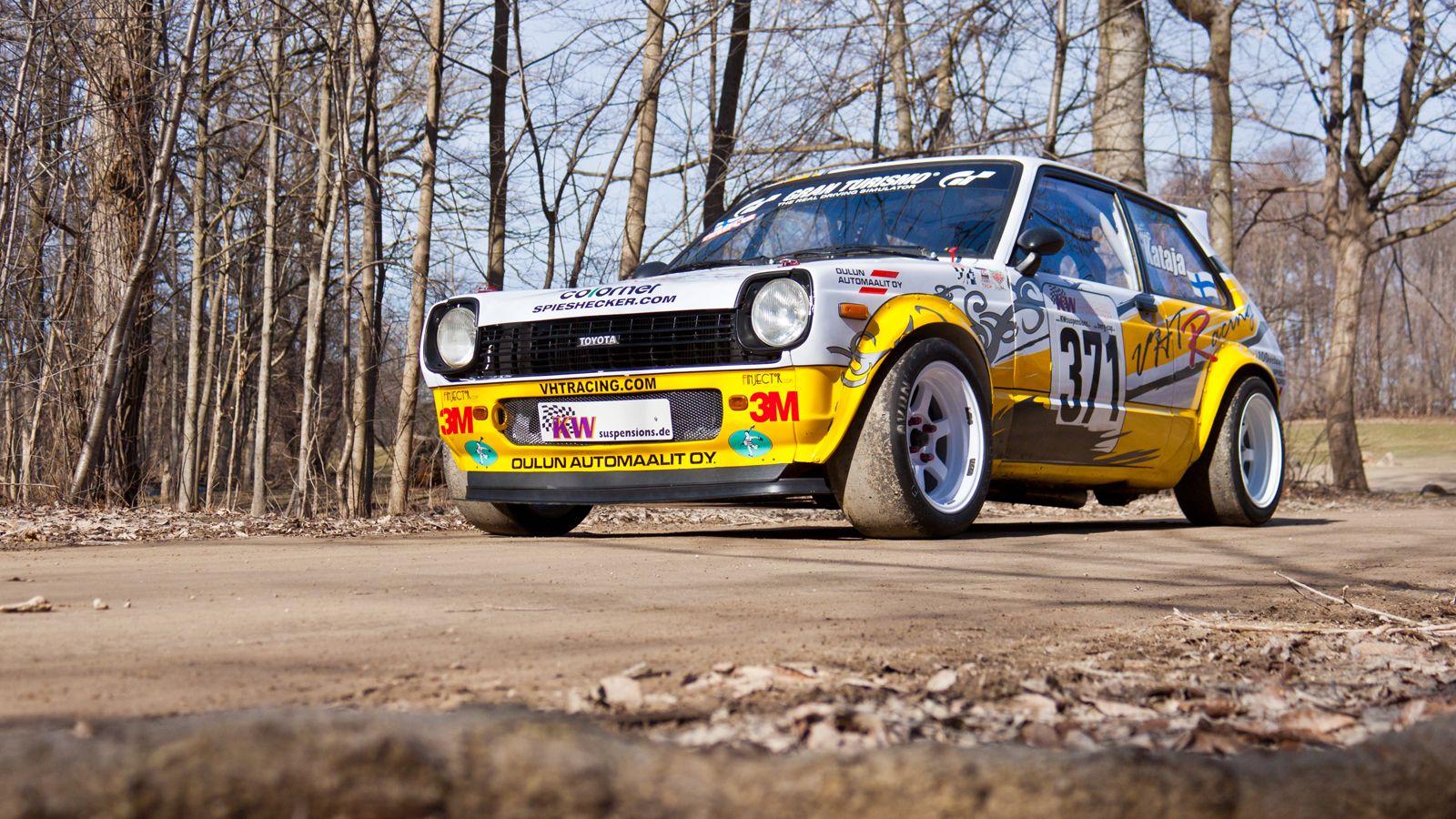
The Toyota Starlet is a five-generation subcompact hatchback that ran from 1973 to 1999 under the Starlet nameplate, replaced by the Vitz/Yaris for the 2000 model year. It sat below the Corolla in Toyota's lineup, sharing its early underpinnings with the Toyota Publica before evolving into the front-wheel-drive EP-platform cars that defined the model in the 1990s. Across two decades the Starlet shifted from a rear-wheel-drive economy car (KP40/KP60/KP70) to a front-wheel-drive hot hatch (EP80/EP82/EP90/EP91), with the JDM-only EP82 GT Turbo (1989-1995) and EP91 Glanza V (1996-1999) carrying the enthusiast story. Both use the 1.3-litre 4E-FTE turbocharged inline-four — a CT9-turbo, air-to-air-intercooled DOHC 16-valve block sharing its bottom end with the naturally aspirated 4E-FE. Curb weight on a stock EP91 sits near 900 kg, which is the single biggest reason the Starlet still surprises modern hot hatches on a tight backroad. The Starlet also competed in the WRC A5 Class during its fourth generation, taking several podium finishes — a credential almost no other 1990s Toyota subcompact carries. Only the third-generation rear-wheel-drive base car was ever officially sold in the United States, between the 1981 and 1984 model years; every turbocharged Starlet was JDM-only, which is the reason US import demand spikes as each successive year-of-production becomes 25-year-eligible.
Why the EP82 GT Turbo and EP91 Glanza V matter
The collector case for the Starlet rests almost entirely on two trims: the EP82 GT Turbo (1989-1995, fourth generation) and the EP91 Glanza V (1996-1999, fifth generation). Both use the 4E-FTE — a 1.3-litre DOHC 16-valve four with a CT9 turbocharger, factory-cooled by an air-to-air intercooler. The EP82 GT Turbo introduced optional all-wheel drive, ABS, a limited-slip differential, and a rear strut tower bar, and was the first Starlet to ship with Toyota's Electronic Modulated Suspension (TEMS) — an early active-damping system that reads driving conditions and can also be switched manually. The EP91 Glanza V refined the formula: revised ECU mapping, a sharper-responding turbocharger, and a curb weight near 900 kg that let a stock car run high-7-second to low-8-second 0-60 mph times. Toyota never offered either car in North America. The 25-year import window opened for 1996 cars in 2021 and closes out the EP91 generation in 2024.
What WP coverage gets right about the 4E engine
The WP source flags carbon buildup, turbo cracking between the port and wastegate, and intercooler degradation as the dominant Starlet failure modes — and the 4E-FTE-specific notes track with what owner communities report. The block itself is durable up to roughly 180-220 hp on stock internals with proper fuel system support, conservative tuning, and an upgraded intercooler. Beyond that, fueling, cooling, and rotating-assembly upgrades become the limiting factor. The cooling system is the single highest-risk subsystem on a high-mileage car: a stuck thermostat, a tired radiator cap, or a clogged turbo oil-feed line all converge on the same outcome (a cooked head gasket or a blown turbo). Pre-purchase, prioritise coolant condition, cap pressure, turbo shaft play, and any sign of oil mist in the boost piping.
Quick read
Key takeaways
- Turbo EP82/EP91 are the value leaders
- Stock, rust-free examples command big premiums
- NA Starlets are cheaper but slowly rising
- Parts availability varies by generation and region
- Rust and mods are the main value killers
- US import interest increases as EP91 hits 25-year
Constants
Common across all Starlet generations
- Subcompact hatchback; switched from rear- to front-wheel drive from the P70 generation
- Turbocharged GT Turbo (P80) and Glanza V (P90) variants used the 4E-FTE 1.3L engine
- Lightweight body giving turbocharged variants a strong power-to-weight ratio
- Naturally aspirated variants used E-series 1.0L–1.3L four-cylinders
- Right-hand drive throughout JDM production
Chassis history
Generation timeline
The Starlet ran for six generations from 1973 until 1999. The first three are rear-wheel drive economy cars and the last three switch to front-wheel drive. The EP82 and EP91 are the ones almost every Starlet buyer ends up looking at, because that's where the 4E-FTE turbo lives.
Third generation — P70 (1984–1989)
Fourth generation — P80 (EP82, GT Turbo; 1989–1996)
Buyer's call
Should you buy a Toyota Starlet?
The Starlet is a small car that gives you a lot of fun for the money, and the trade-offs are pretty obvious. You get lightweight performance and Toyota reliability. You give up rear seat space, modern safety, and the kind of parts availability you'd get on a Civic.
Why you'll love it
- Lightweight performance EP/KP cars feel quick on modest power; great on tight roads and autocross-style driving.
- 4E-FTE tuning potential Turbo EP82/EP91 respond well to bolt-ons; 180-220hp builds are common with supporting mods.
- Toyota reliability baseline Simple drivetrains and robust ancillaries; strong if maintained and not overheated or overboosted.
- Compact ownership costs Low fuel use, small tires/brakes, and simple servicing keep running costs below larger JDM icons.
- Strong enthusiast support Active communities and proven recipes for suspension, brakes, and engine management on EP cars.
- Rarity drives collectability Clean GT Turbo/Glanza V cars are scarce; originality and documentation can lift values sharply.
Why you might not
- Rust is the #1 issue Sills, rear arches, floors, and strut towers can rot; quality repairs are costly and affect value.
- Many are heavily modified Poor wiring, big-boost setups, and cheap coilovers reduce reliability; stock cars are hard to find.
- Parts availability varies Trim, interior, and some engine parts can be scarce; OEM turbo-specific items may be pricey.
- Short wheelbase behavior Can feel nervous at speed; needs good alignment, bushings, and tires to avoid twitchy handling.
- Interior refinement is basic Road noise, thin materials, and limited safety tech; not comparable to newer hot hatches.
- Spec confusion on imports LSD, ABS, and trim claims are often wrong; verify chassis code, ECU, and option plates.
Who should not buy this
- Anyone needing modern crash safety/airbags
- Drivers wanting quiet highway cruising
- People without access to rust repair/welding
- Buyers who can't DIY basic maintenance
- Those needing reliable daily transport in winter salt
- Anyone expecting modern A/C performance
- Tall drivers needing helmet clearance for track
- People who hate rattles, squeaks, and old-car smells
- Turbo GT buyers without budget for tuning/fuel system
- Anyone in strict emissions areas without compliance plan
- Buyers who want easy OEM parts availability everywhere
- People who won't tolerate frequent small fixes
- Those needing real rear-seat space for adults/kids seats
- Anyone expecting strong rust-free resale in wet climates
- Drivers who plan big power on stock internals and cooling
Reliability
Common issues & solutions
Most Starlet problems trace back to two things. Rust on the older cars, and abuse on the turbo cars. A 4E-FTE that's been beaten on with a cheap boost controller and no fuel system work will eat itself. A rust-free Starlet that's been maintained is still happy at 200,000 miles.
| Issue | Cause | Solution | Est. cost |
|---|---|---|---|
| Severe rust in sills/arches | Thin steel, trapped moisture, old repairs | Cut/weld proper panels; treat cavities; undercoat | $1500-6000 |
| Front frame rail corrosion | Road salt, poor underseal, age | Structural weld repair; avoid filler-only fixes | $2000-7000 |
| Rear beam mount rust/cracks | Rust at mounts, impacts, fatigue | Weld reinforcement; replace beam if needed | $800-2500 |
| Overheating in traffic | Aged radiator, stuck thermostat, weak fan circuit | New rad/thermostat/cap; fix fan relay/switch | $300-900 |
| Head gasket failure (abuse) | Overheating, detonation, old coolant | Machine head, gasket set, bolts; fix root cause | $900-2200 |
| Timing belt overdue | Neglected maintenance; unknown history | Belt, tensioner, idlers; water pump while there | $450-1100 |
| Cam cover oil leak | Hardened gasket, overtightened cover | Replace gasket/grommets; check PCV | $60-250 |
| Distributor O-ring leak | Aged O-ring; heat cycles | Replace O-ring; clean oil off timing area | $50-200 |
| Rear main seal leak | Age, crankcase pressure, worn seal lip | Seal replacement; inspect clutch contamination | $600-1400 |
| Idle hunting/stalling | Vacuum leaks, dirty IAC/TB, bad TPS | Smoke test; clean TB/IAC; set TPS; replace hoses | $150-600 |
| Heater core leak | Corrosion, old coolant, electrolysis | Replace core; flush system; new coolant | $500-1200 |
| Radiator plastic tank crack | Age/heat cycling; old cap overpressure | Replace radiator and cap; inspect hoses | $250-650 |
| Alternator weak/charging drop | Worn brushes/diodes; oil contamination | Rebuild/replace alternator; fix oil leaks | $200-600 |
| Starter slow crank | Worn contacts, tired battery, bad grounds | Replace contacts/starter; clean grounds | $120-450 |
| Fuel pump weak (GT worse) | Age, varnish, running low fuel often | Replace pump/filter; verify pressure under load | $250-700 |
| Injector clog/misfire | Old fuel, clogged filters, heat soak | Ultrasonic clean/flow test; replace seals | $150-600 |
| 2nd gear synchro grind | Wear from hard shifts; old gear oil | Rebuild gearbox; quality fluid may reduce symptoms | $900-2500 |
| Clutch slip/chatter | Worn disc, oil contamination, weak pressure plate | Clutch kit; resurface flywheel; fix oil leaks | $700-1600 |
| CV joint clicking | Torn boots; grease loss; age | Replace axle or reboot early; align after | $200-600 |
| Wheel bearing hum | Age, impacts, water ingress | Replace bearing/hub; check torque and seals | $250-650 |
| Rear beam bush failure | Rubber deterioration; harsh springs | Replace bushes; consider OEM rubber for street | $350-1000 |
| Front ball joint failure | Boot tears; lack of grease; impacts | Replace ball joints/control arms; align | $250-800 |
| Seized front calipers | Corrosion, old fluid, torn dust boots | Rebuild/replace calipers; flush fluid | $250-900 |
| Rear wheel cylinder leak | Corrosion in drum cylinders; old fluid | Replace cylinders/shoes; flush; adjust drums | $200-600 |
| Rusty brake hard lines | Salt exposure; aged coatings | Replace lines with NiCopp; inspect flex hoses | $400-1200 |
| Power steering leaks (if eq) | Aged seals/hoses; pump wear | Replace hoses/seals; rebuild pump if whining | $250-900 |
| A/C weak or inop | Leaks, old compressor, R12-to-R134a hacks | Leak test; replace drier; proper conversion service | $400-1400 |
| Water leaks into trunk | Hatch seal, tail light seals, body vents | Replace seals; reseal lights; clear drains | $80-400 |
| Odometer not counting | Worn plastic gear in cluster (varies by year) | Replace gear/cluster; document mileage correction | $120-500 |
| GT turbo smoking | Worn turbo seals; poor oiling; coked oil | Rebuild/replace turbo; add proper oil feed/return checks | $700-2000 |
| GT detonation/knock | Lean fuel, bad tune, heat soak, low octane | Fuel system refresh; intercooler; conservative tune | $500-2500 |
| Cracked turbo manifold | Heat cycling; missing support; overboost | Replace manifold; new studs; check downpipe stress | $400-1200 |
| Boost leaks (GT) | Old couplers, cracked vacuum lines, loose clamps | Pressure test; replace silicone/couplers; new clamps | $150-600 |
| PCV system clogged | Sludge, short trips, neglected oil changes | Replace PCV/hoses; clean breather; fix oil leaks | $80-300 |
Market
Differences between JDM & USDM
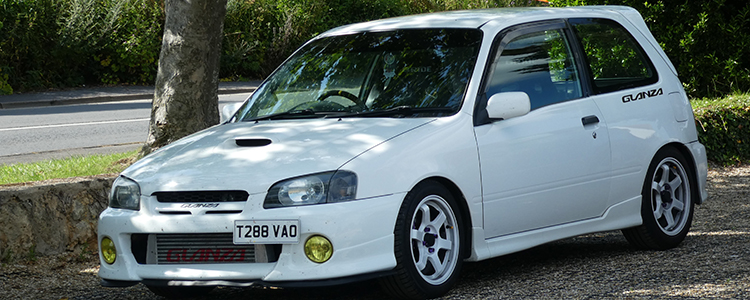
Toyota only sold the Starlet in the United States during the third generation (KP61/KP62, 1981-1984 model years) as a rear-wheel-drive economy hatch with the 1.3-litre 4K-E engine. No turbocharged Starlet was ever offered through US Toyota dealers. The EP71 1.3 Turbo (1986-1989), the EP82 GT Turbo (1989-1995), and the EP91 Glanza V (1996-1999) were all JDM-only with limited grey-market exports to the UK, Ireland, Cyprus, and Australasia. The 25-year FMVSS exemption opened EP82 GT Turbo eligibility in 2014 and EP91 Glanza V eligibility in 2021; the final 1999 cars become US-legal in 2024. Identification cues to confirm a real Glanza V on import: 4E-FTE engine code on the block, CT9 turbocharger, twin-pot front calipers, factory rear spoiler, and the 'Glanza V' badge on the tailgate. The naturally aspirated Glanza S shares the body but uses the 4E-FE and is the cheaper, slower variant.
Specs
Technical specifications
The Starlet engine lineup goes from the old K-series 1.0 and 1.2 carbs on the early RWD cars to the twin cam 4E-FE and turbocharged 4E-FTE on the EP82 and EP91. The 4E-FTE is the one that matters. It's a 1.3 liter DOHC 16 valve turbo with a CT9 turbocharger, and it's the reason the Starlet gets imported.
Engine options
| Chassis | Engine | Displacement | Power | Boost | Notes |
|---|---|---|---|---|---|
| KP40/KP47 | 2K | 1.0L | estimated | N/A | Carb I4; exact JIS output varies by year |
| KP60 | 2K | 1.0L | estimated | N/A | Carb I4; market/year dependent ratings |
| KP60 | 3K | 1.2L | estimated | N/A | Carb I4; exact JIS output varies |
| KP70 | 2K | 1.0L | estimated | N/A | Carb I4; early RWD Starlet |
| KP70 | 3K | 1.2L | estimated | N/A | Carb I4; output varies by market |
| KP70 | 4K | 1.3L | estimated | N/A | Carb I4; higher output RWD variant |
| EP80 | 1E | 1.0L | estimated | N/A | SOHC I4; carb/EFI varies by market |
| EP80 | 2E | 1.3L | estimated | N/A | SOHC I4; carb/EFI varies by market |
| EP80 | 2E-E | 1.3L | estimated | N/A | EFI SOHC I4; exact JIS varies |
| EP82 | 3E-TE | 1.5L | estimated | estimated | Turbo I4; exact boost/output market dependent |
| EP90 | 1E/1E-E | 1.0L | estimated | N/A | SOHC I4; carb/EFI varies by market |
| EP91 | 4E-FE | 1.3L | estimated | N/A | DOHC 16V; output varies by market/year |
| EP91 | 4E-FTE | 1.3L | estimated | estimated | CT9 turbo; JDM rated ~135 PS (varies) |
| EP95 | 4E-FE | 1.3L | estimated | N/A | 4WD variant in some markets; output varies |
Transmission options
| Type | Ratios | Availability | Notes |
|---|---|---|---|
| 4-speed Manual | estimated | P40/P50, P60, early P70 | Early K-series applications; market dependent |
| 5-speed Manual | estimated | P70, P80, P90, P100 | Common fitment; exact ratios vary by gearbox |
| 3-speed Automatic | estimated | P70/P80 (some markets) | Market dependent automatic option |
| 4-speed Automatic | estimated | P90/P100 (some markets) | Aisin 4AT variants; ratios vary by model |
Lineup
Variants & trims
Starlet trim names are scattered across the generations and the markets. The ones worth knowing are the GT Turbo on the EP82 and the Glanza V on the EP91. Both use the 4E-FTE. The Glanza S looks like a Glanza V but uses the non-turbo 4E-FE, so check the engine code on the block before you pay Glanza V money.
| Generation | Trim | Engine | Key features |
|---|---|---|---|
| P40/P50 (1st gen, 2-door sedan) | Starlet (base) | 1.0L 2K I4 | 2-door sedan, basic trim, steel wheels |
| P40/P50 (1st gen, 2-door sedan) | Starlet Deluxe | 1.0L 2K I4 | upgraded interior, brightwork, higher equipment |
| P60 (2nd gen, 3-door hatch) | Starlet Standard | 1.0L 2K I4 | 3-door hatch, basic trim, steel wheels |
| P60 (2nd gen, 3-door hatch) | Starlet Deluxe | 1.0L 2K I4 | upgraded interior, brightwork, higher equipment |
| P60 (2nd gen, 3-door hatch) | Starlet (1.2) | 1.2L 3K I4 | larger engine, improved drivability, higher spec |
| P70 (3rd gen, RWD hatch) | Starlet Standard | 1.0L 2K I4 | RWD, 3-door hatch, basic trim |
| P70 (3rd gen, RWD hatch) | Starlet Deluxe | 1.0L 2K I4 | RWD, upgraded interior, brightwork |
| P70 (3rd gen, RWD hatch) | Starlet (1.2) | 1.2L 3K I4 | RWD, 1.2L, higher equipment |
| P70 (3rd gen, RWD hatch) | Starlet (1.3) | 1.3L 4K I4 | RWD, 1.3L, improved performance |
| P80 (4th gen, FWD) | Starlet Base | 1.0L 1E I4 | FWD, 3/5-door, basic trim |
| P80 (4th gen, FWD) | Starlet XL | 1.0L 1E I4 | higher equipment, improved interior, trim upgrades |
| P80 (4th gen, FWD) | Starlet (1.3) | 1.3L 2E/2E-E I4 | 1.3L option, improved torque, higher spec |
| P80 (4th gen, FWD) | Starlet Si | 1.3L 2E-E I4 | sport trim, tachometer, firmer suspension |
| P80 (4th gen, FWD) | Starlet Turbo S | 1.5L 3E-TE I4 Turbo | turbo, sport seats, body kit, uprated brakes |
| P90 (5th gen, FWD) | Starlet 1.0 | 1.0L 1E/1E-E I4 | FWD, 3/5-door, base equipment |
| P90 (5th gen, FWD) | Starlet 1.3 | 1.3L 2E/2E-E I4 | 1.3L, improved drivability, higher spec |
| P90 (5th gen, FWD) | Starlet Si | 1.3L 4E-FE I4 | DOHC, sport trim, tach, firmer suspension |
| P90 (5th gen, FWD) | Starlet GT Turbo | 1.3L 4E-FTE I4 Turbo | turbo, hood scoop, sport seats, rear spoiler |
| P90 (5th gen, FWD) | Starlet GT Turbo (EP91 late) | 1.3L 4E-FTE I4 Turbo | CT9 turbo, revised ECU, improved response |
| P100 (6th gen, FWD) | Starlet 1.0 | 1.0L 4E-FE I4 | FWD, 3/5-door, base equipment |
| P100 (6th gen, FWD) | Starlet 1.3 | 1.3L 4E-FE I4 | 1.3L, improved torque, higher spec |
| P100 (6th gen, FWD) | Starlet Sportif | 1.3L 4E-FE I4 | sport appearance, alloy wheels, firmer suspension |
| P100 (6th gen, FWD) | Starlet Glanza V | 1.3L 4E-FTE I4 Turbo | turbo, CT9, optional LSD, sport interior |
| P100 (6th gen, FWD) | Starlet Glanza S | 1.3L 4E-FE I4 | NA Glanza, sport trim, aero options |
| P100 (6th gen, FWD) | Starlet Carat | 1.3L 4E-FE I4 | lux trim, upgraded interior, higher equipment |
| P100 (6th gen, FWD) | Starlet Reflet | 1.3L 4E-FE I4 | special edition, unique trim, equipment package |
Pricing
Average prices & original MSRP
Today's market range: $3,500 to $35,000 (median ~$14,500). Source: JDMBuySell / USS Auction.
Turbo EP82/EP91 prices remain firm with premiums for stock, rust-free cars; modified examples lag. NA cars are slowly appreciating. As 1999 EP91 becomes import-eligible, demand should lift entry and mid-tier prices, while top cars stay scarce.
Inspect
Pre-purchase inspection checklist
Walk the Starlet checklist with the car cold and the seller on the other side of the garage. Rust is the deal breaker on any pre-1996 car. Cooling system condition is the deal breaker on any GT Turbo or Glanza V. A 30 minute drive that includes some boost and some highway will tell you most of what you need to know.
Critical priority
- Chassis Rust Check rear arches/sills for bubbling & filler
- Front Frame Rails Inspect rails for rot, kinks, poor weld repairs
- Rear Beam Mounts Check trailing arm/beam mounts for rust cracks
- Strut Towers Inspect front/rear towers for rust & seam splits
- Thermostat/Fans Verify fan cycles; no overheating in traffic
- Timing Belt Proof Confirm belt date/mileage; inspect stickers/receipts
- Turbo (GT only) Check shaft play, smoke on boost, oil in pipes
- Brakes/Lines Inspect hard lines for rust; flex hoses cracks
- Fuel Lines Inspect underbody lines for rust & seepage
- VIN/Chassis Plate Match VIN plates; check import paperwork accuracy
- Mods Quality Inspect wiring, boost controller, fuel cuts, tune
High priority
- Floor Pans Lift carpets; check footwells for rust patches
- Spare Tire Well Check trunk well for standing water & rust
- Windshield Cowl Check cowl drains; rust under windshield trim
- Accident Repair Measure gaps; look for overspray & pulled rails
- Underbody Coating Probe underseal for soft rust hiding repairs
- Engine Cold Start Start cold; listen for rattle, knock, smoke
- Oil Leaks Check cam cover, dizzy O-ring, front/rear main
- Coolant Condition Look for oil in coolant; rusty coolant; leaks
- Radiator/Cap Check plastic tank cracks; cap pressure rating
- Compression Test Check even compression; low cyl suggests rings/valves
- Boost Control Verify stable boost; no spikes or fuel cut
- Intercooler/Leaks Pressure test; check couplers for splits/oil mist
- Exhaust Manifold Check cracks, missing studs, ticking cold
- Gearbox Syncros 2nd/3rd grind on fast shifts; test cold & hot
- Clutch/Slave Check bite point; slip in 4th; leaks at slave
- Front Control Arms Check bush cracks; ball joint play; wandering
- Rear Beam Bushes Check beam bushes; rear steer feel over bumps
- Calipers/Rear Cyl Check seized calipers; leaking rear wheel cylinders
- Charging System Verify 13.8-14.4V; alt noise; belt condition
- Cooling Hoses Squeeze hoses; check swelling, crust at clamps
- Heater Core Check sweet smell, fogging windows, wet carpet
- Fuel Pump Noise Listen for loud whine; check pressure under load
- Vacuum Hoses Check brittle hoses; boost/vac leaks on GT
- ECU/Check Light Pull codes; verify no cleared codes recently
- Seatbelt Retract Check belts retract; fraying; buckle function
- Service Records Look for timing belt, coolant, brake fluid history
- Emissions Readiness Check cat present; no fuel smell; passes local test
Medium priority
- Door Bottoms Inspect door seams/drains for rust swelling
- Hatch/Boot Seam Check hatch lip seam for rust & water ingress
- Idle Quality Check hunting idle; A/C on/off stability
- Engine Mounts Check excessive rocking; clunks on throttle
- CV Joints Clicking on lock; torn boots; grease sling
- Wheel Bearings Listen for hum; check play at 12/6 o'clock
- Steering Rack Check inner tie rods play; rack boots torn
- Power Steering If equipped: pump whine, leaks at lines
- Struts/Springs Check leaks, sag, broken coils, uneven ride height
- ABS (if fitted) ABS light self-test; scan codes; wheel sensors
- Wheels/Tires Check mismatched tires; inner wear from toe issues
- Electrical Grounds Check battery terminals; engine/body grounds clean
- Starter Health Listen for slow crank; solenoid click only
- A/C System Confirm cold vent temps; compressor noise/leaks
- Injector Health Check misfire under load; balance test if possible
- Cluster/Odometer Verify odo works; common gear failure on older units
- Interior Leaks Check wet rear carpets; hatch seals & grommets
Cross-shop
Comparable alternatives
If the Starlet doesn't work out, the natural cross shops are the Honda Civic EG6 if you want more space and a bigger aftermarket, the Suzuki Swift GTi if you want something even lighter and quirkier, or the Daihatsu Charade GTti if you like the tiny turbo hatch idea but want something rarer. The Civic is the sensible choice. The Starlet is the one you buy because you actually want a Starlet.
Toyota Corolla AE92 GTi
Light FWD Toyota; 4A-GE revs; more space
Honda Civic EG6 SiR
Iconic 90s hot hatch; B16 VTEC; huge support
Nissan March K11 Super S
Small, light, fun; cheaper entry; simple upkeep
Suzuki Swift GTi (SA/EA)
Lightweight 1.3 DOHC; analog feel; rising cult
Daihatsu Charade GTti
Tiny turbo hot hatch; rare; similar sleeper vibe
Compare
How it compares
The Starlet's competition is basically the Civic EG6 for cross shopping and the Nissan Pulsar GTI-R for raw performance. The Civic is easier to live with. The GTI-R is faster but heavier and more complicated. The Starlet sits in the middle. It's the light, simple, turbocharged Toyota hot hatch, and that combination doesn't really exist anywhere else.
| Feature | Toyota Starlet | Honda Civic EG6 SiR | Nissan Pulsar GTI-R N14 |
|---|---|---|---|
| Power (factory) | EP91 Glanza V: ~135hp | Civic EG6: ~160hp | Pulsar GTI-R: ~227hp |
| Torque (factory) | 4E-FTE: ~116 lb-ft | B16A: ~111 lb-ft | SR20DET: ~210 lb-ft |
| Curb weight | EP91: ~900-950kg | EG6: ~1050-1100kg | GTI-R: ~1290kg |
| Drivetrain | FWD; some LSD-equipped | FWD; LSD common in SiR | AWD; viscous center diff |
| Engine layout | 1.3L I4 turbo (4E-FTE) | 1.6L NA I4 (B16A VTEC) | 2.0L I4 turbo (SR20DET) |
| 0-60 mph (typical) | EP91 turbo: ~7.0-8.0s | EG6: ~7.0-7.5s | GTI-R: ~5.5-6.0s |
| Tuning headroom | 180-220hp common on stock block | NA gains modest; swap-friendly | Big power possible; costly AWD upkeep |
| Reliability baseline | Strong if stock boost & cooling OK | Very strong; watch oil use on B16 | More complex; AWD/boost heat issues |
| Rust risk | High on EP/KP in salted climates | Moderate; rear arches/sills | Moderate; underbody & rear quarters |
| Parts availability | Good aftermarket; some OEM scarce | Excellent OEM/aftermarket support | Specialist parts; pricier supply |
| Cabin practicality | Small; usable hatch, tight rear seat | More space; better ergonomics | More room; heavier, taller stance |
| Collector demand | High for Glanza V/GT Turbo, stock | High for clean EG6/Type R lineage | Niche; rally icon but fewer buyers |
| Insurance/attention | Often flagged due to theft/mods | Also flagged; high theft risk | Less theft; higher repair costs |
Gallery
In pictures
Editorial
The buyer's read
If you're buying a Starlet, the question isn't really which one. It's which one in what condition. A clean unmodified EP91 Glanza V is the car most enthusiasts end up wanting, and it's also the hardest to find. A rough modified EP82 GT Turbo is the car you'll actually be looking at most of the time, and that's where the buying mistakes happen.
Start with rust. Any Starlet from a salt climate that doesn't have receipts for sill, arch, and floor pan repair is a project, not a daily driver. The thin steel on these cars rots from the inside out, and by the time you can see it on the outside the repair bill is already in the thousands. A Japanese auction car with a clean sheet is almost always a better starting point than a UK or Irish car at the same price, just because of climate.
Next, look at the mods. A bone-stock GT Turbo or Glanza V is worth more than a fast one. If the car has a piggyback ECU, a bigger turbo, or a front-mount intercooler, ask for receipts and a tune log. If the seller can't tell you what the fuel system is running, walk. A 4E-FTE will live a long happy life at 180 to 220 horsepower with proper fueling, cooling, and a conservative ECU. It will die fast at 250 horsepower with a cheap controller and a worn pump.
The right Starlet to buy is a documented Glanza V with the original turbo, a proven timing belt history, a clean cooling system, and either factory mods or sensible bolt-ons. Budget $15,000 to $25,000 for one of those. Anything cheaper is going to need work. Anything more expensive better have a build sheet and a service history that justifies it. The Starlet is a small car, but the right one isn't a cheap car anymore.
FAQ
Frequently asked questions
- Which Starlet is the most desirable for collectors?
- The EP91 Glanza V and EP82 GT Turbo lead demand, especially stock, rust-free cars with documentation.
- What are the biggest problems to check before buying?
- Prioritize rust, cooling/overheating, and wiring quality on modified cars. Verify compression and boost control.
- How much power can a 4E-FTE handle reliably?
- Many run 180-220hp with proper fueling, intercooling, and ECU. Beyond that, budget for forged internals.
- Do all Glanza V cars have an LSD?
- No. LSD was option/market dependent. Confirm via gearbox code, driveshaft behavior, or physical inspection.
- Are automatic Starlets worth buying?
- Autos are fine for cruising but less desirable. Manuals command higher prices; swaps can hurt value if poorly documented.
- What rust areas are most critical on EP models?
- Check sills, rear arches, floorpans, rear beam mounts, and front strut towers for repairs or rot.
- How do values differ between NA and turbo Starlets?
- Turbo trims carry the premium. NA EP90/EP91 are cheaper but rising as clean cars get scarce and imports grow.
- When is the EP91 Starlet US-legal under 25-year rule?
- EP91 production runs to 1999; 1996 cars became legal in 2021, and 1999 cars become legal in 2024.
Citations
Sources & references
- Toyota Starlet — encyclopedic overview (generations, chassis codes, WRC history) — WikipediaVerified
- Toyota Starlet — Japanese encyclopedic overview (JDM trim levels, Glanza V history) — Wikipedia (Japanese)Verified
- Toyota Starlet — vehicle heritage page — Toyota Motor CorporationVerified
- Toyota E engine family — 4E-FE/4E-FTE technical reference — WikipediaVerified
- Toyota K engine family — 2K/3K/4K technical reference (early Starlet generations) — WikipediaVerified
- Toyota Starlet — auction comps and price history — Classic.comVerified
- Toyota Starlet — model and generation reference imagery — WheelsAgeVerified
- Toyota Starlet — secondary encyclopedic overview — WikiwandVerified
Sources last verified: