The base GL on the X100 was offered only with the 2L-TE 2.4L turbo diesel and a 4-speed automatic — power windows, power doors, and air conditioning were the only meaningful options. The Grande sat at the volume mid-trim with tilt steering, ABS, and optional AWD. The Grande G ran the 1JZ-GE or 2JZ-GE NA engines mated to a 4-speed automatic, with leather seats and leather steering wheel on the options sheet. The Tourer V continued as the JDM-only halo, and a portion of X100 Tourer V production received the R154 5-speed manual — the configuration that commands the highest resale today. Parts interchange across the JZX100 Mark II, JZX100 Chaser, and JZX100 Cresta is the practical reason the platform remains supportable thirty years out.
Buyer's guide
Toyota Mark 2 JZX100 — Buyer's Guide & Specs
The X100 (1996–2000) is the Mark II generation that defined the JZX100 chassis code and the platform's reputation in drift culture. The Tourer V continued with the 1JZ-GTE twin-turbo, AWD became available on Grande and Grande G trims, and ABS plus traction control moved to standard across the lineup.
Looking to buy?
Browse Toyota Mark 2 listings →
Key Takeaways
The Mark II ran 36 years from 1968 until 2004, and nine generations is a lot of car to keep straight. The early T60 through X70 cars are interesting historically but rarely cross over to the US. The X80 is where the 1JZ engine family first showed up. The X90 introduced the Tourer V nameplate. The X100 is the one most people picture when they hear Mark II, and the X110 closed out the run before the Mark X replaced it.
- Tourer V (1JZ-GTE) is the value leader
- Factory manual commands the biggest premium
- Stock, low-rust cars outperform modified
- Autos/non-turbo are best budget entries
- Chaser/Cresta share parts and pricing cues
- US legality improves demand as years roll in
Should You Buy a Toyota Mark 2 JZX100?
The Mark II is the kind of car where the trade-offs depend almost entirely on which trim you're looking at. A Tourer V and a base Grande are different propositions even though they wear the same badge. The general pattern holds across the run though, and the strong points and weak points have stayed consistent enough to talk about as one car.
Why You'll Love It
- 1JZ/2JZ drivetrain upside Turbo trims take power reliably; NA trims swap-friendly with deep aftermarket.
- RWD dynamics and balance Long wheelbase stability with predictable breakaway; great for street or drift.
- Tourer V halo desirability Factory 1JZ-GTE + sport trim drives top demand and strongest resale.
- Huge parts interchangeability Shares components with Chaser/Cresta/Crown; easy sourcing for mechanical parts.
- Comfortable real-world sedan Four doors, usable rear seats, and quiet cruising; easier to live with than coupes.
- Strong community knowledge Well-documented swaps, wiring, and maintenance; many proven build recipes.
- Value in non-turbo trims Grande/NA cars offer same chassis look/feel for less; ideal clean daily base.
- Manual conversion viable R154/W55/W58 swaps common; many off-the-shelf mounts and pedal solutions.
Why You Might Not
- Rust and prior crash repairs Sills, rear arches, floors, and trunk wells rust; many cars have drift damage.
- Manual scarcity premium Factory 5MT Tourer V is rare; buyers overpay or settle for swapped examples.
- Modified car risk Boost creep, poor wiring, cheap coilovers, and cut harnesses hurt reliability/value.
- Aging electronics/interior Climate control, LCDs, and brittle plastics fail; OEM trim can be hard to find.
- Automatic limitations A340 autos are durable but dull; high-power builds need cooling and upgrades.
- Insurance/registration friction Import paperwork, inspections, and parts lead times vary by state and insurer.
- Fuel and cooling sensitivity Turbo cars need good fuel and cooling; neglected radiators cause overheating.
- Weight vs sport coupes Heavier than Silvia/AE86; needs suspension/brakes to feel sharp on track.
Who Should NOT Buy This
- Anyone needing modern crash safety and airbags
- Buyers who can't wrench or pay a JDM specialist
- People needing guaranteed parts next-day locally
- California residents without a clear compliance plan
- Those expecting 30+ mpg or cheap fuel costs
- Drivers wanting quiet, modern NVH and refinement
- Anyone who hates chasing oil leaks and seepage
- People who won't do timing belt on schedule
- Buyers who need OBD2 plug-in diagnostics everywhere
- Those needing perfect A/C without ongoing upkeep
- Owners without covered parking (rust and leaks worsen)
- People who want zero electrical gremlins from age
- Anyone buying a heavily modified/tuned example
- Those who can't tolerate RHD quirks in LHD traffic
- People who need strong dealer support and recalls
- Drivers in salted-road regions without rustproofing
- Anyone needing modern infotainment and phone integration
- Buyers expecting cheap insurance or easy financing
- People who won't run proper oil and cooling maintenance
- Those who need a one-car solution with no downtime
Common Issues & Solutions
The Mark II is a mechanically tough car. The 1JZ and 2JZ engines are famously durable, and the chassis itself doesn't have hidden weak spots. Most of the trouble comes from age and from how hard a given car was driven. The cooling system needs attention. The auto transmissions on neglected cars start to slip. The interior plastics fade and the dash cracks. Walk away from anything that's been drifted hard without paperwork showing the work.
| Issue | Cause | Solution | Est. Cost |
|---|---|---|---|
| Timing belt overdue | Unknown history; long intervals; age cracking | Full TB kit: belt, idlers, tensioner, WP | $700-1400 |
| Cam/crank seal oil leak | Aged seals; crank pulley wear; high mileage | Replace seals; inspect pulley; reseal front cover | $400-1200 |
| Valve cover gasket leak | Hardened gasket; overtorque; PCV restriction | Replace gasket/grommets; service PCV; clean wells | $150-450 |
| Rear main seal leak | Age; crankcase pressure; worn seal lip | Replace RMS during clutch or trans service | $700-1600 |
| Cooling system failures | Old radiator tanks; brittle hoses; weak cap | Radiator/hoses/thermostat/cap; proper bleed | $400-1100 |
| Heater core seep/leak | Corrosion; old coolant; electrolysis | Replace heater core; flush; new coolant | $900-1800 |
| Turbo oil smoke (1JZ) | Worn seals/bearings; poor oiling; high heat | Rebuild/replace turbos; check PCV and drain | $900-2500 |
| Boost creep/overboost | Exhaust mods; weak wastegate control; leaks | Fix leaks; proper boost control; tune if needed | $200-1200 |
| Detonation under load | Bad tune; low octane; heat soak; lean fuel | Compression test; fuel system check; proper tune | $300-2500 |
| Ignition coil misfire | Aged coils/boots; oil in plug wells; heat | Replace coils/boots; plugs; fix valve cover leak | $250-900 |
| Injector seal fuel leak | Hardened O-rings/insulators; ethanol exposure | Replace injector seals/insulators; inspect rail | $200-600 |
| Fuel pump weak/noisy | Age; clogged sock; low tank running | Replace pump and filter; verify pressure | $250-700 |
| A/T shift flare/slip | Worn clutches; overheated ATF; neglect | Service fluid early; rebuild/replace if slipping | $250-3500 |
| A/T delayed engagement | Valve body wear; low fluid; internal seals | Check level; service; valve body or rebuild | $250-3200 |
| M/T 2nd gear crunch | Synchro wear; wrong fluid; hard driving | Correct fluid; rebuild gearbox if persistent | $120-2500 |
| Clutch slip/chatter | Worn disc; oil contamination; weak pressure plate | Clutch kit; resurface flywheel; fix oil leaks | $700-1600 |
| Driveshaft vibration | Worn center bearing; U-joints; bent shaft | Replace bearing/U-joints; balance or replace shaft | $300-1200 |
| Diff whine/leaks | Worn bearings; low oil; pinion seal aging | Reseal; refill; rebuild diff if noisy | $200-1800 |
| Front ball joint wear | Age; torn boots; lowered suspension stress | Replace ball joints; align; inspect control arms | $250-700 |
| Control arm bushing tear | Rubber aging; oil exposure; aggressive driving | Replace bushings/arms; consider quality poly | $400-1200 |
| Rear subframe bushings | Collapsed rubber; age; torque loads | Replace bushings; check subframe rust/cracks | $600-1600 |
| Steering rack leak | Seal wear; contaminated fluid; torn boots | Rebuild/replace rack; flush PS system | $600-1600 |
| PS pump whine | Low fluid from leaks; worn pump; aeration | Fix leaks; flush; replace pump if noisy | $250-900 |
| Brake caliper sticking | Seized slide pins; torn boots; corrosion | Rebuild/replace calipers; new pads/rotors | $300-1200 |
| Warped brake rotors | Cheap rotors; overheated; stuck caliper | Quality rotors/pads; fix caliper; bed properly | $250-800 |
| ABS sensor faults | Broken wiring; dirty tone rings; sensor aging | Repair wiring; clean rings; replace sensor | $150-700 |
| Rust in rockers/sills | Poor drainage; salted roads; hidden seam rust | Cut/weld repair; treat cavities; avoid undercoat | $800-5000 |
| Trunk water intrusion | Tail light seals; trunk gasket; seam sealer cracks | Reseal lights/seams; replace gasket; dry interior | $150-800 |
| Sunroof drain leaks | Clogged drains; cracked tubes; poor prior repair | Clear/replace drains; dry and treat mold | $150-900 |
| Cluster backlight failure | Aged bulbs; solder cracks; dimmer issues | Replace bulbs/LED; reflow solder; check grounds | $80-400 |
| Speedo not working | Vehicle speed sensor; cluster fault; wiring | Test VSS; repair wiring; cluster service | $150-700 |
| Climate control faults | Blend door servo; control head aging; vacuum leaks | Diagnose actuators; repair controls; reseal ducts | $200-900 |
| A/C weak or warm | Low refrigerant; condenser leak; tired compressor | Leak test; replace O-rings; compressor if needed | $200-1500 |
| Window regulator slow | Dry tracks; weak motor; worn regulator cables | Lubricate tracks; replace regulator/motor | $150-600 |
| Door lock actuator weak | Aged actuator motor; sticky linkages | Replace actuators; clean/lube mechanisms | $150-700 |
| Power antenna failure | Stripped mast; dead motor; water intrusion | Replace mast/motor; delete if desired | $80-400 |
| Aftermarket wiring hacks | Alarm/stereo/boost controller poor installs | Trace/repair harness; restore grounds/fuses | $200-2000 |
Differences between JDM & USDM
The Mark II and the North American Cressida share a platform and a production line but were not the same car at trim level. The Cressida (sold in the US 1976–1992, in Canada and Australia on overlapping timelines) was built around the JDM Mark II X40 through X80 generations and re-trimmed for export markets: Cressida fitment was always the higher-content grades, with automatic transmissions overwhelmingly dominant, and the export 5M-GE / 7M-GE NA inline-six rather than the 1G-GTE or 1JZ-GTE turbo engines reserved for JDM trims. The JDM-only Tourer V (X90, X100) and iR-V (X110) — the 1JZ-GTE twin-turbo and VVT-i single-turbo sport trims — were never officially sold in any export market. Australia received the Cressida through 1993; Toyota pulled it to clear space for the Camry and the Lexus ES300 / LS400. In North America the Cressida was replaced by the front-wheel-drive Avalon in 1995. For US buyers today, the Tourer V and iR-V cars are the import-only halo trims — every Tourer V or iR-V on US roads arrived via 25-year-rule import, not original factory channels.
Toyota Mark II JZX100 — 1JZ-GTE drift footage
Pre-Purchase Inspection Checklist
Go through this list with the seller before you put money down. The Critical items are the ones that will end the deal if there's no paperwork. The High items can be priced into the offer. A cold start, ten minutes at idle, and a 30 minute drive will surface most of what a Mark II is going to do to you in the first year.
Critical Priority
- Chassis VIN plates Match VIN plates, auction sheet, export docs
- Frame rails Inspect rails for kinks, ripples, welds
- Sills/rockers Probe pinch welds; look for filler, bubbles
- Strut towers Inspect tops for cracks, rust, mushrooming
- Engine cold start Start cold; listen for knock, VVT rattle
- Exhaust smoke Blue on decel/idle; white sweet coolant smoke
- Oil pressure light Ensure light goes out fast; no flicker hot
- Timing belt history Confirm belt/water pump date; sticker/receipt
- Turbo (1JZ-GTE) Check shaft play, oil smoke, boost response
- Transmission (A/T) Check shift flare, harsh 2-3, delayed engage
- Test drive load Full-throttle pull; watch temp; no detonation
High Priority
- Accident repair Check apron seams, overspray, uneven gaps
- Front crossmember Check for bends, crushed jacking points
- Rear subframe Look for rust, cracks, bushing collapse
- Floor pans Check under mats for damp, rust patches
- Trunk floor Lift carpet; check spare well rust/water
- Underbody coating Look for fresh undercoat hiding rust
- Blow-by test Oil cap off at idle; excessive smoke/puffing
- Cooling system Check radiator tanks, cap, crusty leaks
- Coolant condition Look for oil sheen, rust sludge, low level
- Thermostat behavior Watch temp stability; no creeping in traffic
- Timing belt noise Listen for idler squeal; check belt cover oil
- Cam/crank seals Inspect for oil at covers, crank pulley area
- Front main leak Look behind crank pulley; oil sling on belt
- Rear main leak Inspect bellhousing weep; oil on trans pan
- Power steering Check pump whine, rack boots wet with ATF
- Steering rack Check inner tie play; rack clunk over bumps
- Boost leaks Listen for hiss; inspect intercooler couplers
- Fuel smell Check tank area, lines, injector seals
- Injector health Misfire under load; check plugs for lean/soot
- Ignition coils Scan/feel misfire; check coil boots for cracks
- ATF condition Fluid not burnt; no glitter; level correct
- Transmission (M/T) Check 2nd gear crunch; synchro wear cold/hot
- Clutch operation Check slip in 4th/5th; high bite point
- Driveshaft Check center bearing, U-joint play, vibration
- Differential Listen for whine; check leaks at pinion seals
- Front suspension Check ball joints, LCA bushings, strut leaks
- Rear suspension Check toe arms, traction rods, subframe bushings
- Wheel bearings Listen for hum; check play at 12/6 o'clock
- Brakes Check pulsation, caliper slide seizure, leaks
- ECU location Check for water intrusion/corrosion at ECU
- Heater core leak Sweet smell, fogging windows, wet carpet
- Mod quality Check wiring, boost controller, piggyback install
- Emissions readiness Check cat present; no CEL; OBD where applicable
- Braking test Hard stop; no pull; ABS engages smoothly
Medium Priority
- Windshield cowl Check cowl drains; rust at corners
- Door bottoms Check drain holes; rust seam swelling
- Sunroof drains Test drains; look for wet headliner/A-pillars
- Idle quality Check hunting idle; A/C on/off response
- Heater operation Verify hot heat; weak heat suggests air/plug
- Valve cover leaks Check plug wells for oil; burning smell
- Engine mounts Brake-torque test; excessive engine lift
- Intercooler Check for bent fins, oil pooling in pipes
- Fuel pump noise Listen for loud whine; check pressure under load
- O2 sensor/AFR Check fuel trims; rich smell; poor mileage
- Vacuum hoses Inspect brittle hoses, tees, boost control lines
- PCV system Check PCV valve; excessive oil in intake
- LSD function Test tight turns; check chatter; verify type
- Shocks/coilovers Check leaks, seized collars, uneven ride height
- ABS system ABS light self-test; check wheel speed sensors
- Tires/wheels Check uneven wear; bent wheels; mismatched sizes
- Alignment signs Steering off-center; pull; inner tire wear
- Battery/charging Check alternator output; dim lights at idle
- Ground points Inspect corroded grounds causing weird faults
- Cluster function Check speedo/tacho; backlight; warning lamps
- Climate control Test all modes; blend door; A/C compressor noise
- A/C performance Vent temp cold; check leaks at condenser lines
- Odor/mold Musty smell indicates water leaks/drain issues
- Keys/immobilizer Confirm all keys; alarm/immobilizer behavior
- NVH/vibration Check 60-80 mph vibration; driveline angles
Low Priority
- Window regulators Slow windows; crunching; check switch function
- Door locks Test central locking; weak actuators common
- Lighting Check headlight haze, leveling motors, tail seals
- Wiper linkage Check sloppy linkage; intermittent function
- Audio/antenna Test power antenna; dead motors common
- Seat wear Check bolster collapse; recline mechanism play
Generation History
Mark II 1st (T60/T70) (1968-1972)
- Corona Mark II origins; early upscale sedan
- Carb I4/I6 options; comfort-focused
- Collector niche; limited export awareness
Mark II 2nd (X10/X20) (1972-1976)
- Larger body; more luxury positioning
- I6 availability expands; smoother cruising
- Early classic appeal, thin parts supply
Mark II 3rd (X30/X40) (1976-1980)
- Boxier styling; stronger Japan taxi presence
- I6 lineup matures; improved durability
- Low US demand; Japan classic market niche
Mark II 4th (X60) (1980-1984)
- Iconic wedge/box styling; rising classic JDM
- Twin-cam trims appear; better performance
- Rust and trim scarcity are key issues
Mark II 5th (X70) (1984-1988)
- Popular RWD platform; drift/stance interest
- 1G/7M-era engines; strong interchangeability
- Values tied to condition; mods common
Mark II 6th (X80) (1988-1992)
- More modern chassis; still RWD
- 1JZ/2JZ family begins era (market-dependent)
- Good value; watch rust and wiring age
Mark II 7th (X90) (1992-1996)
- Sweet spot: RWD, light, huge support
- Tourer V: 1JZ-GTE; strong tuning ceiling
- Manuals rare; clean cars climbing fast
Mark II 8th (X100) (1996-2000)
- Refined interior; better NVH and safety
- Tourer V remains 1JZ-GTE; strong driveline
- Most liquid market; best parts availability
Mark II 9th (X110) (2000-2004)
- More luxury, heavier; still RWD-based
- 1JZ-GTE continues early; later NA focus
- Great daily; less 'raw' than X90/X100
Sales Numbers by Year
| Year | Exports | Notes |
|---|---|---|
| 1977 | 2,526 | First US sales as Cressida |
| 1978 | 12,484 | |
| 1979 | 11,910 | |
| 1980 | 11,627 | |
| 1981 | 29,583 | |
| 1982 | 37,448 | |
| 1983 | 39,755 | |
| 1984 | 34,456 | |
| 1985 | 45,286 | Peak US Cressida sales year |
| 1986 | 42,180 | |
| 1987 | 21,968 | |
| 1988 | 14,035 | |
| 1989 | 23,785 | |
| 1990 | 12,710 | |
| 1991 | 9,415 | |
| 1992 | 3,528 | Final US Cressida model year |
| 1993 | 322 | |
| 1994 | 5 | |
| 1995 | 10 | Cressida replaced by Avalon in North America |
Market Data
Production Numbers & Rarity
| Generation | Years | Total Built | Notes |
|---|---|---|---|
| Mark II (T60/T70, 3rd gen) | 1972-1976 | estimated | Exact global totals not consolidated; estimated |
| Mark II (X30/X40, 4th gen) | 1976-1980 | estimated | Exact totals vary by body/market; estimated |
| Mark II (X50/X60, 5th gen) | 1980-1984 | estimated | Exact totals vary by body/market; estimated |
| Mark II (X70, 6th gen) | 1984-1988 | estimated | Exact totals vary by body/market; estimated |
| Mark II (X80, 7th gen) | 1988-1992 | estimated | Exact totals vary by market; estimated |
| Mark II (X90, 8th gen) | 1992-1996 | estimated | Exact totals not published as single figure; est. |
| Mark II (X100, 9th gen) | 1996-2000 | estimated | Exact totals not published as single figure; est. |
| Mark II (X110, 10th gen) | 2000-2004 | estimated | Exact totals not published as single figure; est. |
How It Compares
Among the JDM RWD turbo six sedans of the late 1990s and early 2000s, the Mark II is the comfortable one, the Skyline is the sporty one, and the Cefiro and Laurel are the quieter alternatives. The table below leans on what the Mark II actually does well, which is daily usability with real tuning headroom underneath.
| Feature | JZX100 | Nissan Laurel C35 | Toyota Chaser X100 |
|---|---|---|---|
| Layout/mission | RWD sport sedan | RWD sport sedan | RWD sport sedan |
| Halo trim | Tourer V | RB25DET | Type R |
| Turbo engine | 1JZ-GTE 2.5T I6 | RB25DET 2.5T I6 | 1JZ-GTE 2.5T I6 |
| Stock power (JP) | 280 PS (gentlemen) | 280 PS (typical) | 280 PS (typical) |
| Transmission options | 5MT rare; 4AT common | 5MT rare; 4AT common | 5MT rarer; 4AT common |
| Diff/traction | LSD on sport trims | LSD on some trims | LSD on Type R/V |
| Chassis feel | Stable, comfort-leaning | Softer, luxury-leaning | Sportier steering feel |
| Aftermarket depth | Massive (JZ platform) | Strong (RB platform) | Massive (shared parts) |
| Parts interchange | Chaser/Cresta/Crown | Skyline/Stagea bits | Mark II/Cresta shared |
| Drift popularity | High (X90/X100) | Medium-high | Very high |
| Cabin space | Excellent rear legroom | Good rear legroom | Similar; slightly tighter |
| Ride comfort | Comfort-biased | Most comfort-biased | Sport-biased trims |
| Typical price (US) | $12k-$45k+ | $10k-$35k | $15k-$55k+ |
| Collector ceiling | High for 5MT Tourer V | Moderate; fewer icons | Very high; cult status |
| Reliability baseline | Strong if unmodified | Strong; watch RB cooling | Strong; same JZ caveats |
Comparable Alternatives
If the Mark II doesn't end up being right, the natural alternatives are its triplet siblings, the Toyota Chaser and Toyota Cresta. Same platform, same engines, different sheet metal and different dealer channel. Beyond the triplets, the Nissan Skyline R33 GTS-t and the Nissan Laurel C35 Medalist sit in similar territory.
Toyota Chaser X100
Sportier image; same JZ ecosystem; strong resale
Toyota Cresta X100
More luxury look; same platform; often cheaper than Chaser
Nissan Laurel C35
RB25DET option; similar RWD sedan vibe; often lower buy-in
Nissan Skyline R33
RB platform, stronger cachet; more coupe-like driving feel
Toyota Crown JZS171
1JZ turbo luxury sedan; great daily; less drift tax
In Pictures
The Buyer's Read
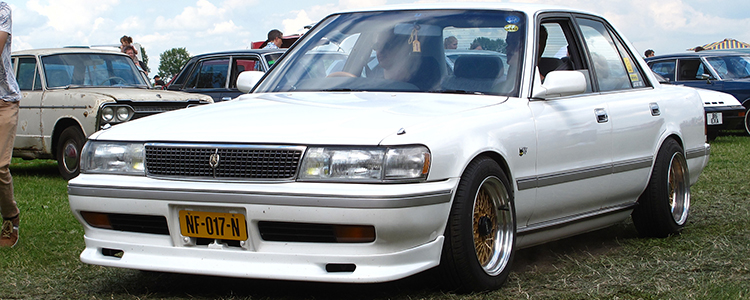
If you're buying a Mark II, the question that matters most is which trim. A factory R154 5-speed manual JZX100 Tourer V is the car most people are chasing, and it's also the one with the smallest supply and the highest price. Expect to pay $40,000 and up for a clean documented one, and expect to wait. A 4-speed automatic Tourer V costs roughly half that and gets you the same 1JZ-GTE engine, the same reinforced body, and the same parts catalog. If you're going to swap to a manual later anyway, the automatic Tourer V is the smarter buy.
If you don't need the turbo, the X100 and X110 Grande and Grande G cars are some of the best values in the whole JDM import market. The 1JZ-GE NA is bulletproof, parts are cheap, and a clean Grande with leather and the bigger wheels looks the part without the Tourer V price tag. The X110 iR-V is the dark horse pick. Same 280 PS rating as the X100 Tourer V but with VVT-i and slightly more modern electronics. Prices haven't fully caught up to the X100 yet.
The Mark II to avoid is a heavily modified Tourer V without paperwork. The JZX100 was the drift platform of the late 1990s, and a lot of cars got beaten on hard before they left Japan. Cracked dashes and faded interiors are normal for the age. Bent subframes, replaced floors, and welded diffs are not, and they're easy to miss if you don't know what to look for. Pay for a pre-purchase inspection in Japan before you buy, or buy locally from someone who already imported and sorted the car. A clean stock Tourer V is worth the wait. A rough one will cost you more in the first year than you saved on the purchase, and you'll never get that money back when you sell it.
Frequently Asked Questions
- Which Mark II is most desirable?
- The X90/X100 Tourer V is the halo. Factory 5MT and clean, stock condition bring top money.
- What should I pay for a Tourer V in the US?
- Expect roughly $25k-$45k+ depending on 5MT vs auto, rust, mileage, and originality; show cars go higher.
- Are automatic Mark IIs worth buying?
- Yes. A340 autos are durable and cheaper; budget for trans cooler and consider a manual swap later.
- Common rust areas to inspect?
- Check sills/rockers, rear arches, floor pans, jack points, and trunk well; inspect under side skirts.
- Is the 1JZ-GTE reliable at higher boost?
- Generally yes with supporting mods. Prioritize fueling, intercooling, timing, and a healthy cooling system.
- What mods hurt value the most?
- Poor wiring, cut harnesses, cheap coilovers, loud exhaust, and unknown turbo setups. Stock ECU/airbox helps resale.
- What are the best trims besides Tourer V?
- Tourer S and clean Grande trims are great value. NA cars are comfy and can be upgraded without Tourer V tax.
- What makes a Mark II different from Chaser/Cresta?
- They share the platform; differences are styling and trim mix. Mark II is often the most understated and best value.
Sources & References
- Toyota Mark II — encyclopedic overview — WikipediaVerified
- Toyota Cressida — export-market overview — WikipediaVerified
- Toyota JZ engine family (1JZ-GE, 1JZ-GTE, 1JZ-FSE, 2JZ-GE) — WikipediaVerified
- Toyota Chaser — JZX-platform sibling reference — WikipediaVerified
- Toyota Cresta — JZX-platform sibling reference — WikipediaVerified
- Toyota Verossa — X110-era replacement for Chaser and Cresta — WikipediaVerified
- Bring a Trailer auction results — Toyota Cressida (Mark II export) — Bring a TrailerVerified
- Classic.com aggregated sales — Toyota Mark II — Classic.comVerified
- Goo-net Exchange — Toyota Mark II export listings — Goo-netVerified
- Carsensor — Toyota Mark II domestic Japan listings — Carsensor (Recruit)Verified
- Toyota 75-year history — Motomachi plant overview — Toyota Motor CorporationVerified
Sources last verified: