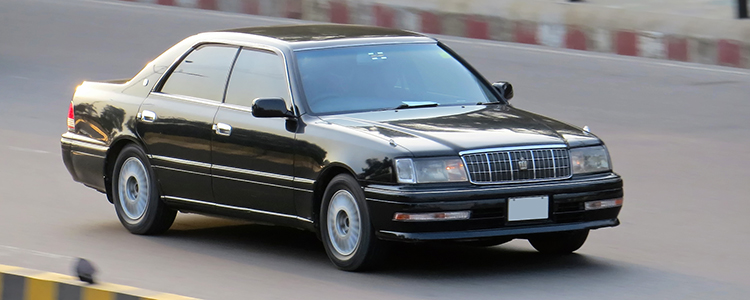
For import buyers, the S170 is the generation that does the most under the 25-year rule: 1JZ-GTE turbocharged inline-six (the same engine family as the Mark II and Chaser), V8 Majesta, RWD across the standard Crown, and modern enough to be a daily driver. The S170 Athlete V is the import enthusiast's pick. The trade-off is that Athlete V production was modest, and clean, documented examples are increasingly priced above S180 Athlete cars that aren't yet US-eligible.
Buyer's guide
Toyota Crown S170 — Buyer's Guide & Specs
The S170 (1999–2003) is the most-exported Crown generation and the one most US buyers encounter first as it clears the 25-year rule between 2024 and 2028. The Majesta sub-line returned on a longer wheelbase, with the 1UZ-FE 4.0L V8 and AWD on top-spec variants. The Athlete trim was formalized with sportier suspension, 1JZ-GTE (turbocharged, 280 PS) on the high-spec Athlete V, 2JZ-FSE and 2JZ-GE on other Athlete variants, and four-piston front brakes. The Royal Saloon retained the comfort-first tuning. The Crown Estate wagon returned alongside the sedan and continued in production through 2007 — past the S180 launch.
Looking to buy?
Browse Toyota Crown listings →
Key Takeaways
The Crown has run from 1955 to now, which makes it Toyota's longest nameplate by a wide margin. Each generation feels like a different car. Early S10 through S100 cars are pre-war Japanese taxi lineage that almost nobody imports today. The S110 and S120 are the first ones that look like a recognisable Crown. The S130 is the technology jump that became Lexus. The S140 and S150 are inline-six daily drivers. The S170 is the one most US buyers are looking at right now. The S180 onward is when V8 power got pulled out of every trim except the Majesta.
- Prices vary hugely by era; trim matters more than mileage
- US 25-year rule is boosting 1999–2003 demand
- Athlete/Majesta trims carry the strongest premiums
- Rust + air suspension are the biggest budget risks
- Stock, documented cars outperform modified examples
- Parts support is good, but some luxury bits are scarce
Technical Specifications
The engine list across the Crown's run is enormous because the car has been built for 70 years. The ones that matter for import buyers are the 1JZ-GE and 2JZ-GE inline-sixes (S130 through S170), the 1JZ-GTE turbocharged six in the S170 Athlete V at around 280 hp, the 1UZ-FE 4.0 V8 from the S130 onward, and the 3UZ-FE 4.3 V8 in the S180 Majesta. Gearboxes went from 4-speed automatic to 5-speed to 6-speed to CVT. Drive is rear-wheel except the Majesta AWD trims.
Engine Options
| Engine | Displacement | Power | Boost | Notes |
|---|---|---|---|---|
| 1JZ-GTE | 2.5L | 280PS @ 6200rpm | Turbo (factory) | Twin-turbo, JDM cap rating |
| 1JZ-FSE | 2.5L | 200PS @ 6000rpm (estimated) | N/A | D-4 direct injection (est.) |
| 2JZ-GE | 3.0L | 220PS @ 5800rpm (estimated) | N/A | NA I6; figures vary by year (est.) |
Transmission Options
| Type | Ratios | Availability | Notes |
|---|---|---|---|
| 4-speed Automatic | N/A | Early generations (various) | Multiple Aisin units; ratios vary |
| 5-speed Automatic | N/A | S170 (some trims) | Aisin 5AT; ratios vary by engine |
| 6-speed Automatic | N/A | S180/S200/S210 (V6) | Aisin 6AT; paddle shift on Athlete |
| 8-speed Automatic | N/A | S220 2.0T (some markets) | Aisin 8AT; market/engine dependent |
| e-CVT | N/A | Hybrid trims (S180+) | Power-split device; no fixed ratios |
| Multi Stage Hybrid (e-CVT + 4AT) | N/A | S220 3.5 Hybrid (GWS224) | Hybrid with stepped gearset |
Livability
- Headroom
- 38.0"
- Good front headroom; sunroof trims space
- Rear Seats
- Good for adults
- Limo-like legroom on some trims; center hump
- Cargo
- 15.0 cu ft
- Sedan trunk is deep; hybrids/4WD may reduce
Variants & Trims
The Crown isn't one car. From the S130 onward it splits into three sub-lines that share a chassis code and not much else. The Royal Saloon is the chauffeur-comfort trim, with the air suspension option and the rear-seat features. The Athlete (called Royal Touring on the S140) is the sportier trim with the 1JZ-GTE or 2JZ-GE and firmer suspension. The Majesta is the longer wheelbase V8 flagship, sitting between the standard Crown and the Toyota Century. A 1999 Royal Saloon and a 1999 Majesta are not the same car, and you should know which one you're looking at before you make an offer.
| Generation | Trim | Engine | Key Features |
|---|---|---|---|
| S170 (JZS171/JZS173/JZS175, 1999-2003) | Royal (Royal Saloon) | 1JZ-FSE/1JZ-GE/2JZ-GE | Luxury trim, optional air suspension |
| S170 (JZS171/JZS173/JZS175, 1999-2003) | Athlete (Athlete V) | 1JZ-GTE | Turbo, sport suspension, body kit (some) |
| S170 (JZS171/JZS173/JZS175, 1999-2003) | Athlete (Athlete) | 1JZ-GE/1JZ-FSE | Sport trim, firmer suspension, aero (some) |
| S170 (JZS171/JZS173/JZS175, 1999-2003) | Royal Extra / Royal Four | 1JZ-FSE/1JZ-GE | Value luxury, AWD on Royal Four |
Should You Buy a Toyota Crown S170?
The Crown was built to be quiet and comfortable, not fast. The pros and the cons are the same across the run. You get great seats, a smooth V6 or V8, and a cabin that's still nicer than most things at the price. You also get 13 to 15 mpg, a 3,500 pound curb weight, and a car that doesn't like being driven hard. If that sounds fine, the Crown is a bargain. If you want a JDM sedan that drifts, look at the Chaser or the Mark II instead.
Why You'll Love It
- Exceptional long-distance comfort Quiet cabin, stable ride, and seats built for hours; ideal highway cruiser.
- Toyota reliability baseline Many drivetrains are understressed; strong longevity with routine maintenance.
- Strong value vs JDM icons More car for the money than Supra/GT-R; luxury without hype tax.
- Trim variety for buyers Royal for comfort, Athlete for sport, wagon/estate niches; easy to target.
- Parts support (mechanicals) Common Toyota engines/trans parts are obtainable; shared components help.
- High build quality feel Switchgear, paint, and NVH often outclass same-era mainstream sedans.
- Rising US eligibility tailwind 1999–2003 cars gaining buyers; clean examples appreciating fastest.
- Great platform for VIP style Crown is a VIP staple; tasteful wheels/suspension can add appeal.
Why You Might Not
- Air suspension repair costs Majesta/upper trims can have expensive air struts/compressors; budget accordingly.
- Rust risk on older imports Undercarriage, arches, and seams; coastal Japan cars can hide corrosion.
- Aging electronics & displays Climate/nav screens, soft-touch plastics, and modules can fail with age.
- Trim-specific parts scarcity Luxury interior bits, aero, and glass can be hard to source outside Japan.
- Fuel economy varies widely Big I6/V8 trims can be thirsty; hybrids are better but more complex.
- Insurance/registration friction Some states/insurers dislike grey-market VIN formats; plan ahead.
- Modified cars can be traps Cheap coilovers, stance wear, and wiring hacks hurt value and drivability.
- Not a sports sedan by default Even Athlete is more GT than track; weight and comfort tuning dominate.
Who Should NOT Buy This
- Anyone needing cheap, quick parts at local stores
- Owners without a JDM-savvy shop or DIY ability
- People who can't tolerate occasional electrical quirks
- Buyers in strict OBD/emissions states without planning
- Those expecting modern US infotainment compatibility
- Anyone who won't budget for suspension bushing work
- Air-suspension trims if you can't fund big repairs
- Drivers wanting sporty handling over comfort
- People who park outside in salty winter climates
- Anyone who needs a hatch/wagon level of cargo space
- Buyers who won't verify mileage/auction history
- Those who need premium fuel but won't pay for it
- People who hate right-hand-drive daily inconveniences
- Anyone expecting Lexus-level dealer support in the US
Common Issues & Solutions
The Crown is reliable in the way old Toyota luxury cars are reliable. The engine and gearbox don't fail. The stuff around them does. Water pumps on the 2GR-FSE, 3GR-FE, and 1UR-FSE V8 are a known weak point on cars built before Toyota fixed it in 2010. Timing belts on the 1JZ and 2JZ stretch before the 60,000 mile interval Toyota lists, so don't trust the sticker. Air suspension on the Royal Saloon G fails with age and the repair bill can outrun the car's value. None of these are deal breakers if the seller has the paperwork.
| Issue | Cause | Solution | Est. Cost |
|---|---|---|---|
| VVT-i startup rattle | Worn cam phaser/OCV; low oil pressure at start | Use correct oil; replace VVT gear/OCV if persists | $300-1800 |
| Timing chain noise | Stretched chain or weak tensioner from poor oiling | Replace chain/tensioner/guides; inspect oil pickup | $1200-3500 |
| Valve cover oil leaks | Hardened gaskets; PCV restriction increases pressure | Replace gaskets/PCV; clean breather system | $250-700 |
| Front cover oil seep | Aging FIPG sealant; crank seal wear | Reseal front cover; replace crank seal | $900-2500 |
| Rear main seal leak | Seal wear; crankcase pressure; high mileage | Replace rear main; address PCV; inspect flexplate | $900-2200 |
| Oil consumption | Stuck rings/varnish; long oil intervals | Compression test; piston soak or rebuild if severe | $150-6000 |
| Radiator end tank crack | Aged plastic tanks; heat cycling | Replace radiator cap/hoses; refill with SLLC | $350-900 |
| Water pump seep/noise | Bearing wear; coolant neglect | Replace pump and thermostat; bleed system properly | $450-1100 |
| Overheating in traffic | Weak fans, stuck thermostat, clogged radiator | Diagnose fan control; replace thermostat/radiator | $250-1200 |
| Heater core restriction | Coolant neglect; sediment buildup | Backflush; replace core if flow doesn't recover | $150-1600 |
| A/C weak or warm | Low refrigerant; condenser leak; tired compressor | Leak test; replace condenser/compressor; evac/recharge | $250-1800 |
| Misfire under load | Coil packs/plugs; oil in plug wells from leaks | Plugs/coils; fix valve cover leaks; clear fuel trims | $250-1200 |
| MAF/Vacuum idle hunt | Dirty MAF; cracked intake boot; vacuum leaks | Smoke test; clean/replace MAF; repair hoses/boot | $80-500 |
| P0420 catalyst efficiency | Aged cats; upstream misfire/oil burning damages cat | Fix root cause; replace cats/O2 sensors as needed | $300-2500 |
| O2 sensor failures | Age/heat; wiring fatigue | Replace affected sensor; inspect harness routing | $200-600 |
| Fuel pump weak/hard start | Pump wear; clogged strainer; low tank running | Replace pump/strainer; verify fuel pressure | $350-900 |
| ATF neglect shift issues | Lifetime fluid myth; varnish in valve body | Drain/fill cycles; filter; valve body service if needed | $250-2500 |
| Torque converter shudder | Worn lockup clutch; degraded ATF | ATF exchange; add OE friction modifier; replace TC | $250-2500 |
| Harsh/flare shifting | Solenoid wear; valve body issues; adaptation off | Scan data; service valve body/solenoids; relearn | $400-3000 |
| Diff pinion seal leak | Seal wear; vent clog raises pressure | Replace seal; clean vent; refill correct gear oil | $250-650 |
| Driveshaft vibration | Center bearing wear; U-joint wear; bent shaft | Replace CSB/shaft; check angles and mounts | $350-1400 |
| Lower control arm bush | Rubber cracks; heavy chassis loads | Replace arms or press bushings; align afterward | $400-1400 |
| Ball joint wear/clunk | Boot tears; grease loss; age | Replace joints/arms; torque at ride height | $300-1200 |
| Steering rack leak | Seal wear; torn boots trap grit | Replace/reseal rack; flush fluid; align | $900-2200 |
| Wheel bearing hum | Bearing wear; impacts/potholes | Replace hub/bearing assembly | $300-900 |
| Brake pulsation | Rotor thickness variation; stuck caliper slides | Replace rotors/pads; service calipers and slides | $350-1100 |
| Caliper drag/uneven pads | Seized slide pins; torn boots; corrosion | Rebuild/replace calipers; new hardware and fluid | $250-900 |
| ABS/VSC warning lights | Wheel speed sensor; yaw/steering angle calibration | Scan codes; replace sensor; perform zero-point cal | $150-900 |
| Air suspension sag | Leaking air struts/bags; cracked lines | Leak test; replace struts/lines; consider coil swap | $800-4500 |
| Air compressor runs often | Small leaks or weak compressor/dryer saturation | Fix leaks; replace compressor/dryer; recalibrate | $600-2200 |
| HVAC actuator clicking | Stripped blend door gears; actuator motor wear | Replace actuator; run HVAC calibration | $200-900 |
| Nav/infotainment limits | JDM maps/language; FM band expander hacks | Convert/replace head unit; add CarPlay interface | $200-2000 |
| Cluster pixel/dimming | Aging LCD/backlight; solder joint fatigue | Cluster rebuild or replace; verify mileage legality | $250-900 |
| SmartKey intermittent | Weak fob battery; door handle sensor wear; antennas | New fob battery; diagnose antennas; replace handle | $50-700 |
| Trunk harness breaks | Repeated flex at hinge; insulation cracks | Repair/replace loom; secure strain relief | $120-450 |
| Water intrusion cabin | Sunroof drains/cowl leaks; door vapor barrier failure | Clear drains; reseal cowl/barriers; dry modules | $150-1200 |
| Rust at underbody seams | Japan coastal/snow exposure; poor undercoating | Rust treatment; weld repairs; undercoat properly | $300-6000 |
Differences between JDM & USDM
The Toyota Crown was effectively a JDM-exclusive nameplate from the early 1970s onward. Toyota Motor Sales USA imported small numbers of S40 and S50 coupes, sedans, and wagons in the 1960s — fewer than ten thousand units cumulatively — and then withdrew the Crown from the US lineup. From the S60 (1971) forward, no Crown was sold new in North America. Every Crown imported into the US today reaches the country through one of three paths: a pre-1973 model under existing collector exemptions, a 25-year-rule import (S130 cleared 2012, S140 cleared 2016, S150 cleared 2020, S170 clearing 2024–2028, S180 clearing 2028 onward), or a Show & Display exemption for a documented historically significant variant. Canadian import rules clear the same generations on a 15-year rolling schedule, which is why most Crown imports between 2008 and 2024 went through Canada first. The current S220 and S230 are sold globally in some markets — including a North American return for the S230 sedan/crossover variant in 2023 — but those are modern cars, not the JDM imports this guide focuses on.
Pre-Purchase Inspection Checklist
The Crown's inspection list is longer than most JDM sedans because the car has 70 years of variants and the V8 cars have more electronics than the inline-six cars. Walk this list with the seller, not in front of him. The Critical items mean walking away if there's no paperwork. The High items can be priced into the deal. A 30 minute drive will surface most of what you need to know about a Crown that's already in your country.
Critical Priority
- Auction sheet/grade Verify auction sheet; check for tamper/forgery
- Import compliance Check title status, EPA/DOT, state inspection readiness
- Odometer integrity Cross-check km with JEVIC/service stickers/ECU data
- Front rails/aprons Inspect for kinks, weld marks, pulled metal
- Underbody rust Probe pinch welds, floor seams, jacking points
- OBD scan Scan all modules; check pending codes & freeze frame
- Exhaust smoke Blue on decel = rings/seals; white sweet = coolant
- Thermostat Confirm stable temp; overheating in traffic is red flag
- Trans fluid Check ATF color/burnt smell; verify service history
- Air suspension If equipped: check height changes & compressor run time
- Service records Look for timing/coolant/ATF history; gaps are risk
- Test drive Highway + bumps; listen for clunks, shudder, wind noise
High Priority
- Chassis code/trim Confirm model (S170/S180/S200/S210/S220) & grade
- Accident repair Look for overspray, seam sealer breaks, uneven gaps
- Core support Check radiator support for bends/bolt witness marks
- Rear subframe mounts Check for rust, cracks, crushed bush sleeves
- Rocker panels Inspect inner/outer rockers for bubbling and repairs
- Trunk well Lift carpet; check spare well for water/rust
- Windshield cowl Check cowl seal; water leaks into cabin/ECU areas
- Battery/charging Load test battery; verify alternator output stable
- Cold start Listen for VVT-i rattle/timing noise on startup
- Oil leaks Inspect valve covers, front cover, rear main area
- Coolant condition Check for oil sheen/sludge; verify correct Toyota SLLC
- Radiator Check end tanks for cracks; look for pink crust
- Water pump Check weep hole stains; listen for bearing noise
- Shift quality Test cold/hot; flare, slam, delay indicates wear
- Torque converter Check shudder at 40-60 mph light throttle
- Suspension bushings Inspect lower arm, toe, trailing bush cracks
- Ball joints Check play/boots; clunk over bumps
- Steering rack Check for leaks, torn boots, off-center pull
- Brakes Measure rotor lip; check pulsation and caliper drag
- ABS/VSC Confirm no warning lights; scan for yaw sensor codes
- Interior water leaks Check damp carpets; mold smell; ECU corrosion risk
- Keyless/SmartKey Test both keys; check SKS antennas and door sensors
- Immobilizer Confirm starts reliably; no security light anomalies
- Radar cruise/PCS If equipped: check radar alignment and warning lights
- Fuel system Smell for fuel; check pump noise and hard starts
- Evap readiness For OBD states: confirm monitors set; no evap codes
- Catalysts/O2 Check for P0420 history; inspect for aftermarket exhaust
Medium Priority
- Wheel arches Check lip rust, liner damage, hidden filler
- Sunroof drains Pour water; confirm fast drain, no headliner stains
- Headlights Test AFS/auto-level; check lens haze and ballast
- Parasitic draw Check sleep current; aftermarket alarms cause drains
- Idle quality Check for hunting idle; vacuum leaks/MAF issues
- Heater output Weak heat can mean air pockets or clogged core
- A/C performance Check vent temp; listen for compressor clutch noise
- A/C condenser Inspect fins and leaks; road damage common
- Diff noise Listen for whine on accel/decel; check for leaks
- Driveshaft CSB Check center bearing play; vibration at 40-70 mph
- Engine mounts Check for collapse; clunk on gear change
- Struts/shocks Look for leaks; bounce test; uneven tire wear
- Power steering Listen for pump whine; check fluid condition
- Parking brake Check hold on incline; rear shoe delam possible
- Tires Check date codes; uneven wear indicates alignment issues
- Wheel bearings Listen for hum; check play on lift
- Seat functions Test all motors/heaters/vent; memory recall
- Cluster/ODO Check dead pixels/dimming; verify warning lights work
- Infotainment Test screen, buttons, nav; JDM units may be locked
- HVAC servos Listen for clicking; blend door actuator failure
- Cameras/sensors Test backup/360; parking sonar; calibration errors
- Audio amp Check for no-sound or popping; amp moisture damage
- Trunk harness Check hinge loom cracks; causes lights/camera faults
- Recalls/TSBs Check applicable campaigns; JDM may not show in US
Low Priority
- Door seals Check torn seals; listen for wind noise at speed
- Tail lights Check for condensation; inspect trunk harness grommets
Generation History
Crown S30/S40 (1955-1962)
- Early Crown; collector niche outside Japan
- Simple mechanicals; parts scarcity growing
- Best as restored classics, not daily drivers
Crown S50/S60/S70 (1962-1971)
- Export presence; period taxi/fleet heritage
- Inline-6 options; durable but slow
- Restoration costs often exceed values
Crown S80/S90/S100 (1971-1979)
- Bigger body; comfort focus over sport
- Carb I6/V8 era; emissions-era complexity
- Survivors valued for originality
Crown S110 (1979-1983)
- Boxy styling; strong JDM nostalgia
- Diesel variants exist; slow but efficient
- Rust and trim parts are key concerns
Crown S120 (1983-1987)
- More modern chassis; improved refinement
- Turbo I6 variants in some markets
- Good entry point; watch for rust
Crown S130 (1987-1991)
- Last of the classic boxy Crowns
- 1G/7M/1UZ era depending on market/trim
- Rising collector interest; clean cars scarce
Crown S140 (1991-1995)
- Rounded styling; big comfort leap
- 1JZ/2JZ-era drivetrains in some trims
- Good value; electronics aging now
Crown S150 (1995-1999)
- Refined luxury; strong highway cruiser
- Athlete trims add sport tuning
- US interest rising as eligibility nears
Crown S170 (1999-2003)
- Sweet spot: modern feel, classic Toyota build
- Athlete V/3.0 popular; Majesta adjacent appeal
- US-legal wave driving premiums for clean cars
Crown S180 (2003-2008)
- More tech; sharper chassis, better safety
- 3.0/3.5 V6 + hybrid in later markets
- Values firming; condition and options matter
Crown S200 (2008-2012)
- Modern interior; strong daily-driver usability
- Hybrid trims popular; fuel economy advantage
- Export demand steady; auction grades critical
Crown S210 (2012-2018)
- Athlete/Royal split; excellent refinement
- Hybrid mainstream; advanced driver aids
- Strong demand; higher buy-in but fewer surprises
Crown S220 (2018-2022)
- TNGA platform; big dynamics improvement
- Hybrid-only in many specs; very efficient
- Not 25-year eligible; grey-market varies
Crown S230 (Crossover) (2022-present)
- Global Crown reboot; crossover-like stance
- Factory US sales reduce import pressure
- Different buyer: new-car shoppers vs JDM
Sales Numbers by Year
| Year | Domestic | Notes |
|---|---|---|
| 1955 | 0 | S10 launches January 1955 — Toyota's first passenger-car chassis engineered domestically post-war. |
| 1962 | — | S40 introduced; first inline-six engines; small numbers reach the US via Toyota Motor Sales USA and third-party exporters. |
| 1964 | — | JDM-only 2.6L V8 (Toyopet Crown G10) — first Japanese-domestic-market V8 passenger car. |
| 1971 | — | S60/S70 generation; Crown effectively withdrawn from US new-car market. |
| 1987 | — | S130 introduces electronically controlled air suspension on Royal Saloon G; first JDM application. |
| 1991 | — | S140; carbureted engines discontinued across the Crown line. Royal Touring trim introduced with 1JZ/2JZ options. |
| 1995 | — | S150 launches still using the S130 chassis; LPG variant added for taxi market. |
| 1999 | — | S170 introduces Majesta as a longer-wheelbase V8 sub-line; Crown Estate wagon returns. |
| 2003 | — | S180; inline-six engines retired across most trims (V8 retained for Majesta only); V6-only powertrains for Royal/Athlete. |
| 2008 | — | S200; CVT introduced; first Crown hybrid (3.5L 2GR-FSE). |
| 2012 | — | S210; 2.5L inline-four hybrid and 2.0L turbo (Crown RS) added; 8-speed eCVT. |
| 2018 | — | S220; final pure-JDM Crown sedan generation before the S230 platform shift. |
Market Data
Production Numbers & Rarity
| Generation | Years | Total Built | Notes |
|---|---|---|---|
| S30 | 1955-1962 | unknown (estimated low 100k+) | Early records incomplete; estimate only |
| S40 | 1962-1967 | unknown (estimated) | Factory totals not consolidated publicly |
| S50 | 1967-1971 | unknown (estimated) | Multiple body styles; totals uncertain |
| S60/S70 | 1971-1974 | unknown (estimated) | Oil-crisis era; totals uncertain |
| S80/S90 | 1974-1979 | unknown (estimated) | Long run; many sub-variants |
| S110 | 1979-1983 | unknown (estimated) | Sedan/hardtop; totals uncertain |
| S120 | 1983-1987 | unknown (estimated) | No single verified global total |
| S130 | 1987-1991 | unknown (estimated) | High domestic volume; exact totals unclear |
| S140 | 1991-1995 | unknown (estimated) | Sedan/hardtop; exact totals unclear |
| S150 | 1995-1999 | unknown (estimated) | Majesta separate line; totals unclear |
| S170 | 1999-2003 | unknown (estimated) | Athlete V relatively low share |
| S180 | 2003-2008 | unknown (estimated) | Hybrid introduced late; totals unclear |
| S200 | 2008-2012 | unknown (estimated) | Hybrid volume modest; totals unclear |
| S210 | 2012-2018 | unknown (estimated) | Strong domestic sales; totals not published |
| S220 | 2018-2022 | unknown (estimated) | 3.5 hybrid RS Advance low volume |
| S230 | 2022-present | in production | Current model; totals not final |
Rarest variant: Crown Sedan Z FCEV
How It Compares
Among Japanese luxury sedans of the same era, the Crown is the most affordable of the V8 cars, the Cedric and Gloria are the closest direct rivals, and the Cima and President are the more chauffeur-coded options. The Crown wins on parts availability and on resale stability. It loses on outright luxury feel to the Celsior and Century. The table below leans toward the Crown's strengths because that's where it actually competes.
| Feature | S170 | Nissan Cedric Y34 | Nissan Cima F50 |
|---|---|---|---|
| Market positioning | JDM exec sedan; VIP staple | JDM sport-lux sedan | JDM luxury flagship |
| Typical drivetrain | I6/V6/V8; RWD/AWD | V6/V8; RWD | I6/V8; RWD |
| Sporty trim focus | Athlete trims (sport) | Gran Turismo trims | Type S / sport packages |
| Luxury trim focus | Royal/Majesta (lux) | Cima/President vibe | Aristo as lux-sport alt |
| Ride comfort | Excellent; tuned for Japan | Softer, floatier feel | More isolated, heavier |
| Handling character | Stable GT; Athlete sharper | Similar GT, less precise | More sporty, smaller |
| Power potential | Varies; some turbo I6 trims | Turbo VQ options in era | 2JZ-GTE tuning ceiling |
| Reliability reputation | Strong; conservative engineering | Good, more electronics risk | Strong; premium parts costs |
| Parts availability | Good mechanicals; trim varies | More model-specific parts | Better global interchange |
| Import desirability (US) | Rising; 1999+ wave | Lower demand; niche VIP | High demand; Lexus badge |
| Value retention | Best in Athlete/wagons | Softer; fewer buyers | Strong; flagship cachet |
| VIP styling support | Huge aftermarket in Japan | Also strong VIP scene | Strong but pricier parts |
| Daily-driver usability | High; easy manners | Similar; older tech feel | More modern, more complex |
Comparable Alternatives
If the Crown isn't the right car, the closest JDM alternatives are the Toyota Mark II or Chaser if you want the same chassis family in a sportier package, the Nissan Cedric or Gloria if you want a V8 alternative, or the Toyota Celsior if you want a Lexus LS twin without the variant complexity. The Toyota Century is the step up if budget allows. The Mitsuoka and Mazda Sentia are niche luxury alternatives that show up occasionally.
Toyota Aristo JZS161
2JZ-GTE option; more sport-lux, strong tuning
Toyota Celsior UCF30
Flagship V8 luxury; quieter, more isolated ride
Toyota Mark II JZX110
Similar era RWD sedan; lighter, more driver-focused
Nissan Cedric Y34
Closest direct rival; VIP-friendly, similar size/mission
Lexus GS S160
US-market alternative; easier registration and parts support
In Pictures
The Buyer's Read
If you're buying a Crown, the safest place to start is a documented S170 Royal Saloon from 1999 to 2003. That gives you the 1JZ-GE or 2JZ-GE inline-six, a 4-speed or 5-speed automatic, and electronics that still work without being so old the modules are unobtainable. The S170 cleared the US 25-year rule in 2024, so this is the generation you can actually import right now. Skip anything under $5,000. A cheap Crown almost always means deferred maintenance, and the timing belt on a 1JZ or 2JZ that's never been done is a bill that will erase whatever you saved on the purchase.
If you want the chauffeur-flagship feel, look at the S170 Majesta. Longer wheelbase, 1UZ-FE 4.0 V8, all the luxury features the standard Crown doesn't get. Just know that the air suspension and the JDM-only navigation modules will need attention, and that AWD Majesta cars are heavier and thirstier than the standard Crown. Budget another $3,000 to $5,000 on top of the purchase price over the first few years for catch-up maintenance and you'll be fine.
If you want the most fun, the S170 Athlete V with the 1JZ-GTE turbocharged inline-six is the import enthusiast's pick. Close to 280 hp from the factory, four-piston front brakes on later cars, and the same engine family as the Mark II Tourer V and the Chaser. The catch is that Athlete V production was modest and clean documented examples are already priced above S180 Athlete cars that aren't US-eligible yet.
The one Crown to avoid is a rough early-production S180 with the 2GR-FSE or 1UR-FSE without water pump documentation. Toyota fixed the water pump issue in 2010, but cars built before that need the updated pump confirmed in writing. An undocumented early S180 is a coin flip on a $2,000 repair, and the S180 doesn't clear the US 25-year rule until 2028 anyway. Wait, or buy a documented S170 instead.
Frequently Asked Questions
- Which Toyota Crown generation is best to buy today?
- For value, target S150/S170. For daily use, S200/S210. Collectors like clean S130 boxy cars.
- What trims matter most for resale value?
- Athlete (sport) and rare wagons/estates lead. Royal/Majesta can be strong if low-km and original.
- Are Crowns reliable as daily drivers in the US?
- Yes if maintained. Watch cooling, bushings, electronics, and any air suspension on luxury trims.
- What are the biggest ownership costs or surprises?
- Common surprises: air struts, aging nav/climate screens, and trim parts that require Japan sourcing.
- How do I avoid buying a bad import example?
- Insist on auction sheet, verify grade, check rust, and avoid heavy stance/coilover hacks.
- Is the Crown better than a Celsior or Aristo?
- Crown is the best all-rounder. Celsior is quieter luxury; Aristo is faster and more tunable.
- When will 1999–2003 Crowns be US-legal?
- Under the 25-year rule, 1999 becomes legal in 2024, 2000 in 2025, 2003 in 2028.
- What should I look for on a test drive?
- Check trans shifts, steering play, brake vibration, HVAC function, and listen for suspension knocks.
Sources & References
- Toyota Crown — encyclopedic overview — WikipediaVerified
- Toyota Crown — buying guide and used-car listings — CarsGuide AustraliaVerified
- Toyota Crown — used-car listings (NZ market) — TradeMe (NZ)Verified
- Toyota Crown — official Toyota Automobile Museum exhibition page — Toyota Motor CorporationVerified
- Toyota Crown — long-term reliability and model history — Car and DriverVerified
- Toyota UZ engine family (1UZ-FE / 3UZ-FE) — used in Crown Majesta — WikipediaVerified
- Toyota JZ engine family (1JZ-GE / 2JZ-GE) — used in Crown Royal and Athlete — WikipediaVerified
- Toyota Crown — UK-market parts and model reference — MyKP (UK)Access blocked
Sources last verified: