Buyer's guide
Toyota Celica
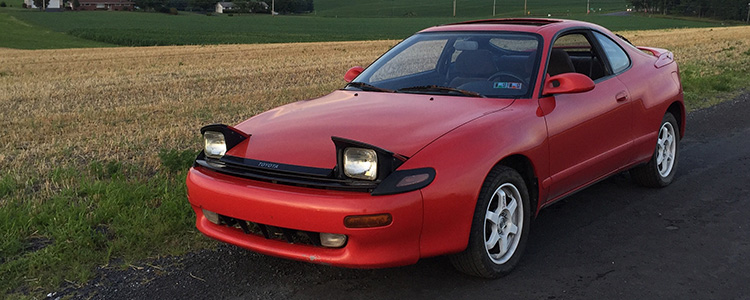
The Toyota Celica is one of the few JDM sports cars that started life as a sports car, drifted into liftback-coupe territory through the 1980s and 1990s, and then closed out as a focused, lightweight front-driver before Toyota discontinued the nameplate in 2006. Production opened at the 1970 Tokyo Motor Show with the A20 ST20 series, sharing platform components with the Toyota Carina and aimed squarely at the same young-buyer ground that Nissan was carving out with the S30 240Z. Across seven generations — A20, A40, A60, T160, T180, T200, and T230 — the Celica is best remembered for two things: the rear-drive, twin-cam A20–A60 cars that defined a Japanese sports coupe template, and the ST165, ST185, and ST205 GT-Four homologation specials that anchored Toyota Team Europe's World Rally Championship campaign through the late 1980s and the 1990s. Toyota built 4,129,626 Celicas over 36 years; the final T230 ran the high-revving 2ZZ-GE alongside the 1ZZ-FE before the nameplate was retired without a direct successor.
GT-Four — the rally story behind the homologation Celicas
The Celica GT-Four exists because Group A rallying required Toyota to sell a road-going version of whatever it wanted to enter in the World Rally Championship. The first car, the ST165, debuted in the United States in 1988 (badged as the Celica All-Trac Turbo in North America) with the 3S-GTE turbocharged 2.0L inline-four making approximately 240 horsepower, full-time all-wheel drive, and a five-speed manual. Carlos Sainz drove the ST165 to the 1990 Drivers' World Championship for Toyota Team Europe. The second-generation ST185 (T180, 1989–1993) sharpened the package — Castrol livery, water-cooled intercooler, larger turbo — and delivered Toyota's 1992 (Sainz again) and 1993–1994 manufacturers' titles. The third and final ST205 (T200, 1994–1999) was built around the WRC car: Super Strut front suspension on some markets, a CT20B turbo, a JDM 250 horsepower cap (export markets were rated higher), and a water-spray intercooler. The ST205 program ended badly — Toyota was disqualified from the 1995 WRC season for an illegal turbo restrictor bypass discovered at Catalunya and banned by the FIA for 1996. The ST205 remains the rarest and most expensive Celica today; clean documented examples regularly clear $50,000 at auction.
T230 — the last Celica, and the high-rev finale
The seventh-generation T230 (1999–2006) was the Celica's last act. No GT-Four was offered; no rear-drive variant was offered. Instead, Toyota built a lightweight front-drive coupe around two Yamaha-developed 1.8L inline-fours: the 1ZZ-FE in the entry SS-I and US GT (140 hp, four-speed automatic or five-speed manual) and the 2ZZ-GE in the SS-II and US GT-S (180 hp at 7,600 rpm, six-speed manual, VVTL-i variable lift-and-timing engagement around 6,000 rpm). The T230 was also the first Celica to offer JBL premium audio, leather seats, six-disc CD changer, side-impact airbags, and standard ABS. It sold poorly relative to forecast — coupe-buyer demand collapsed through the 2000s — and was discontinued in 2006 with no direct successor. Today the T230 GT-S is the easiest, cheapest entry point into modern Celica ownership; the 2ZZ-GE's lift-cam-bolt failure and oil-consumption issues are the dominant pre-purchase concerns.
Quick read
Key takeaways
- GT-Four/All-Trac Turbo models lead values
- Rust and crash repairs drive price more than miles
- ST205 is priciest; ST185 best value turbo
- 7th-gen GTS is the best cheap driver
- Originality beats mods; OEM parts add value
- Rally pedigree keeps long-term demand strong
Constants
Common across all Celica generations
- Transitioned from rear-wheel drive to front-wheel drive from the T160 generation
- GT-Four variants (ST165/ST185/ST205) used the turbocharged 3S-GTE and all-wheel drive
- Liftback and coupe body styles across the model's history
- Final T230 generation was front-wheel drive only, with no GT-Four variant
- Right-hand drive throughout JDM production
Chassis history
Generation timeline
The Celica ran from 1970 until 2006 across seven generations, from the rear-drive A20 coupe to the front-drive T230. The early Celica was built to chase the Mustang in the US market. The middle Celica became Toyota's WRC homologation car with the ST165, ST185, and ST205 GT-Four. The last Celica went front-drive only and ended without a successor.
Fourth generation — T160 (1985–1989)
Fifth generation — T180 (ST185 GT-Four; 1989–1993)
Sixth generation — T200 (ST205 GT-Four; 1993–1999)
Buyer's call
Should you buy a Toyota Celica?
The Celica is the JDM coupe where what you give up and what you get are both easy to see before you start shopping. You're buying a Toyota that's cheap to run and easy to fix, and you're also buying a 4-cylinder front-drive car that nobody mistakes for a Supra. The GT-Four trims change the math, but only those trims.
Why you'll love it
- Broad price entry points From $3k drivers to $60k+ GT-Four, Celica fits many budgets and goals.
- Rally pedigree (GT-Four) ST165/185/205 WRC lineage supports collector demand and long-term interest.
- Strong Toyota reliability baseline Non-turbo trims are durable; simple maintenance keeps ownership costs reasonable.
- Tunable turbo AWD platform 3S-GTE responds well to supporting mods; AWD traction adds real-world pace.
- 7th-gen is a great driver car 2ZZ GTS + 6MT offers modern usability, low weight, and strong aftermarket.
- Distinct styling across eras Liftbacks, pop-ups, and wedge shapes create strong nostalgia-driven demand.
- Good parts interchange (some gens) Shared Toyota components help, especially for 7th-gen and some 80s/90s items.
- Undervalued vs halo rivals Often cheaper than Supra/GT-R/Type R, especially in clean driver condition.
Why you might not
- Rust is the #1 value killer Sills, arches, floors, strut towers; repairs are costly and hard to reverse.
- GT-Four parts scarcity ST185/ST205 trim, AWD, and turbo-specific parts can be rare and expensive.
- Modded examples are risky Boost creep, poor tuning, wiring hacks; originality and documentation matter.
- Cooling and head gasket risks Neglected 3S-GTE cooling leads to overheating; check radiator, hoses, fans.
- ST205 Super Strut costs Super Strut front end wear can be pricey; clunks and tire wear are red flags.
- 7th-gen 2ZZ known issues Lift bolts and oil consumption; verify lift engagement and service history.
- Insurance/registration for imports JDM GT-Four import paperwork and parts sourcing add time and ownership friction.
- Interior plastics age poorly Dash cracks, brittle trim, seat wear; clean interiors command big premiums.
Who should not buy this
- Anyone needing real rear-seat adult space
- Drivers over 6'2" wanting helmet clearance
- People who can't tolerate road noise/firm ride
- Buyers without a rust budget in salt states
- Anyone needing modern crash safety and airbags
- Owners who won't check oil level regularly
- People needing reliable A/C without spending money
- Those who hate chasing old-car electrical gremlins
- Emissions-strict areas if cat/O2 readiness is iffy
- Anyone expecting cheap insurance for a sporty coupe
- Buyers who can't DIY or pay for aging-car upkeep
- People wanting strong low-end torque for commuting
- Those who plan to slam it on cheap coilovers
- Anyone expecting modern infotainment and NVH
- People who need AWD or winter traction confidence
- Buyers who can't walk away from heavily modified cars
Reliability
Common issues & solutions
The Celica is mechanically tough, but the issues change by generation. A20 and A40 Celicas rust everywhere the rubber seals have gone hard. The ST165 and ST185 3S-GTE has known head gasket and rod bearing weaknesses if it's been overheated or chip tuned. The ST205 turbo is rare enough that parts hunting is the real problem. On the T230 the 2ZZ-GE has the lift cam bolt failure and the oil consumption issue, and both have been written up enough that any honest seller will know the answer.
| Issue | Cause | Solution | Est. cost |
|---|---|---|---|
| Rust in rockers/quarters | Road salt traps moisture in seams and liners | Cut/weld metal; treat cavities; avoid filler fixes | $1500-6000 |
| Strut tower rust/perforation | Water intrusion + thin metal at tower seams | Structural repair; tower caps; alignment after | $2000-8000 |
| Hatch/trunk water leaks | Aged hatch seal, tail lamp seals, clogged drains | Replace seals; reseal lamps; clear drains; dry interior | $150-800 |
| Oil consumption (some engines) | Worn rings, stuck oil control rings, neglect | Leakdown test; rebuild/replace engine if severe | $2000-6500 |
| Valve cover oil leaks | Hardened gasket and PCV restriction | Replace gasket/grommets; service PCV; clean breather | $120-450 |
| Timing belt overdue (belt cars) | Skipped interval; unknown history on imports/older | Do belt, tensioner, idlers, water pump immediately | $600-1400 |
| Timing chain rattle (chain cars) | Worn tensioner/guides; low oil; poor maintenance | Inspect; replace tensioner/guides; address oil issues | $500-1800 |
| Overheating in traffic | Aging radiator, weak fans, stuck thermostat | Radiator/thermostat/cap; verify fan relays and temps | $300-1200 |
| Head gasket failure (abused) | Overheat events, low coolant, detonation | Machine head; gasket set; fix cooling root cause | $1500-3500 |
| Heater core leak | Corrosion and age; old coolant | Replace heater core; flush system; new coolant | $700-1600 |
| A/C weak or inop | Leaks at condenser/lines; worn compressor | Leak test; replace failed parts; evac/recharge | $300-1500 |
| Manual synchro grind (2nd/3rd) | Worn synchros from hard shifting/old fluid | Try correct fluid; rebuild trans if persistent | $120-2500 |
| Clutch hydraulic leaks | Aged master/slave seals; contaminated fluid | Replace master/slave; flush; inspect hard line | $200-700 |
| Clutch slip/shudder | Worn disc/pressure plate; oil from rear main | Clutch kit; resurface flywheel; fix oil leak | $700-1600 |
| Auto trans harsh shifts | Old ATF, solenoid wear, valve body varnish | Service ATF; solenoids/valve body; rebuild if needed | $200-3500 |
| CV axle clicking/vibration | Torn boots, dried grease, aftermarket axle imbalance | Reboot OEM or replace with quality axle; align | $250-900 |
| Wheel bearing humming | Age, water intrusion, impact damage | Replace hub/bearing; torque to spec; recheck alignment | $250-800 |
| Steering rack leaks/clunk | Worn seals/bushings; torn boots let grit in | Rebuild/replace rack; new tie rods; flush PS fluid | $600-1600 |
| Suspension bushing wear | Age; lowered cars accelerate bushing failure | Replace control arms/bushings; alignment afterward | $400-1800 |
| Brake caliper slide seizure | Dry pins, torn boots, corrosion | Service pins/boots; replace calipers if pitted | $150-700 |
| Brake line rust (salt states) | Coating failure; road salt exposure | Replace lines; inspect flex hoses; full bleed | $400-1500 |
| ABS light / sensor faults | Corroded tone rings, broken sensor wiring | Scan codes; repair wiring; replace sensor/ring | $150-800 |
| Window regulator failure | Worn cables/plastic guides; dry tracks | Replace regulator; lube tracks; check switches | $200-600 |
| Door lock actuator weak | Motor wear and sticky linkages | Replace actuator; clean/lube latch mechanism | $150-500 |
| Dash/cluster lighting issues | Aged bulbs, cracked solder joints, dimmer faults | Replace bulbs/LED; reflow solder; repair dimmer | $50-350 |
| Misfire under load | Old plugs/wires/coils; vacuum leaks; injector clog | Ignition service; smoke test; clean/replace injectors | $150-900 |
| Vacuum leaks/idle hunt | Cracked hoses, intake gasket leaks, ISC/IAC issues | Smoke test; replace hoses/gaskets; clean IAC/ISC | $100-700 |
| Catalytic converter failure | Oil burning, misfire overheating cat, age | Fix root cause; replace cat; verify O2 sensors | $400-2000 |
| O2 sensor / CEL (96+) | Aged sensors, exhaust leaks, wiring damage | Diagnose with scan data; fix leaks; replace sensors | $150-600 |
| Fuel pump weak/no start | Age, low-tank running, corroded connectors | Fuel pressure test; replace pump/filter; clean grounds | $250-900 |
| Engine bay wiring hacks | Alarm/stereo installs; poor grounds; splices | Remove hacks; restore OEM wiring; add proper grounds | $200-1500 |
| Aftermarket coilover misery | Cheap dampers, wrong spring rates, blown seals | Replace with quality struts/springs; align/corner balance | $600-2500 |
Market
Differences between JDM & USDM
JDM and USDM Celicas diverged sharply in the GT-Four era and again in the T230 finale. JDM ST165, ST185, and ST205 GT-Fours were sold through the Toyota dealer network in Japan in higher trim spec than the US-market All-Trac Turbo cars: factory Recaro seats on certain trims, JDM-only Group A homologation editions (the ST185 'Rally Edition' and ST205 'WRC' road car), and a 250 PS (approximately 247 hp) JDM rating versus the higher 252–255 hp export-market rating on the ST205. North America never received the ST205 — the All-Trac Turbo was discontinued for the US market after the 1993 ST185. The T230 split is simpler but no less meaningful: JDM cars wore the SS-I (1ZZ-FE) and SS-II (2ZZ-GE) trim designations, with the SS-III as the top spec (Recaros, body kit, TRD options); the US-market equivalents were Celica GT (1ZZ-FE) and Celica GT-S (2ZZ-GE). Japan also offered the TRD Sports M body and suspension package, never federalised for North America. Right-hand drive is standard on every JDM Celica.
Specs
Technical specifications
Every Celica runs a 4-cylinder. The early cars used the T-series and 18R-G twin cams. The middle Celica got the 4A-GE and the 3S-GE naturally aspirated twin cams, plus the 3S-GTE turbo for the GT-Four. The T230 swapped to the Yamaha developed 1ZZ-FE and 2ZZ-GE with VVTL-i. The GT-Four cars are 240 to 255 hp depending on market and generation. The 2ZZ-GE T230 makes 180 hp at 7,600 rpm and that's the highest revving Celica engine.
Engine options
| Chassis | Engine | Displacement | Power | Boost | Notes |
|---|---|---|---|---|---|
| TA22/TA23 (A20) | 2T | 1.6L | estimated | N/A | Market/yr dependent; carb I4 |
| TA22/TA23 (A20) | 2T-G | 1.6L | estimated | N/A | DOHC; output varies by spec |
| RA20/RA21/RA25 (A20) | 18R / 18R-G | 2.0L | estimated | N/A | SOHC/DOHC depending on variant |
| RA40/RA45 (A40/A50) | 20R | 2.2L | estimated | N/A | US-market spec varies by year |
| RA40/RA45 (A40/A50) | 22R | 2.4L | estimated | N/A | Carb I4; output varies by year |
| RA60/RA61 (A60) | 22R-E | 2.4L | estimated | N/A | EFI; US outputs vary by year |
| MA61 (A60 Celica Supra) | 5M-GE | 2.8L | estimated | N/A | DOHC I6; market/yr dependent |
| ST162 (T160) | 3S-FE | 2.0L | estimated | N/A | DOHC 16V; output varies by market |
| ST162 (T160) | 3S-GE | 2.0L | estimated | N/A | High-output NA; market dependent |
| ST165 (T160 GT-Four) | 3S-GTE | 2.0L | estimated | estimated | Turbo AWD; gen1 3S-GTE varies |
| ST184/ST182 (T180) | 5S-FE | 2.2L | estimated | N/A | US GT engine; year-dependent output |
| ST182/ST183 (T180) | 3S-GE | 2.0L | estimated | N/A | NA performance engine; market varies |
| ST185 (T180 GT-Four/All-Trac) | 3S-GTE | 2.0L | estimated | estimated | Turbo AWD; gen2 3S-GTE varies |
| ST202/ST203 (T200) | 3S-GE | 2.0L | estimated | N/A | Gen3 NA; outputs vary by market |
| ST204 (T200) | 5S-FE | 2.2L | estimated | N/A | US-market; year-dependent output |
| ST205 (T200 GT-Four) | 3S-GTE | 2.0L | 250PS @ 6000rpm; 304Nm @ 4000rpm | estimated | JDM rated; CT20B turbo |
| ZZT230 (T230) | 1ZZ-FE | 1.8L | 140hp @ 6400rpm; 171Nm @ 4200rpm | N/A | VVT-i; US GT typical rating |
| ZZT231 (T230) | 2ZZ-GE | 1.8L | 180hp @ 7600rpm; 180Nm @ 6800rpm | N/A | VVTL-i; US GT-S typical rating |
Transmission options
| Type | Ratios | Availability | Notes |
|---|---|---|---|
| 5-speed Manual | varies by generation/market | Most trims (1970-2006) | Multiple A/W/S-series gearboxes |
| 6-speed Manual | varies (C60/C64 family) | T230 GT-S/SS-II | 2ZZ-GE applications |
| 3-speed Automatic | varies by year | Early A20/A40 trims | Market-dependent |
| 4-speed Automatic | varies by year | Common 1980s-2000s trims | A-series/U-series depending on era |
Lineup
Variants & trims
The trim that matters most is GT-Four on the T160, T180, and T200, and SS-II or SS-III on the T230. On the T160 the ST165 is the rally homologation original and Carlos Sainz won the 1990 WRC drivers' title in one. On the T180 the ST185 is the WRC peak car and the Carlos Sainz Limited and Group A Rallye are the trims to look for. On the T200 the ST205 GT-Four is the rarest and the JDM WRC homologation edition is the one collectors chase. On the T230 the SS-II and SS-III get the 2ZZ-GE and the 6-speed manual.
| Generation | Trim | Engine | Key features |
|---|---|---|---|
| A20 (1st gen Celica, 1970-1977) | Celica 1600 ST | 2T (1.6L I4 NA) | Base trim, 4MT/3AT, steel wheels |
| A20 (1st gen Celica, 1970-1977) | Celica 1600 GT | 2T-G (1.6L DOHC I4 NA) | DOHC, sport suspension, tachometer |
| A20 (1st gen Celica, 1970-1977) | Celica 2000 GT | 18R-G (2.0L DOHC I4 NA) | 2.0L DOHC, higher output, sport interior |
| A20 (1st gen Celica, 1970-1977) | Celica Liftback (TA22/RA25) | 2T / 18R (market-dependent) | Liftback body, fold rear seat, sport styling |
| A40/A50 (2nd gen Celica, 1977-1981) | Celica ST | 20R/21R/22R (market-dependent) | Base trim, comfort focus, 4/5MT or AT |
| A40/A50 (2nd gen Celica, 1977-1981) | Celica GT | 22R (2.4L I4 NA) / 18R-G (market) | Sport trim, tach, upgraded suspension |
| A40/A50 (2nd gen Celica, 1977-1981) | Celica GT Liftback | 22R (2.4L I4 NA) | Liftback, sport trim, rear wiper (market) |
| A60 (3rd gen Celica, 1981-1985) | Celica ST | 22R (2.4L I4 NA) / 1S/2S (market) | Base trim, 5MT/4AT, pop-up lamps |
| A60 (3rd gen Celica, 1981-1985) | Celica GT | 22R-E (2.4L EFI I4 NA) | EFI, sport suspension, alloy wheels |
| A60 (3rd gen Celica, 1981-1985) | Celica GTS | 22R-E (2.4L EFI I4 NA) | Top NA trim, sport interior, body kit (market) |
| A60 (3rd gen Celica, 1981-1985) | Celica Supra (Celica XX) | 5M-GE (2.8L I6 NA) | I6, wider body, performance brakes |
| T160 (4th gen Celica, 1985-1989) | Celica ST | 3S-FE / 2S-ELC (market-dependent) | FWD, base trim, 5MT/4AT |
| T160 (4th gen Celica, 1985-1989) | Celica GT | 3S-FE (2.0L I4 NA) | 2.0L, sport seats, upgraded suspension |
| T160 (4th gen Celica, 1985-1989) | Celica GTS | 3S-GE (2.0L DOHC I4 NA) | DOHC, higher output, sport aero (market) |
| T160 (4th gen Celica, 1985-1989) | Celica GT-S (US) | 3S-GE (2.0L DOHC I4 NA) | DOHC, 5MT, sport suspension |
| T160 (4th gen Celica, 1985-1989) | Celica GT-Four | 3S-GTE (2.0L Turbo I4) | AWD, turbo, rally homologation basis |
| T180 (5th gen Celica, 1989-1993) | Celica ST | 4A-FE / 5S-FE (market-dependent) | Base trim, 5MT/4AT, pop-up lamps |
| T180 (5th gen Celica, 1989-1993) | Celica GT | 5S-FE (2.2L I4 NA) | 2.2L, comfort/sport balance, alloys |
| T180 (5th gen Celica, 1989-1993) | Celica GT-S | 3S-GE (2.0L DOHC I4 NA) | DOHC, sport suspension, rear disc brakes |
| T180 (5th gen Celica, 1989-1993) | Celica All-Trac Turbo (US) / GT-Four | 3S-GTE (2.0L Turbo I4) | AWD, turbo, intercooler, rally spec |
| T200 (6th gen Celica, 1993-1999) | Celica ST | 7A-FE / 4A-FE (market-dependent) | Base trim, 5MT/4AT, dual airbags (market) |
| T200 (6th gen Celica, 1993-1999) | Celica GT | 5S-FE (2.2L I4 NA) / 3S-FE (market) | 2.2L (NA), comfort trim, alloys (market) |
| T200 (6th gen Celica, 1993-1999) | Celica GT-S | 3S-GE (2.0L DOHC I4 NA) | High-rev NA, sport suspension, 5MT |
| T200 (6th gen Celica, 1993-1999) | Celica GT-Four (ST205) | 3S-GTE (2.0L Turbo I4) | AWD, turbo, WRC homologation, Super Strut |
| T200 (6th gen Celica, 1993-1999) | Celica GT-Four WRC (homologation) | 3S-GTE (2.0L Turbo I4) | Water spray IC, anti-lag prep, 250PS cap |
| T230 (7th gen Celica, 1999-2006) | Celica SS-I | 1ZZ-FE (1.8L I4 NA) | Base JDM, 5/6MT, sport seats (market) |
| T230 (7th gen Celica, 1999-2006) | Celica SS-II | 2ZZ-GE (1.8L I4 NA) | VVTL-i, 6MT, 4-wheel discs |
| T230 (7th gen Celica, 1999-2006) | Celica GT (US) | 1ZZ-FE (1.8L I4 NA) | 5MT/4AT, ABS optional, 15/16in wheels |
| T230 (7th gen Celica, 1999-2006) | Celica GT-S (US) | 2ZZ-GE (1.8L I4 NA) | 6MT/4AT, VVTL-i, larger brakes |
| T230 (7th gen Celica, 1999-2006) | Celica TRD Sports M (Japan) | 1ZZ-FE (1.8L I4 NA) | TRD body, suspension, limited-run package |
Pricing
Average prices & original MSRP
The Celica market is bifurcated. Cheap late model T230 drivers sit around $3,000 to $8,000, clean ST165 GT-Four cars run $15,000 to $30,000, ST185 GT-Four trades in the $18,000 to $35,000 range, and ST205 GT-Four regularly clears $50,000 for documented examples. Early A20 GT cars in clean condition can hit $30,000 too. The numbers below are what the current market looks like, and the GT-Four prices keep setting higher comps as rust free originals get scarcer.
Today's market range: $3,000 to $65,000 (median ~$18,000). Source: JDMBuySell / USS Auction.
Market is bifurcated: cheap late-model drivers stay soft, while clean **GT-Four/All-Trac** and early survivors trend up. 2020-22 spike cooled, but top-condition, stock turbo AWD cars keep setting higher comps; rust-free originals remain scarce.
Inspect
Pre-purchase inspection checklist
Walk this list with the seller and bring a flashlight for the rust check. The Critical items mean walking away if the paperwork isn't there, and that's especially true on a GT-Four where head gasket and turbo history are the whole story. Run a GT-Four from cold, drive it for at least 30 minutes, and watch the coolant temperature and the oil pressure the whole way. A Celica that drives well at temperature usually is what it looks like.
Critical priority
- VIN/Title Verify VIN tags match; check salvage/flood history
- Rust: Rockers Inspect rocker seams for bubbling/soft spots
- Rust: Floor Pans Lift carpet; check front/rear floor rust holes
- Rust: Strut Towers Inspect strut tops for cracking/rust perforation
- Rust: Subframes Probe front/rear subframe mounts for rot
- Engine Cold Start Start cold; listen for knock, chain rattle, VVT noise
- Oil Level/Condition Check for low oil, fuel smell, glitter in oil
- Overheat Evidence Check warped radiator, crust at cap, stained overflow
- Compression Test Compression/leakdown if possible; uneven = walk away
- Test Drive Full warm drive; check temp stability and misfires
- Modifications Avoid turbo swaps/hard mods without receipts/tune proof
High priority
- Model/Gen Confirm Confirm generation/engine code matches listing
- Rust: Rear Arches Check rear quarter arches lip rust from inside
- Rust: Spare Well Check trunk spare well for standing water/rust
- Accident Signs Check apron rails, core support, weld seams
- Oil Leaks Inspect valve cover, pan, timing cover, rear main
- Coolant Condition Check for oil in coolant; rusty coolant indicates neglect
- Timing Belt/Chain Verify belt service records; inspect stickers/receipts
- Exhaust Smoke Blue smoke on decel/idle = rings/valve seals
- Manual Trans Check 2nd/3rd synchro grind; test cold and hot
- Auto Trans Check ATF color/smell; harsh shifts; delayed engagement
- Clutch/Slave Clutch slip in 3rd/4th pull; check master/slave leaks
- Steering Rack Check for leaks, torn boots, clunk over bumps
- Brakes Check rotor lip, caliper slide pins, brake line rust
- ECU Codes Scan OBD (96+); pull codes on older via TE1/E1
- Cooling Fans Fans should cycle; check relays and fan resistors
- Heater Core Sweet smell/fogging = heater core leak
- Interior Damp Check under mats for moisture from hatch/sunroof leaks
- Dash Lights Ensure CEL/ABS/SRS bulbs not removed
- Airbags/SRS SRS light behavior normal; check recalls if applicable
- Service Records Look for timing service, coolant, trans fluid history
- Emissions Status Check cat present; readiness monitors; no exhaust leaks
Medium priority
- Panel Alignment Uneven gaps; check hood/fender bolt paint marks
- Glass/Seals Check hatch/door seals for leaks and wind noise
- Sunroof (if eqp) Test drains; check cassette rust and slow motor
- Idle Quality Warm idle steady; hunting may be vacuum/ISC issues
- PCV System Check PCV valve/hoses; sludge indicates blow-by
- Air Intake Avoid hacked intakes; check MAF/MAP wiring integrity
- Engine Mounts Excess vibration/clunk on throttle blip = mounts
- CV Axles Check boots torn; clicking on full lock turns
- Wheel Bearings Listen for growl; check play at 12/6 o'clock
- Suspension Bushings Inspect control arm, trailing arm, sway bush cracks
- Struts/Shocks Bounce test; check for oil seep and uneven tire wear
- Power Steering Whine on lock; check fluid leaks at pump/lines
- ABS (if eqp) ABS light on start then off; test on gravel safely
- Battery/Charging Check alternator output; dim lights at idle = weak alt
- Grounds/Wiring Look for hacked stereo alarms; brittle grounds
- A/C Operation Check vent temp; compressor noise; leaks at condenser
- Windows/Locks Test regulators, door lock actuators, hatch release
- Highway Cruise Check vibration at 60-75mph; alignment pull
- Hard Braking Brake hard; check pull, ABS function, steering shimmy
Low priority
- Hatch Struts Hatch should hold; weak struts common
- Tires/Wheels Mismatched tires suggest neglect; check bent wheels
- Seat Bolsters Driver bolster wear; check seat rails for wobble
- Headlights Check pop-ups (older) or hazy lenses; aim and function
Cross-shop
Comparable alternatives
If the Celica ends up not being right, the Nissan Silvia S13 and S14 give you the same era rear-drive coupe experience with the SR20DET turbo, and the Honda Prelude gives you a comparable front-drive coupe with the VTEC H-series. The Toyota MR2 is the mid-engine Toyota alternative if you want something more focused, and the Mazda RX-7 is the rotary option for buyers willing to take on the maintenance.
Toyota MR2 SW20
90s Toyota performance; turbo options; similar era appeal
Subaru WRX GC8
Rally-bred AWD turbo; easier parts support than GT-Four
Mitsubishi Evo I-III
Hardcore AWD turbo sedan; stronger collector heat than Celica
Honda Integra Type R
High-rev FWD benchmark; better chassis feel than late Celica
Acura RSX Type-S
Modern-ish 2+2 coupe; K-series tuning; similar daily usability
Compare
How it compares
Against the Silvia S14 the Celica GT-Four is AWD instead of rear-drive, so it's the all-weather car of the two. Against the Honda Prelude the Celica GT-Four has turbocharging and a real rally pedigree that the Prelude doesn't match. The 3S-GTE is what makes this comparison. Nothing else in the segment has the WRC history.
| Feature | Toyota Celica | Subaru Impreza WRX GC8 | Mitsubishi Lancer Evo III |
|---|---|---|---|
| Layout/Drivetrain | ST205: AWD turbo | AWD turbo | AWD turbo |
| Power (stock) | ST205: ~239-255 hp | ~240-280 hp | ~270 hp |
| Torque (stock) | ST205: ~225-230 lb-ft | ~224 lb-ft | ~228 lb-ft |
| Weight | ST205: ~3,100-3,200 lb | ~2,800-3,000 lb | ~2,750-2,950 lb |
| Handling character | Stable, safe understeer | More playful rotation | Sharper, more pointy |
| Tuning headroom | 3S-GTE: strong w/ mods | EJ20: strong, watch ringlands | 4G63: very strong |
| Parts availability | GT-Four: mixed/limited | Strong global support | Good but pricey OEM |
| Reliability (stock) | Good if unmodified | Good; watch cooling/oil | Good; timing/boost upkeep |
| Collector demand | Rising; ST205 strongest | High; STI premiums | Very high; Evo I-III |
| FWD sport coupe rival | 7th: Celica GTS 2ZZ | FWD, K20 high-rev | FWD, B18C |
| Power (NA) | GTS: ~180 hp | ~200-220 hp | ~195 hp |
| Transmission | 6MT (GTS), 5MT (GT) | 6MT close ratio | 5MT close ratio |
| Diff/LSD | Some GTS got LSD | Helical LSD common | Helical LSD |
| Running costs | Low; Toyota parts common | Moderate; Type R tax | Moderate; Type R tax |
| GT-Four vs GT-R | ST205: AWD 3S-GTE | AWD RB26TT | AWD RB26TT |
| Power (turbo) | ~239-255 hp | ~276 hp (gentlemen's) | ~276 hp (gentlemen's) |
| Market pricing | Often cheaper than GT-R | Higher collector premiums | Higher collector premiums |
| Ownership complexity | Moderate; parts hunt | High; RB26/ATTESA costs | High; heavier, more systems |
| 90s turbo coupe rival | ST185/ST205 GT-Four | RWD 13B-REW | RWD 2JZ-GTE |
| Driving feel | Grip/traction, secure | Light, sharp, fragile | Fast GT, heavier |
| Reliability risk | Good if stock | Higher; rotary upkeep | Good; but expensive mods |
Gallery
In pictures
Drivetrain
Engine references
Editorial
The buyer's read
If you're buying a Celica, the honest play in 2026 is a documented ST185 GT-Four with paperwork showing the head gasket and the turbo have been sorted. The ST185 is cheaper than a clean ST205, mechanically simpler, and parts are easier to find. Skip anything under $12,000 on a GT-Four unless you're prepared to find out why it's cheap. The non-GT-Four naturally aspirated T180 and T200 cars are reliable and unremarkable. They're fine as cheap drivers and they won't appreciate.
If the budget is there and you want the real one, the buy is an ST205 GT-Four with the JDM WRC homologation package. That means the water spray switch, the hood vents, the rear bumper duct, and the special rear wing. Around 2,500 ST205 cars were built across the production run and clean documented examples regularly clear $50,000 at auction. The ST205 is the last factory WRC homologation Celica, and that pedigree is what holds the price up. Watch for overboost ring land damage on any GT-Four. Watch for chassis rust at the rear strut towers on ST185 and ST205. Watch for cracked exhaust manifolds on both, since the cast iron is a known failure point.
The cheap, easy, usable Celica is a clean T230 SS-II or US Celica GT-S with the 2ZZ-GE and the 6-speed manual. Low mile examples trade in the $8,000 to $15,000 range. Just make sure the lift cam bolt has been done preventatively and the oil consumption hasn't gotten bad. The 1ZZ-FE SS-I and US Celica GT are more durable but the 4-speed automatic versions are slow and not worth chasing. The Celica to walk away from is an early A20 or A40 with rust through the floor pans, or any GT-Four where the previous owner can't tell you when the head gasket was last done. Those cars exist for a reason. Buy a documented one or don't buy at all.
FAQ
Frequently asked questions
- Which Celica is most collectible?
- The GT-Four/All-Trac Turbo (ST165/ST185/ST205) leads; rare trims and originality bring the biggest premiums.
- What is the best value GT-Four generation?
- ST185 is often the sweet spot: strong WRC link, simpler than ST205, and usually cheaper than clean ST205s.
- What are the biggest problem areas to inspect?
- Rust, accident repairs, cooling system health, and wiring. On ST205, check Super Strut wear and clunks.
- Are modified Celicas worth buying?
- Only with proof of professional tuning and parts list. Poor boost control and wiring hacks can erase any savings.
- What should I check on a 7th-gen Celica GTS?
- Verify lift engagement, check lift bolts history, oil consumption, and 6MT synchros; stock intake/exhaust is a plus.
- How do Celica prices compare to Supra or GT-R?
- Celicas are typically cheaper; GT-Four offers AWD turbo thrills with less halo tax, but parts can be harder to source.
- Is the Celica GT-Four US legal to import?
- Under the 25-year rule, eligibility depends on build year. ST205 (1994+) becomes legal starting 2019+ by year.
- What documentation adds the most value?
- Service records, timing belt/cooling receipts, import paperwork, and OEM manuals. Stock ECU/airbox and OEM wheels help.
Citations
Sources & references
- Carproblemzoo.com (cited in the WordPress original) — CarproblemzooMoved View archived ↗
- CelicaHobby.com (cited in the WordPress original) — CelicaHobbyVerified
- ToyotaCelicas.com (cited in the WordPress original) — ToyotaCelicasMoved View archived ↗
- TrueDelta — Celica reliability data (cited in the WordPress original) — TrueDeltaMoved View archived ↗
- Toyota Celica — encyclopedic overview, generation specs and history — WikipediaVerified
- Toyota Celica GT-Four — homologation history, ST165/ST185/ST205 detail — WikipediaVerified
- Toyota Team Europe — Group A and WRC campaign history — WikipediaVerified
- Carlos Sainz — 1990 and 1992 WRC Drivers' Champion in Celica GT-Four — WikipediaVerified
- Toyota 3S-GTE — engine development and Celica GT-Four applications — WikipediaVerified
- Toyota Celica — Japanese encyclopedic overview — Wikipedia (Japanese)Verified
- Hagerty valuation tools — Toyota Celica — HagertyVerified
- Bring a Trailer auction results — Toyota Celica — Bring a TrailerVerified
Sources last verified: