The JZS161 V300 is the trim that drives Aristo demand today. It is the only four-door production Toyota with the 2JZ-GTE, and clean stock examples are now firming against the broader JDM sedan market as the 25-year US import rule clears each successive model year. The S300 (2JZ-GE) is the easier daily car — smoother on fuel, simpler under the bonnet, much cheaper to insure abroad — and was offered with a 5MT in limited numbers. The rarest factory configuration is the V300 Vertex Edition with the Getrag 6MT, which surfaces only occasionally on Japanese auctions. The model ended in 2005 when Toyota folded the line into the global Lexus GS rebranding; the JZS161 has no direct successor.
Buyer's guide
Toyota Aristo JZS161 — Buyer's Guide & Specs
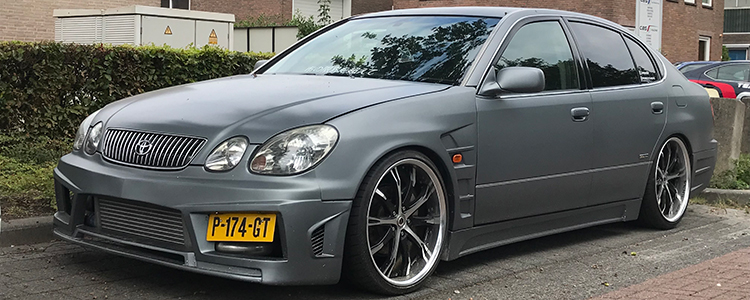
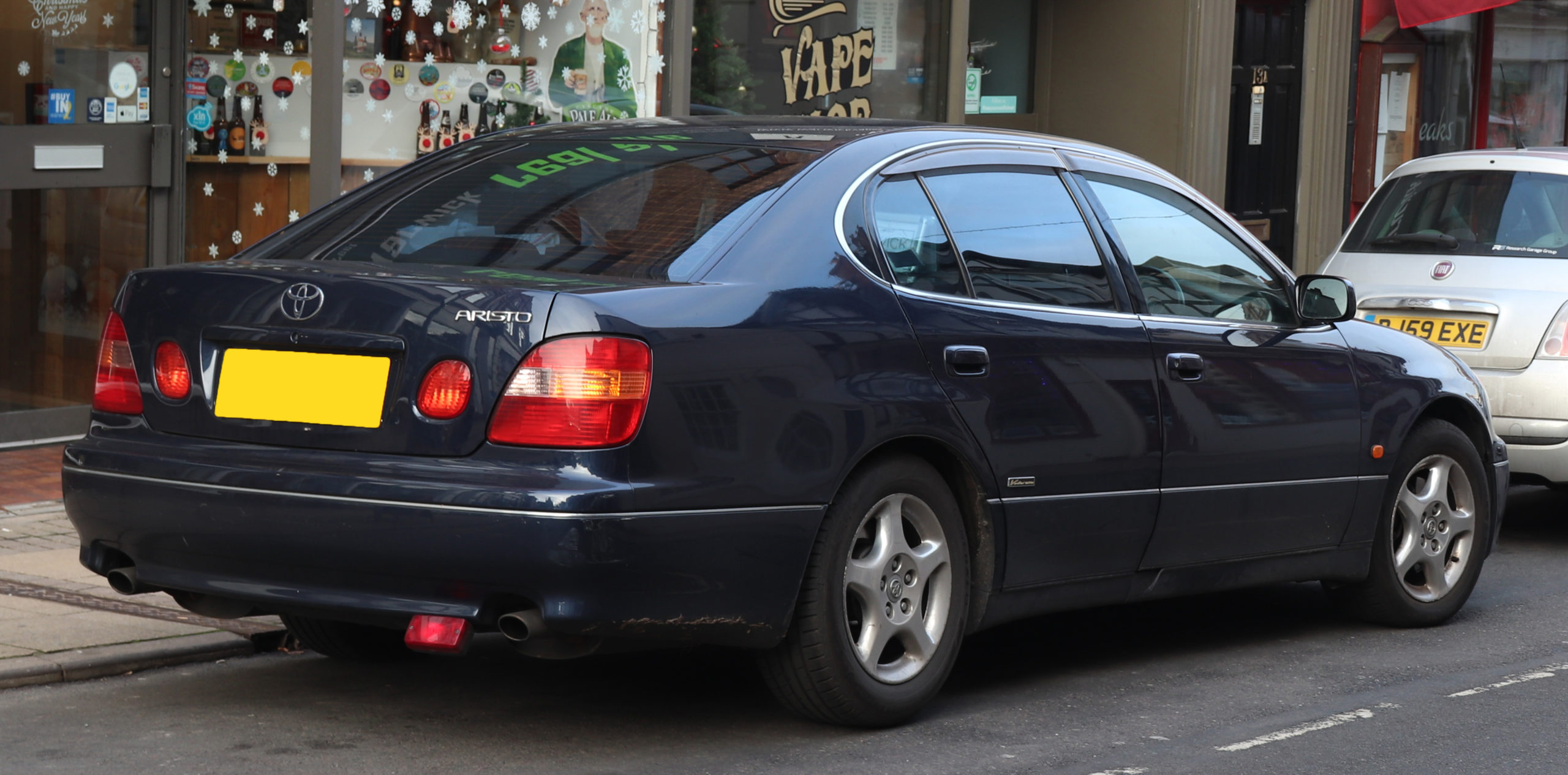
The second-generation Aristo (JZS161, August 1997 to 2005) is the car the model is remembered for. The body was redrawn around quad headlights styled to echo the Lexus SC; the V300 trim carried the VVT-i 2JZ-GTE twin-turbo, the same engine fitted to the A80 Supra RZ of the same era, and Toyota and Lexus claimed it was the quickest production sedan of its moment. The V300 introduced vehicle stability control and traction control as Japanese-market firsts for a Toyota sedan, paired with larger brakes and 16-inch wheels. A 2001 facelift brought a revised grille, tinted headlights, and standard Xenons on V300s.
Looking to buy?
Browse Toyota Aristo listings →
Key Takeaways
The Aristo had two generations from 1991 until 2005, and the second one is the one everyone talks about. The JZS147 is the cheaper way in, and it's the same chassis underneath. The JZS161 is where the V300 lives, and that's the four-door 2JZ-GTE that Toyota never sold anywhere outside Japan.
- V300 2JZ-GTE is the value and demand driver
- Stock, low-km cars command the biggest premiums
- A341E auto is durable but limits purist appeal
- US 25-year eligibility is expanding demand
- Mods hurt value unless documented, reversible, tidy
- Parts shared with GS/SC/Soarer helps ownership
Technical Specifications
Every Aristo runs a 2JZ. The S300 and 3.0V cars use the 2JZ-GE naturally aspirated. The V300 and 3.0V Turbo use the 2JZ-GTE twin-turbo, the same engine as the A80 Supra RZ. The gearbox is almost always an automatic. Factory manuals exist on the V300 Vertex Edition with the Getrag 6MT and on some early NA cars, but you'll spend years looking for one.
Engine Options
| Engine | Displacement | Power | Boost | Notes |
|---|---|---|---|---|
| 2JZ-GE | 3.0L | 230PS @ 6000rpm (169kW) | N/A | VVT-i, ETCS-i (typical) |
| 2JZ-GTE | 3.0L | 280PS @ 5600rpm (206kW) | 11.6 psi (0.8 bar) (est.) | VVT-i, sequential twins, JDM rated |
Transmission Options
| Type | Ratios | Availability | Notes |
|---|---|---|---|
| 4-speed Automatic (A340E) | 2.804/1.531/1.000/0.705 | JZS147 NA & Turbo (most) | RWD electronic auto |
| 5-speed Automatic (A650E) | 3.357/2.180/1.424/1.000/0.753 | JZS161 S300/V300 (var.) | RWD electronic auto |
| 5-speed Manual (R154) | 3.251/1.955/1.310/1.000/0.753 | JZS147 3.0V & 3.0V Turbo (rare) | Factory rare; strong Toyota 5MT |
| 6-speed Manual (Getrag V160/V161) | 3.827/2.360/1.685/1.312/1.000/0.793 | JZS161 V300 Vertex Ed. (6MT) | Getrag; limited factory fitment |
Livability
- Headroom
- 37.5"
- Sunroof cars feel tighter; tall drivers may rub
- Rear Seats
- Usable for adults
- Good legroom; center seat is narrow and firm
- Cargo
- 15.0 cu ft
- Big trunk but small opening; spare well leaks common
Variants & Trims
JDM Aristos came in 3.0V, 3.0Q, S300, V300, and the Vertex Edition body kit cars. The Vertex Edition is the JDM-only sport pack with the aero and the sport seats. The V300 Vertex Edition with the 6MT is the rarest factory Aristo and the one people chase.
| Generation | Trim | Engine | Key Features |
|---|---|---|---|
| JZS161 (2nd gen, 1997-2005) | S300 | 2JZ-GE 3.0 NA | RWD, 5AT, VSC/TRC (var.), luxury interior |
| JZS161 (2nd gen, 1997-2005) | S300 Vertex Edition | 2JZ-GE 3.0 NA | RWD, aero, sport seats (var.), 5AT |
| JZS161 (2nd gen, 1997-2005) | S300 (5MT) | 2JZ-GE 3.0 NA | RWD, rare 5MT, sport-oriented, limited availability |
| JZS161 (2nd gen, 1997-2005) | V300 | 2JZ-GTE 3.0 TT | RWD, twin turbo, 4AT/5AT, larger brakes (var.) |
| JZS161 (2nd gen, 1997-2005) | V300 Vertex Edition | 2JZ-GTE 3.0 TT | RWD, aero, sport suspension (var.), 4AT/5AT |
| JZS161 (2nd gen, 1997-2005) | V300 Vertex Edition (6MT) | 2JZ-GTE 3.0 TT | RWD, Getrag 6MT, LSD (var.), rare factory combo |
Should You Buy a Toyota Aristo JZS161?
The Aristo is a luxury sedan that happens to have the Supra's engine. That sentence captures most of what's good and bad about it. You get the 2JZ-GTE tuning headroom in a body that hides what's under the hood, and you give up the manual gearbox most buyers want and the coupe styling that drives Supra prices.
Why You'll Love It
- 2JZ-GTE tuning headroom V300 responds to bolt-ons; strong bottom end supports big power with proper fuel/turbo.
- Luxury-sport sleeper appeal Understated sedan with serious pace; ideal for discreet street/GT use.
- Toyota durability baseline Robust driveline and electrics vs many 90s rivals; good if maintained and unmolested.
- Parts interchange advantage Shares components with Lexus GS/SC/Soarer; simplifies sourcing and upgrades.
- Comfortable long-distance car Quiet cabin, stable ride, strong A/C; better GT than many JDM performance coupes.
- Rising collector legitimacy Clean V300s gaining auction traction as 25-year imports expand and supply tightens.
Why You Might Not
- Automatic-only performance ceiling Most are A341E autos; fun but less engaging, and hard use needs cooling and upkeep.
- Weight and size Heavy sedan; not as nimble as JZX100/Chaser or Skyline; brakes/suspension wear faster.
- Modified-car risk Many were tuned; wiring, boost control, and fuel mods can be messy and value-negative.
- Aging rubber and cooling system Hoses, radiator, heater core, and vacuum lines age; overheating risk if neglected.
- Interior wear and trim scarcity Seat bolsters, headliners, and plastics age; some JDM-specific trim is harder to find.
- Rust and underbody corrosion Japan coastal/snow use can rust subframes and sills; inspections are critical.
Who Should NOT Buy This
- Anyone needing a cheap, reliable daily commuter
- Buyers who can’t budget $2k-5k in catch-up service
- People without a JDM-capable shop nearby
- Owners who need easy parts at local auto stores
- Anyone who won’t do timing belt service immediately
- Drivers wanting manual transmission (rare/converted)
- People who hate chasing oil leaks and seepage
- Those expecting modern infotainment or nav usability
- Emissions-strict states without a compliance plan
- Buyers who want stock-quiet exhaust and no drone
- Anyone planning high boost on a stock A340E
- People who won’t verify mileage via auction/docs
- Rust-belt buyers without indoor storage
- Drivers over 6'3" wanting sunroof + helmet clearance
- Anyone who can’t tolerate 15-20 mpg real-world
- People who won’t undo bad aftermarket wiring
- Buyers expecting Lexus-level dealer support in the US
- Those needing advanced safety tech (no modern ADAS)
Common Issues & Solutions
The Aristo is a Toyota underneath, so the engine is bulletproof if you stay on top of it. Most of the trouble on a V300 comes from the sequential turbo system getting tired, the A340E auto cooking itself under heavy boost, and the cooling system aging out. None of these are deal breakers if the paperwork's there.
| Issue | Cause | Solution | Est. Cost |
|---|---|---|---|
| A340E auto trans failure | Heat, old ATF, high boost, worn clutches | Rebuild + shift kit + external cooler | $2500-5500 |
| 2-3 shift flare/harsh shift | Valve body wear, solenoids, low line pressure | Valve body rebuild/solenoids; verify TPS | $600-1800 |
| Radiator end tank crack | Aging plastic tanks, heat cycling | Replace radiator + cap; flush with Toyota coolant | $350-900 |
| Water pump seep/leak | Age, bearing wear, neglected timing service | Timing belt kit + water pump + seals | $900-1800 |
| Timing belt overdue risk | Unknown history; importers skip major service | Full timing service immediately after purchase | $900-1800 |
| Crank pulley wobble | Harmonic damper rubber delaminates | Replace crank pulley; inspect keyway and bolt | $350-900 |
| VVTi gear rattle/leak (2JZ) | Worn VVTi cam gear; seal hardening | Replace VVTi gear and cam seal; fresh oil | $600-1400 |
| Valve cover gasket leaks | Gasket shrink; overtorque; heat cycles | Replace gaskets + plug tube seals; clean PCV | $250-700 |
| Cam/crank seal oil leak | Aged seals; timing service skipped | Replace seals during timing belt service | $900-1800 |
| Rear main seal leak | Age; crankcase pressure; long oil intervals | Confirm source; replace seal when trans out | $900-2000 |
| Turbo oil seal smoke | Worn CHRA, high mileage, poor oiling | Rebuild/replace turbo; check oil feed/return | $900-2500 |
| Boost leaks/hesitation | Old couplers, cracked hoses, loose clamps | Pressure test; replace couplers/lines; retune | $150-700 |
| Detonation on bad tune | Aggressive boost, poor fuel, wrong plugs | Compression check; proper tune; colder plugs | $500-6000 |
| Fuel pump weak under load | Old pump, clogged sock/filter, low voltage | Replace pump + filter; check wiring and relay | $300-900 |
| Injector imbalance/misfire | Dirty injectors, aging coils, oil in plug wells | Injector clean/flow + coils/boots + gaskets | $400-1500 |
| O2 sensor slow/rich running | Aged sensors; exhaust leaks upstream | Replace O2 sensors; fix leaks; reset trims | $250-800 |
| Idle hunting/stall | Dirty IAC/TB, vacuum leaks, BOV venting | Clean TB/IAC; smoke test; recirc BOV | $150-600 |
| Power steering rack leak | Inner seals fail; boots fill with fluid | Rebuild/replace rack; flush system | $900-2200 |
| PS pump whine/aeration | Suction hose cracks; low fluid; worn pump | Replace suction/return hoses; rebuild pump | $250-900 |
| Front tension rod bushings | Hydraulic bush leaks; age and potholes | Replace bushings/arms; alignment afterward | $350-900 |
| Lower ball joint wear | Age; torn boots; heavy front end | Replace LBJs; inspect control arms | $300-800 |
| Rear toe bushing wear | Rubber degradation; aggressive alignment | Replace bushings/arms; full 4-wheel alignment | $500-1400 |
| Wheel bearing hum | Age, impacts, water intrusion | Replace hub/bearing assembly | $350-900 |
| Brake caliper slide seizure | Dry pins, torn boots, corrosion | Service/replace calipers; new rotors/pads | $400-1200 |
| ABS/TRAC warning lights | Wheel speed sensors, tone rings, wiring breaks | Scan codes; replace sensor/repair harness | $150-700 |
| A/C weak at idle | Low refrigerant, tired compressor, condenser clog | Leak test; recharge; replace compressor if needed | $200-1600 |
| Heater core seep | Age corrosion; neglected coolant changes | Replace heater core; flush cooling system | $900-1800 |
| Cluster backlight/pixels | Aging bulbs/LEDs, solder cracks | Cluster rebuild or replacement | $200-700 |
| Window regulator failure | Cable fray, plastic guides break | Replace regulator; lube tracks | $250-650 |
| Door lock actuator weak | Small motor wear; cold weather worsens | Replace actuator or motor rebuild | $150-450 |
| Rear subframe mount rust | Salt exposure; trapped moisture under undercoat | Rust repair/weld; treat; avoid severe cases | $800-4000 |
| Trunk water intrusion | Tail light seals, trunk gasket, body seam leaks | Reseal lights/seams; dry and treat rust | $100-800 |
| Aftermarket wiring gremlins | Alarm/AV/boost controller hacks and poor grounds | Remove hacks; re-pin/repair harness properly | $300-2000 |
Differences between JDM & USDM
The Toyota Aristo and the Lexus GS300 / GS400 are the same car at the platform and bodyshell level — JZS147 / JZS161 chassis codes for the JDM Aristo, JZS147 / UZS161 for the export Lexus. The split is in the drivetrain and trim. The Aristo V300 (JZS147 and JZS161) ran the 2JZ-GTE twin-turbo inline-six — the same engine as the A80 Supra RZ, JDM only, never offered in any export Lexus GS. Export markets got the Lexus GS300 with the naturally aspirated 2JZ-GE and, on the JZS161 generation, the Lexus GS400 with the 1UZ-FE 4.0L V8 — a V8 that was never sold in the Aristo. The Aristo Vertex Edition body kit, the S300 5MT, the V300 Vertex Edition 6MT (Getrag), the JDM-spec navigation and audio modules, the EMV multimedia screen, and the RHD configuration are all JDM-only. Lexus GS-spec parts cross over for most service items — brakes, suspension, cooling, much of the interior — but the 2JZ-GTE long-block, the JDM ECU, and the V300-specific drivetrain are not interchangeable with any Lexus GS. For a US buyer the practical upshot is: the Aristo gets you a 2JZ-GTE in a sedan, but you import the car under the 25-year rule and source GTE-specific parts through the JDM aftermarket, not through Lexus.
1997 Toyota Aristo 2JZ Twin Turbo (Canada Import) Japan Auction Purchase Review
Pre-Purchase Inspection Checklist
Walk this list with the seller, not in front of them. The Critical items mean walking away if there's no paperwork backing them up. Pay extra attention to the turbo health and the timing belt history on a V300, because both are expensive to fix after the fact.
Critical Priority
- Chassis Rust Inspect rear subframe mounts for rust scale
- Cooling System Pressure test; inspect radiator end tanks for cracks
- Oil Pressure Hot idle oil light flicker is a walk-away
- Compression Test Warm test; cylinders within 10% across bank
- Leakdown Test Listen intake/exhaust/crankcase; confirm ring health
- Timing Belt Verify date/mileage proof; inspect belt condition
- Auto Trans A340E Check 2-3 flare, harsh shifts, delayed engagement
- ATF Condition Fluid bright red; burnt smell means rebuild soon
- Airbags Confirm SRS light behavior; no missing airbags
- Test Drive Full warm drive; watch temps, shifts, boost, brakes
High Priority
- Front Frame Rails Check rails for kinks/welds from crash repair
- Underbody Seams Check seam sealer splits and fresh undercoat
- Trunk Floor Lift carpet; check spare well for water/rust
- Coolant Condition Check for oil sheen/sludge; verify Toyota red/pink
- Water Pump Look for weep crust; listen for bearing growl
- Hoses & Clamps Squeeze hoses; check swelling, oil-soaked rubber
- Heater Core Sniff sweet odor; check foggy windows, wet footwell
- 1JZ/2JZ Oil Leaks Inspect cam seals, VVTi gear, front main area
- Rear Main Seal Check bellhousing for oil; confirm not PS fluid
- Turbo Condition Check shaft play, oil in intercooler piping
- Boost Control Verify stable boost; no overboost fuel cut events
- Vacuum Lines Inspect brittle hoses; check for boost leaks
- Idlers/Tensioner Listen for chirp; check service includes idlers
- Crank Pulley Check wobble; rubber damper separation
- Spark Plugs Pull 1 plug; check heat range and detonation speck
- Fuel System Smell for fuel; check lines, filter age, pump noise
- Fuel Pressure Verify base pressure; watch drop under boost
- ECU Fault Codes Pull codes; ensure no cleared readiness tricks
- Wiring Harness Check hacked splices for alarms/boost controllers
- Trans Cooler Check for added cooler; stock cooling marginal
- Driveshaft Check center bearing and U-joint play/vibration
- Diff Noise Whine on cruise/decel; check fluid and backlash
- Suspension Bushings Check front LCA, tension rod, rear toe bushings
- Ball Joints Check play; torn boots; clunk over bumps
- Wheel Bearings Listen for hum; check play at 12/6 o'clock
- Brakes Check rotor lip, caliper slide pins, pad taper
- ABS/TRAC Lights Confirm bulb check; scan for wheel speed faults
- Power Steering Check pump whine and rack boots for fluid
- Steering Rack Check inner seals; wet boots mean rack rebuild
- Odometer Credibility Compare wear vs km; check auction sheets/service
- Seatbelts Check retraction and fraying; pretensioner status
Medium Priority
- Jack Points Look for crushed pinch welds and rust bubbles
- Sunroof Drains Pour water; confirm drains flow, no headliner stains
- Windshield Cowl Check for leaf clogging and water intrusion signs
- Paint & Panels Check overspray, mismatched orange peel, tape lines
- Thermostat Verify stable temps; no slow warm-up or spikes
- Fan & Clutch Check fan clutch resistance and shroud intact
- Valve Cover Gasket Check plug wells for oil; misfire under load
- Intercooler Piping Check couplers for oil sweat and loose clamps
- PCV System Check PCV valve and grommet; excessive crankcase
- Ignition Coils Scan for misfire; check coil boots for cracks
- Injectors Listen for even tick; check trims for imbalance
- Airflow Meter Check for hesitation; inspect AFM/MAF wiring
- Idle Quality Warm idle steady; no hunting with A/C on
- Exhaust Check for cracks, leaks, missing cats/resonators
- O2 Sensors Scan live data; lazy sensors cause rich running
- Battery/Charging Test alternator output; check voltage under load
- Starter Listen for slow crank; hot-start issues common
- Axle Seals Look for diff oil at inner CVs and rear hubs
- Engine Mounts Powerbrake test; excessive rock indicates mounts
- Tie Rods Check inner/outer play; uneven tire wear clues
- Shocks/Struts Look for leaks; bounce test; uneven damping
- A/C Performance Vent temp cold; check compressor noise and cycling
- Instrument Cluster Check dead pixels, dim backlight, gauge accuracy
- Window Regulators Check slow windows; listen for cable crunch
- Key/Immobilizer Confirm all keys; check aftermarket alarm issues
- Tires Check date codes and inner wear from bad alignment
- Wheels Check cracks/bends; mismatched offsets rub liners
Low Priority
- Door Seals Check for wind noise, torn seals, wet carpets
- Headlights Test leveling/aim; check haze and cracked mounts
- Throttle Body Check sticky throttle and dirty IAC passages
- Heater Blend Doors Confirm hot/cold change; listen for actuator clicks
- Seat Wear Driver bolster wear should match claimed mileage
- Door Locks Test actuators; common weak motors
- Audio/Navi Test amp, speakers; JDM navi often dead/obsolete
- HVAC Display Check dim segments and button response
Generation History
S140 Aristo (1st gen) (1991-1997)
- First Aristo; early JDM Lexus GS twin
- 2JZ-GE NA and 2JZ-GTE twin-turbo trims
- A341E 4AT; strong but not sporty
- Analog luxury; heavy, stable highway car
- Growing collector interest in clean V300
S160 Aristo (2nd gen) (1997-2005)
- Sharper styling; most sought-after generation
- V300 uses 2JZ-GTE VVT-i (late cars)
- Improved chassis; better daily usability
- Interior tech upgrade; still JDM-only
- Best aftermarket + parts interchange with GS
Market Data
Production Numbers & Rarity
| Generation | Years | Total Built | Notes |
|---|---|---|---|
| JZS147 (1st gen) | 1991-1997 | ~(unknown) estimated 70,000-110,000 | Exact Aristo-only totals not published (est.) |
| JZS161 (2nd gen) | 1997-2005 | ~(unknown) estimated 80,000-140,000 | Exact Aristo-only totals not published (est.) |
Rarest variant: JZS161 V300 6MT
How It Compares
Among the JDM 2JZ and RB sedans, the Aristo is the most luxurious, the Chaser is the most playful, and the R33 Skyline is the most capable on a track. The table below leans toward what the Aristo actually does well, which is highway comfort and tuning headroom in a body that doesn't look fast.
| Feature | JZS161 | Nissan Skyline R33 | Toyota Chaser JZX100 |
|---|---|---|---|
| Engine/Induction | 2JZ-GTE TT / 2JZ-GE NA | RB25DET T / RB26DETT TT | 1JZ-GTE TT / 2JZ-GE NA |
| Power (factory) | 280 PS (V300) / ~220 PS NA | 250-280 PS depending trim | 280 PS (1JZ-GTE) / NA lower |
| Transmission | Mostly 4AT A341E | 5MT/4AT depending model | 5MT available on Tourer V |
| Drivetrain layout | FR (RWD) | FR or AWD (GT-R) | FR (RWD) |
| Tuning ceiling | High; 2JZ supports big power | High; RB strong but costlier | High; 1JZ strong, cheaper |
| Aftermarket support | Excellent (2JZ ecosystem) | Excellent (Skyline ecosystem) | Strong (JZX drift/GT scene) |
| Ride/comfort | High; luxury-biased | Medium; sportier, noisier | Medium-high; sedan comfort |
| Handling feel | Stable, less agile due to weight | More agile; GT-R very capable | More playful; lighter front feel |
| Collector premium | Rising for clean V300s | High for GT-R; mixed for GTS | Strong for Tourer V manuals |
| Running costs | Moderate; Toyota parts access | Higher; RB/ATTESA parts cost | Moderate; 1JZ parts plentiful |
| Best buy criteria | Stock V300, records, no rust | Unmodified, rust-free, service | Manual Tourer V, clean shell |
Comparable Alternatives
If the Aristo doesn't end up being the right car, the natural alternative is the Lexus GS300 or GS400, which is the same chassis with US specs and easier parts. The JZX100 Chaser gets you a 1JZ-GTE and a factory 5MT for less money. The Soarer is the coupe version of the same Toyota DNA.
Lexus GS300/400 (S160)
US-market sibling; easier parts/registration
Toyota Chaser JZX100
1JZ-GTE, lighter feel; 5MT available
Nissan Laurel C35
RB25DET sedan; similar sleeper vibe
Mitsubishi Legnum VR-4
AWD twin-turbo wagon; rare, fast GT
Toyota Soarer JZZ30
1JZ/2JZ grand tourer; shared Toyota DNA
In Pictures

The Buyer's Read
If you're buying an Aristo, the V300 is the car. Everything else is a compromise on the way to it. A documented JZS161 V300 with stock turbos, a clean auction sheet, and a recent timing belt service is the safest place to put your money. Skip anything under $12,000 on a V300. A cheap V300 almost always means the previous owner ran it hard, and you'll spend what you saved on the purchase chasing turbo seals, blown couplers, and a tired automatic in the first year.
The S300 is the sensible Aristo. You give up the twin turbos and you get a smoother daily car with the same Toyota durability underneath. A clean S300 runs about half what a V300 does, and the 2JZ-GE will outlast everything else on the car. If you don't need the turbo headroom and you want a comfortable RWD sedan with a Lexus interior, the S300 is the smarter buy. The catch is that it's not the car people talk about, so resale is softer.
The JZS147 is the cheaper way in, and the chassis is the same one underneath. The problem with a JZS147 today is age. Every rubber part is end-of-life, the rear subframe mount rust is a known killer, and the early cars without VVT-i lack the refinements that make the JZS161 a better daily. If you find a documented JZS147 3.0V Turbo with a 5MT, that's a different conversation and it's worth chasing. Otherwise the JZS161 V300 is where the value is.
The one Aristo to avoid is a modified V300 with a single-turbo swap, a cut harness, and a mystery tune. The 2JZ-GTE will take all the power you can throw at it, but the work has to be documented or you're buying somebody else's problems. Stock is better than badly modified every time on this car.
Frequently Asked Questions
- Which Aristo is most desirable for collectors?
- The V300 2JZ-GTE twin-turbo, especially clean, stock, low-km S160 cars with records and no rust.
- Are Toyota Aristo and Lexus GS the same car?
- They’re close platform-mates; Aristo is JDM. Many parts interchange with Lexus GS (S140/S160), but trims/ECUs differ.
- Is the Aristo manual from factory?
- Factory manuals are extremely rare to nonexistent for most markets; most are A341E automatic. Manual swaps exist but can hurt value.
- What are common problem areas to inspect?
- Check cooling system, turbo health, oil leaks, front suspension bushings, rust on sills/subframes, and hacked wiring from mods.
- What mods hurt resale the most?
- Poorly documented single-turbo swaps, cut harnesses, cheap coilovers, missing emissions hardware, and interior gauge clutter.
- What’s the best spec for a daily driver?
- A tidy 2JZ-GE NA or lightly modified V300 with stock-like tune, good cooling, and refreshed suspension is ideal.
- How does it compare to a JZX100 Chaser?
- Aristo is more luxury/GT and heavier; JZX100 feels lighter and offers 5MT. Aristo wins on refinement and 2JZ cachet.
- When is it US-legal under the 25-year rule?
- By model year: 1997 in 2022, 1998 in 2023, 1999 in 2024, 2000 in 2025, 2001 in 2026, 2002 in 2027.
Sources & References
- Toyota Aristo — encyclopedic overview — WikipediaVerified
- Lexus GS — encyclopedic overview (export-market sibling) — WikipediaVerified
- Toyota JZ engine family (2JZ-GE / 2JZ-GTE) — WikipediaVerified
- Italdesign Giugiaro — JZS147 Aristo bodywork designer — WikipediaVerified
- Toyota Aristo — Japanese-language encyclopedic overview — Wikipedia (Japanese)Verified
- Toyota Motor Corporation — Vehicle Heritage: Aristo (2nd generation launch) — Toyota Motor CorporationVerified
- Toyota Aristo — model index and trim data — car.infoVerified
- 1997 Toyota Aristo (Lexus GS300) — owner reviews — CarGurusVerified
- Common Aristo problems — what to watch out for (owner forum) — Lexus Owners Club UKVerified
- TOM'S — Toyota's in-house tuning house, Aristo race programs — WikipediaVerified
- TOM'S Racing — Aristo parts catalogue — APEXi USAVerified
- Toyota Aristo — auction sales history — Bring a TrailerVerified
Sources last verified: