Buyer's guide
Mazda RX-8
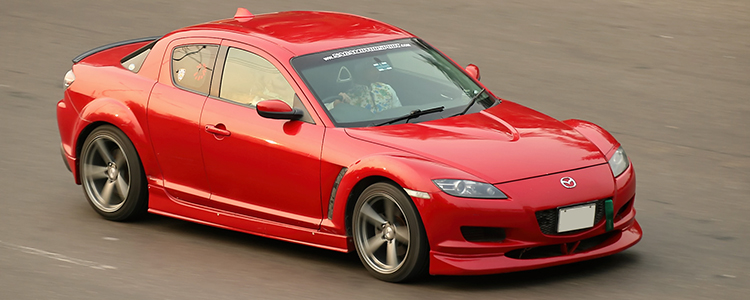
The Mazda RX-8 (SE3P, 2002–2012) was the rotary's pivot from supercar to daily driver — and, in retrospect, its commercial farewell. Mazda launched the car in 2002 as the successor to the FD3S RX-7, but the RX-8 wasn't a successor in the conventional sense. Out went the twin sequential turbos, the cramped 2+2 cockpit, and the FD's hard-edged track focus. In came the naturally aspirated 13B-MSP Renesis, a side-port rotary that ran cleaner, met the emissions rules that ended FD production, and revved to 9,000 rpm in 6-port manual trim. The cabin grew a pair of rear-hinged 'freestyle' suicide doors and four real seats. The body became a 4-door coupe — Mazda's own term — that traded the FD's pin-up looks for genuine usability. JDM-only finals stack up at the top of the range: Type S and Type RS through the Series 1 run, the Mazdaspeed-tuned 480-unit batch from 2003, and the Spirit R Type A (Recaro, Brembo, 6MT) and Type B finals that closed production in 2012. By then the apex-seal reputation had ossified into folklore — partly earned through early-production wear patterns, partly inherited from owners who skipped oil changes and short-tripped the car cold. When Mazda shut the SE3P line in June 2012, it ended fifty years of rotary production cars. The Renesis hasn't returned to a Mazda showroom since.
Renesis vs 13B-REW — why the RX-8 lost the turbos
The 13B-MSP Renesis in the RX-8 is the same 1.3L two-rotor displacement as the 13B-REW in the FD3S RX-7, but it's a fundamentally different engine. The REW used peripheral exhaust ports and twin sequential turbochargers to make 280 PS (gentlemen's agreement cap, real output higher) at the cost of high exhaust temperatures, marginal emissions, and the famous appetite for apex seals under boost. The Renesis (Rotary + Genesis) moved the exhaust ports from the rotor housing periphery to the side housings, freeing up rotor face for a much larger 6-port intake on the manual variant. Mazda used the relocated ports to chase emissions compliance and idle stability — both prerequisites for selling a rotary in 2003 emissions regimes that the REW couldn't meet. The trade-off was peak power: 250 PS from the 6-port MT (revised to 235 PS after the 2003 SAE re-rating), 215 PS from the 4-port AT. No turbos, no intercooler, no boost-driven seal stress. The flip side is the high-rev character — peak power lives at 8,200 rpm, redline is 9,000 rpm on the 6MT, and the engine asks to be driven there. Owners coming from the FD's mid-range boost wave usually find the Renesis underwhelming below 5,500 rpm; the cars reward the wringers and punish the lazy.
The apex seal reputation — pattern, not fate
Renesis apex seal failure is real, but the pattern matters. Early Series 1 cars (2003–2004) shipped with thinner apex seals and a less robust oil metering pump (OMP) calibration; Mazda revised both during the production run, and 2009-on Series 2 cars run later seals and updated OMP mapping. Layered on top of the hardware are the operating conditions that accelerate wear: cold-start short trips that wash the rotor housings with fuel, missed oil top-ups (the rotary burns oil by design — roughly a quart per 2,000–3,000 miles is normal), ignition components run past their service life (weak coils cause incomplete combustion, which dumps fuel into the exhaust and overheats the cat, which back-pressures the rotors), and the post-drive shutdown habit of switching off when the engine is still rich-running. Compression test results — measured with a rotary-specific gauge that records all three faces of each rotor — separate the healthy cars from the marginal ones. Mazda's reference is 7.5 bar minimum per face with no more than 1.5 bar variance; cars that fall below those numbers usually need a rebuild, not a tune. The cars that have stayed healthy past 100,000 miles share a few traits: consistent ignition maintenance (plugs and coils on schedule), aggressive oil top-ups, premix from owners who don't trust the OMP, and a driver who warms the engine before driving it hard.
Quick read
Key takeaways
- Compression test matters more than miles
- R3 (2009-2011) is the top-spec value leader
- 6-speed manual commands the strongest premium
- Mods hurt value unless documented, reversible, quality
- Cooling/ignition upkeep prevents most failures
- Rust-free chassis beats shiny paint every time
Constants
Common across all RX-8 generations
- Naturally aspirated RENESIS 13B-MSP twin-rotor Wankel engine — no turbocharged variant offered
- Front-midship engine placement, rear-wheel-drive layout
- Four-seat body with rear-hinged 'freestyle' half-doors and no B-pillar
- Apex seal maintenance is distinct from conventional piston-engine service intervals
- Right-hand drive available throughout JDM production
Chassis history
Generation timeline
The RX-8 only ever wore one chassis, the SE3P, but the run splits cleanly into two cars. Series 1 (2003 to 2008) is the original, with the thinner early apex seals and the original oil metering pump map. Series 2 (2009 to 2012) is the one to want if you can find it. Mazda revised the seals, the OMP calibration, and the suspension tuning, and the R3 trim picked up Recaros, Bilsteins, and 19s straight from the factory.
Buyer's call
Should you buy a Mazda RX-8?
The RX-8 is the kind of car where the good and the bad are tied to the same thing, the Renesis. The chassis is brilliant. The steering is the best in any 2+2 of the era. The engine is what you live with, and the engine is what costs you money. Read both sides of the list together rather than picking one and ignoring the other.
Why you'll love it
- Chassis balance & steering Exceptional turn-in, feedback, and rotation; feels lighter than it is.
- High-rev character 9k redline (6MT) delivers unique, smooth power and sound unlike piston cars.
- Practical 2+2 packaging Rear-hinged doors make back seats usable; more livable than most coupes.
- Strong value entry point Still cheaper than most JDM icons; big performance-per-dollar when healthy.
- Aftermarket & community Deep knowledge base for diagnostics, coils, cooling, and track setup.
- R3 is a factory sweet spot Best OEM spec: Bilsteins, Recaros, aero, 19s; most desirable trim.
- Track-capable fundamentals Rigid shell, good brakes, stable temps when sorted; rewarding at the limit.
Why you might not
- Compression sensitivity Low compression causes hard hot starts and low power; rebuilds are costly.
- Fuel economy & range Real-world mpg often in the teens; short range and premium fuel expected.
- Ignition system wear Coils/plugs/leads are consumables; neglect accelerates catalyst and engine wear.
- Oil consumption is normal Designed to burn oil; owners must check often and use correct oil strategy.
- Heat management risks Overheating or repeated short trips can shorten apex seal life quickly.
- Insurance/financing friction Some insurers rate as sports car; lenders dislike older rotary examples.
- Rust & neglected examples Cheap cars are often deferred-maintenance; rust and low compression are common.
Who should not buy this
- Anyone who can't budget for an engine rebuild
- People who do lots of short trips/stop-start driving
- Owners who skip warm-up and proper shutdown habits
- Anyone unwilling to check oil every fuel fill-up
- Drivers needing reliable hot starts in all conditions
- Emissions-strict areas if cat/air pump issues exist
- People without a rotary-competent shop nearby
- DIY-averse owners; this car demands proactive care
- Anyone expecting 25+ mpg or low fuel costs
- Buyers who won't replace coils/plugs on schedule
- People who ignore overheating risks or cooling upkeep
- Rust-belt buyers who can't inspect underside thoroughly
- Those needing big cargo space or 5-seat practicality
- People who want set-and-forget daily reliability
- Anyone buying the cheapest example with no records
- Track users without budget for frequent maintenance
- Owners who plan to run it low on oil even once
- People who can't tolerate occasional flooding events
- Those who can't do compression testing before purchase
- Anyone expecting cheap insurance and low running costs
Reliability
Common issues & solutions
Most RX-8 trouble comes back to two things. Owners who didn't know rotaries are different, and ignition parts that got run past their service life. Coils, plugs, and leads on an RX-8 are wear items, not lifetime parts. Skip them and you'll dump fuel into the cat, kill the cat, and back-pressure the rotors. The rest of the failures, hard hot starts, flooding, low compression, are usually downstream of that one neglected maintenance item.
| Issue | Cause | Solution | Est. cost |
|---|---|---|---|
| Low compression / no hot start | Apex/side seal wear from heat, poor lube, flooding | Proper compression test; rebuild or replace engine | $4500-9000 |
| Flooding (won't start) | Short trips, weak ignition, shutdown cold, low battery | Deflood procedure; fix ignition; strong battery/starter | $150-1200 |
| Ignition coil failure/misfire | Coils overheat/age; cheap aftermarket coils fail fast | Replace coils, plugs, wires; verify dwell/grounds | $400-1200 |
| Catalytic converter failure | Misfire dumps fuel; overheating melts/clogs cat | Fix misfire first; replace cat; verify O2 operation | $900-2500 |
| P0420 catalyst efficiency | Aging cat, exhaust leaks, lazy O2, rich running | Smoke test leaks; replace O2/cat as needed | $250-2200 |
| Hard hot start (slow crank) | Weak starter/battery; heat soak reduces cranking RPM | Upgrade starter (S2), new battery, clean grounds | $350-900 |
| Overheating in traffic | Weak fans, clogged radiator, air in system, bad t-stat | Pressure bleed; replace rad/fans/thermostat as needed | $300-1500 |
| Radiator plastic tank crack | Age/heat cycles crack end tanks and seams | Replace radiator; refresh hoses and cap | $350-900 |
| Oil cooler line leaks | Aged hoses, loose banjos, crushed washers | Replace hoses/seals; torque banjos; clean and recheck | $250-900 |
| Excessive oil consumption | Normal metering + worn seals; aggressive driving | Monitor; premix; address compression if worsening | $50-9000 |
| Rough idle / stalling warm | Weak ignition, vacuum leak, dirty MAF/throttle, low comp | Smoke test; clean MAF/TB; refresh ignition; comp test | $150-1500 |
| Secondary air pump failure | Moisture ingestion, bearing wear, carbon buildup | Replace pump/valves; verify hoses and check valves | $400-1600 |
| OMP (oil metering) issues | Electrical faults, clogged lines, poor maintenance | Diagnose OMP; clean/replace lines; consider premix | $200-1200 |
| 2nd/3rd gear synchro grind | Hard shifting at high RPM; old fluid; worn synchros | Fluid change; if persists rebuild/replace trans | $120-3500 |
| Clutch slip or chatter | Worn disc/pressure plate; heat spots; oil contamination | Replace clutch kit; resurface flywheel; inspect seals | $900-2000 |
| Clutch master/slave leak | Seal wear; old fluid absorbs moisture | Replace master/slave; flush fluid; inspect line | $250-700 |
| Differential whine/leak | Low fluid, worn bearings, pinion seal seepage | Service fluid; replace seals; rebuild if noisy | $150-1800 |
| Rear door handle/cable fail | Cable stretch/break; latch contamination | Replace cable/handle; clean/lube latch mechanism | $150-500 |
| Window regulator failure | Motor/regulator wear; dry tracks | Replace regulator; lube tracks; check switches | $250-600 |
| EPS steering warning/light | Low voltage, torque sensor faults, module issues | Test charging; scan EPS; repair wiring/module | $150-1800 |
| Inner tire wear (rear) | Aggressive camber/toe, worn bushings, bad alignment | Align to street specs; replace worn arms/bushings | $150-1200 |
| Suspension clunks | End links, control arm bushings, ball joints worn | Inspect and replace worn components; align after | $200-1500 |
| ABS/DSC lights | Wheel speed sensors, tone rings, low voltage | Scan codes; replace sensor/repair wiring; clear | $150-600 |
| AC weak at idle | Weak fans, low refrigerant, condenser leak | Leak test; repair; recharge; verify fan operation | $200-1200 |
| Rust at rockers/jack pts | Road salt traps; poor undercoating; clogged drains | Inspect/repair rust; treat/undercoat; avoid rusty cars | $500-5000 |
| Water in trunk/spare well | Tail light seals, trunk seal, body seam leaks | Reseal lights/seams; replace weatherstrips | $100-600 |
| Engine oil leaks (front cover) | Aged seals, RTV failure, crank seal seep | Reseal front cover; replace seals; clean and verify | $600-1800 |
| Engine mounts collapse | Heat and age soften mounts; spirited driving | Replace mounts; inspect exhaust flex and driveline | $400-1200 |
| Poor fuel economy | Rotary efficiency + rich warmup; misfire worsens | Fix ignition; ensure thermostat; drive cycles properly | $0-1200 |
Market
Differences between JDM & USDM
The RX-8 was sold globally, but the trim splits differ meaningfully between JDM and USDM. Japan got the Type S and Type RS (Recaro, Bilstein, lightweight wheels) at the top of the Series 1 range; the Mazdaspeed RX-8 (480 units, 2003, JDM-only) and the M'z Tune update; the Type E and Type SP for comfort-leaning buyers; and the Spirit R Type A (6MT, Recaro, Brembo), Type B (AT), and Type C finals that closed production in 2012. The USDM market never received Type RS, Spirit R, or Mazdaspeed factory tunes — the closest USDM equivalents are the R3 (2009–2011, Recaro, Bilstein, 19s, 6MT) and the 40th Anniversary Edition (2008, 400 units globally, of which roughly 1,250 reached the US). UK buyers got their own specials: Evolve, PZ (Prodrive-tuned), Nemesis, and Kuro. Australia received the Revelation (100 units, comfort spec). All RX-8 markets used the same Renesis engine but the JDM cars ran higher-output 6-port calibration in MT trim (250 PS as launched, 235 PS post-2004 SAE revision); the USDM cars were rated at 238 hp net for the 6MT through Series 1 and dropped slightly with Series 2 emissions tuning. Driving position is LHD on USDM/European cars, RHD on JDM and UK.
Specs
Technical specifications
Every RX-8 runs the 13B-MSP Renesis. Two outputs. The 6-port engine in the manual cars makes around 231 PS and spins to 9,000 rpm. The 4-port engine in the automatics makes around 192 PS and stops sooner. There's no turbo, no boost, no intercooler. Unlike the FD3S RX-7 before it, the RX-8 was naturally aspirated from day one.
Engine options
| Chassis | Engine | Displacement | Power | Boost | Notes |
|---|---|---|---|---|---|
| SE3P (MT, 6-port) | 13B-MSP Renesis | 1.3L (654cc x2 rotors) | 231PS @ 8500rpm (228hp @ 8500rpm) | N/A | 6-port, 9000rpm redline (market) |
| SE3P (AT, 4-port) | 13B-MSP Renesis | 1.3L (654cc x2 rotors) | 192PS @ 7000rpm (189hp @ 7000rpm) | N/A | 4-port, lower redline (market) |
| SE3P (MT, 6-port) (NA-spec rating) | 13B-MSP Renesis | 1.3L (654cc x2 rotors) | 238hp @ 8500rpm | N/A | SAE net varies by MY/market |
| SE3P (AT, 4-port) (NA-spec rating) | 13B-MSP Renesis | 1.3L (654cc x2 rotors) | 197hp @ 7000rpm | N/A | SAE net varies by MY/market |
Transmission options
| Type | Ratios | Availability | Notes |
|---|---|---|---|
| 6-speed Manual (Aisin AZ6) | 3.760/2.269/1.645/1.187/1.000/0.843 | 6-port MT trims (most markets) | RWD; close-ratio; final drive varies |
| 5-speed Manual | 3.136/1.888/1.330/1.000/0.814 | Some early/market-specific base | Market-dependent; uncommon |
| 4-speed Automatic | 2.846/1.552/1.000/0.700 | 4-port AT trims | With torque converter; final drive varies |
| 6-speed Automatic | 4.148/2.370/1.556/1.155/0.859/0.686 | Select markets/years (estimated) | Market-dependent; verify by VIN |
Lineup
Variants & trims
JDM RX-8s came in Type E, Type S, Type RS, and Type RZ in Series 1, and the Spirit R Type A, Type B, and Type C closed out production in 2012. The Mazdaspeed RX-8 was a 480-unit JDM-only run in 2003. USDM buyers got the R3 and the 40th Anniversary instead. The Type RS and Spirit R Type A are the ones JDM collectors actually chase, with Recaros, Bilsteins, and Brembos in the Spirit R's case.
| Generation | Trim | Engine | Key features |
|---|---|---|---|
| SE3P Series 1 (JDM/Global, 2003-2008) | Base (Sport, MT) | 13B-MSP Renesis (6-port) | 6MT, 18in wheels, DSC/TCS, sport suspension |
| SE3P Series 1 (JDM/Global, 2003-2008) | Base (AT) | 13B-MSP Renesis (4-port) | 4AT, 16-18in wheels, DSC/TCS, cruise (varies) |
| SE3P Series 1 (JDM/Global, 2003-2008) | Touring (AT/MT) | 13B-MSP Renesis (6-port MT / 4-port AT) | leather, Bose audio, xenon/HID (market), sunroof |
| SE3P Series 1 (JDM/Global, 2003-2008) | Grand Touring (AT/MT) | 13B-MSP Renesis (6-port MT / 4-port AT) | leather, Bose, HID, heated seats, 18in wheels |
| SE3P Series 1 (JDM/Global, 2003-2008) | Shinka (Special Edition) | 13B-MSP Renesis (6-port MT / 4-port AT) | special leather, unique wheels, body kit accents, Bose |
| SE3P Series 1 (JDM/Global, 2003-2008) | Evolve (UK special) | 13B-MSP Renesis (6-port) | Recaro seats, Bilstein dampers, 18in wheels, aero |
| SE3P Series 1 (JDM/Global, 2003-2008) | PZ (UK Prodrive) | 13B-MSP Renesis (6-port) | Prodrive suspension, aero kit, lightweight wheels, 6MT |
| SE3P Series 1 (JDM/Global, 2003-2008) | Mazdaspeed (Japan) | 13B-MSP Renesis (6-port) | Mazdaspeed aero, sport exhaust, 18in wheels, 6MT |
| SE3P Series 1 (JDM/Global, 2003-2008) | Type E (Japan) | 13B-MSP Renesis (4-port) | 4AT, leather (varies), comfort spec, 16-18in wheels |
| SE3P Series 1 (JDM/Global, 2003-2008) | Type S (Japan) | 13B-MSP Renesis (6-port) | 6MT, sport suspension, 18in wheels, DSC/TCS |
| SE3P Series 1 (JDM/Global, 2003-2008) | Type RS (Japan) | 13B-MSP Renesis (6-port) | Recaro, Bilstein, forged wheels (market), aero, 6MT |
| SE3P Series 1 (JDM/Global, 2003-2008) | Type RZ (Japan) | 13B-MSP Renesis (6-port) | Recaro, Bilstein, lightweight wheels, aero, 6MT |
| SE3P Series 2 (R3/refresh, 2009-2012) | Sport (MT) | 13B-MSP Renesis (6-port) | 6MT, updated fascia, revised suspension, DSC/TCS |
| SE3P Series 2 (R3/refresh, 2009-2012) | Touring (AT/MT) | 13B-MSP Renesis (6-port MT / 4-port AT) | leather (market), Bose, updated interior, 18in wheels |
| SE3P Series 2 (R3/refresh, 2009-2012) | Grand Touring (AT/MT) | 13B-MSP Renesis (6-port MT / 4-port AT) | leather, Bose, HID (market), heated seats, 18in wheels |
| SE3P Series 2 (R3/refresh, 2009-2012) | R3 (Special Edition) | 13B-MSP Renesis (6-port) | Recaro, Bilstein, aero, 19in wheels, 6MT |
| SE3P Series 2 (R3/refresh, 2009-2012) | Spirit R (Japan final edition) | 13B-MSP Renesis (6-port MT / 4-port AT) | Recaro (MT), Bilstein, Brembo (varies), aero, 18in |
Pricing
Average prices & original MSRP
RX-8 prices are condition-driven more than year-driven. The cheapest cars start under $5,000 and they're cheap for a reason. The good 6-speed Series 2 cars and the R3s sit in the middle of the market. Spirit R Type As in Japan, and the rare clean low-mile R3s in the US, push past $30,000. What you're paying for is compression health and documentation, not paint.
Original MSRP: $25,700 at launch in 2004. USDM 2004 Mazda RX-8 6-speed manual base MSRP, per Mazda North America launch pricing. Grand Touring trim launched at approximately $32,500. JDM launch pricing was set in yen and varied by trim — Type E from ¥2,490,000, Type RS at the top of the range. Spirit R Type A (2012, JDM final) listed at ¥3,800,000.
Today's market range: $4,500 to $35,000 (median ~$12,500). Source: JDMBuySell / USS Auction.
RX-8 values are condition-driven: cheap cars stay cheap due to compression risk, while clean 6MT and R3 examples have firmed. Expect gradual appreciation for low-mile, stock Series 2; modified/unknown-history cars remain volatile.
Inspect
Pre-purchase inspection checklist
Walk this list cold, then drive the car, then walk it again warm. The Critical items are the ones that decide if you buy the car at all, and the compression test sits at the top. Don't take the seller's word on it. Hot test, all three faces, written numbers. If the seller won't allow a compression test, that's the answer.
Critical priority
- Cold start behavior Cold start: instant fire, stable idle, no hunting
- Hot start test Hot restart after 10 min heat soak; no long crank
- Compression test Rotary compression test w/ proper gauge; record all faces
- Overheat history Ask about overheating; rotary hates heat, seals suffer
- Ignition coils Check coil age/brand; misfire under load = weak coils
High priority
- Cranking speed Listen for slow crank; weak starter kills hot starts
- Battery health Load test battery; low CCA worsens flooding/hot starts
- Flooding signs Raw fuel smell, wet plugs, hard start after short trips
- Oil level/consumption Check oil level; ask miles per quart; inspect top-ups
- Coolant condition Check coolant level/color; pressure test for leaks
- Radiator end tanks Inspect radiator plastic tanks for cracks/seepage
- Thermostat operation Verify warm-up and stable temps; no spikes in traffic
- Cooling fans Confirm both fans cycle; AC on should trigger fans
- Oil cooler lines Inspect oil cooler hoses/banjos for leaks and wetness
- Spark plugs/leads Verify correct plugs/leads; inspect for oil/fuel fouling
- Misfire scan Scan for pending misfire codes; check fuel trims
- Catalytic converter Rattle, sulfur smell, glowing cat; check for P0420
- Exhaust restriction Check for loss of top-end power; clogged cat common
- Oil metering pump Check OMP function/codes; failure reduces lubrication
- Clutch engagement Check bite point, slip in 3rd/4th; clutch wear common
- Transmission synchros 2nd/3rd grind at high RPM; test fast shifts warm
- Steering feel Check for EPS warning light; verify assist consistent
- ABS/DSC lights Verify no ABS/DSC lights; scan for wheel speed codes
- Rust: rocker panels Inspect rocker seams and jack points for bubbling
- Rust: rear arches Check rear wheel arches inside lip for rust
- Rust: subframes Inspect front/rear subframes and suspension mounts
- Rust: floor pans Check under carpets and floor seams for corrosion
- Accident evidence Check core support, apron welds, paint mismatch, gaps
- Instrument cluster Check all gauges; temp gauge should be stable mid
- OBD readiness Check monitors set; recent clears can hide issues
- Emissions legality Verify cat present; no CEL; pass local emissions rules
- Service records Look for coil/plugs, coolant, trans/diff fluid history
- Oil change interval Confirm 3k-5k mi oil changes; neglect accelerates wear
- Warm drive test Drive to full temp; test to redline; no hesitation
- Idle after drive After drive: idle stable, no stalling, no fuel smell
- Smoke check Blue smoke on accel ok light; heavy smoke = trouble
- Coolant leaks Check water pump, hoses, heater core smell, crusty spots
Medium priority
- Oil type history Confirm non-synth or rotary-safe 2T premix use history
- Premix practice Ask if premix used; lack of it can accelerate wear
- Undertray missing Check for missing undertray; affects cooling and leaks
- Engine mounts Inspect mounts; clunk on throttle tip-in indicates wear
- Vacuum leaks Listen for hiss; check intake boots and vacuum lines
- MAF sensor Check MAF cleanliness; rough idle/hesitation if dirty
- S1 vs S2 engine Confirm year: 04-08 S1, 09-11 S2; parts differ
- Air pump (SULEV) Check secondary air pump operation; loud/failed common
- Fuel pump sound Listen for loud pump; check pressure if hot start issues
- Fuel injectors Check for rough idle; injector clogging from short trips
- Clutch hydraulics Inspect master/slave leaks; spongy pedal indicates issues
- Diff noise Whine on decel/accel; check fluid and leaks
- Driveshaft/CV Check for vibration; inspect CV boots for tears/grease
- Suspension clunks Listen over bumps; end links, bushings, ball joints
- Shock leaks Inspect struts for oil seep; bouncy ride indicates wear
- Alignment/tire wear Check inner tire wear; rear camber/toe eats tires
- Brake condition Check rotor lip, pad life, caliper slide pins
- Wheel bearings Listen for hum; check play at 12/6 o'clock
- Sunroof drains If equipped: check wet carpets; drains clog and leak
- Door operation Check rear-hinged doors align; latches and seals intact
- Rear door cables Check rear door handle/cable function; common failure
- AC performance Verify cold AC at idle; condenser leaks and weak fans
- Heater output Check strong heat; weak heat can indicate air in system
- Oil leaks Check front cover, oil pan, rear main area for wetness
Low priority
- Headlights/taillights Check condensation, cracked housings, leveling function
- Window regulators Test all windows; slow/stuck indicates regulator wear
Cross-shop
Comparable alternatives
If the RX-8 doesn't end up being the right car, the natural alternatives are the Nissan 350Z if you want something with more torque and simpler maintenance, the Honda S2000 if you want a high-rev NA engine without the rotary risk, or the BMW 330Ci ZHP if you want a balanced 2+2 that's easier to insure. The FD3S RX-7 is the obvious rotary upgrade, but it's a different car and twice the money.
Nissan 350Z (Z33)
More torque and simpler upkeep; similar FR coupe vibe
Honda S2000 (AP2)
High-rev NA sports car; stronger reliability and resale
BMW 330Ci ZHP (E46)
Balanced FR 2+2 with strong manual market and daily comfort
Nissan 370Z (Z34)
Faster modern alternative; higher buy-in but fewer rotary risks
Subaru BRZ / Scion FR-S
Light FR handling focus; cheaper running costs than rotary
Compare
How it compares
The RX-8 wins on chassis balance, steering feel, and rear-door practicality. It loses on torque, fuel economy, and reliability if you neglect it. The 350Z and 330Ci both have more torque and easier upkeep. The RX-8 is the more rewarding car to drive when it's running right, and the more expensive car to own when it isn't.
| Feature | Mazda RX-8 | Nissan 350Z (Z33) | BMW 330Ci (E46) |
|---|---|---|---|
| Layout/Seats | FR, 2+2, 4-door coupe | FR, 2+2 coupe | FR, 2+2 coupe |
| Engine type | 1.3L 13B-MSP rotary NA | 3.5L V6 NA | 3.0L I6 NA |
| Power (factory) | 192-238 hp (varies by trans) | 287-306 hp | 225 hp |
| Redline | 9,000 rpm (6MT) | 6,500 rpm | 6,500 rpm |
| Torque feel | Low; needs revs | Strong midrange | Broad, usable |
| Handling character | Neutral, agile, playful | Front-heavy, stable | Balanced, refined |
| Steering feel | High feedback, quick | Heavier, less talkative | Accurate, filtered |
| Practicality | Best-in-class access | Tight cargo; 2 seats | Good rear seat, 2 doors |
| Reliability risk | High if neglected | Moderate; oil use possible | Moderate; cooling/CCV |
| Known big-ticket | Rebuild/low compression | Timing chain guides rare | Cooling system overhaul |
| Track running costs | Higher fuel; ignition upkeep | Tires/brakes; fuel moderate | Parts pricier; consumables |
| Tuning headroom | NA gains small; FI complex | Bolt-ons modest; FI common | NA limited; FI kits exist |
| Market desirability | Niche; condition-driven | Broad enthusiast demand | Strong daily/GT appeal |
| Value ceiling | R3/low-mile lead | NISMO/HR lead | ZHP/clean manuals lead |
| Competitor: S2000 | More practical, less torque | 240 hp; 9k; 2 seats | 197-205 hp; light, 2 seats |
| Competitor: 370Z | Cheaper; better steering feel | 332 hp; faster, heavier | 268-276 hp; refined GT |
| Competitor: RX-7 | NA rotary; modern chassis | Twin-turbo rotary; iconic | Turbo rotary; cheaper classic |
Gallery
In pictures
Editorial
The buyer's read
If you're buying an RX-8, the safest starting point is a documented Series 2 6-speed manual with a fresh hot compression test in hand. That gets you the revised apex seals, the updated OMP calibration, and the better suspension tuning Mazda introduced in 2009. The R3 is the version most people want. Recaros, Bilsteins, and the aero kit straight from the factory. Skip anything under $6,000 unless you're shopping for a project. A cheap RX-8 almost always means a tired engine waiting to fail on you, and the rebuild costs more than the car.
The one thing you can't cheap out on is the compression test. Paperwork doesn't replace numbers. A clean idle doesn't replace numbers. Even a cold start that sounds fine doesn't replace numbers. Get a hot test from a rotary shop, all three faces per rotor, written down. Mazda's reference is 7.5 bar per face with under 1.5 bar variance. If the seller won't let you do that test, walk away and find another RX-8. There are plenty of them.
If you're cross-shopping between an automatic and a manual, get the manual. The 4-port automatic Renesis makes about 40 PS less and revs to a lower redline, and the market reflects that. Manual RX-8s hold their value better. They drive better. They're the version the engineers designed first. The auto exists because Mazda needed a comfort spec, not because it makes the car nicer to own.
The RX-8 to avoid is an early Series 1 with no service records, mismatched coils, and an owner who can't tell you when the plugs were last changed. The chassis is fine. The Renesis is fixable. But an undocumented early RX-8 is a parts hunt that ends with a rebuild bill, and the cars that survive long term are the ones that got ignition service every 30,000 miles and oil top-ups between every fill.
FAQ
Frequently asked questions
- What’s the #1 thing to check before buying an RX-8?
- Get a rotary compression test (hot). Paperwork and cold starts don’t replace numbers.
- Which RX-8 years are best to buy?
- Most buyers prefer 2009-2011 R3 or clean late Series 2 cars; early cars vary widely by care.
- Are automatics worse than manuals on the RX-8?
- Autos are typically lower power and less desired. Manuals hold value better and have higher redline.
- What are common signs of low compression?
- Hard hot starts, uneven idle, weak top-end, and needing throttle to start. Confirm with a test.
- How often does an RX-8 need coils and plugs?
- Treat ignition as a wear item; many owners refresh coils/plugs/leads proactively to protect the cat.
- Do RX-8s burn oil and is that normal?
- Yes—oil use is by design via metering. Check frequently and keep level correct.
- Is the RX-8 a good daily driver?
- It can be if maintained: expect low mpg, warm-up discipline, and higher upkeep than a piston coupe.
- Do modifications increase RX-8 value?
- Usually no. The market pays for stock, documented, reversible upgrades and strong compression.
Citations
Sources & references
- Mazda RX-8 — encyclopedic overview — WikipediaVerified
- Mazda Wankel engine — Renesis (13B-MSP) family history — WikipediaVerified
- Wankel engine — design and combustion principle — WikipediaVerified
- マツダ・RX-8 — Japanese encyclopedic overview (JDM trim splits) — Wikipedia (Japanese)Verified
- Mazda RX-8 — owner community technical reference — RX8ClubVerified
- Bring a Trailer auction results: Mazda RX-8 — Bring a TrailerVerified
- Mazda RX-8 — Car and Driver model overview — Car and DriverVerified
- Mazda RX-8 — Edmunds model overview and reviews — EdmundsVerified
- Mazda RX-8 — Top Gear review archive — Top GearVerified
- Mazda RX-8 buyer's guide — Car ThrottleVerified
- r/RX8 — owner community technical and ownership discussion — RedditVerified
Sources last verified: