Key Takeaways
The SA22C/FB had one generation but it ran for seven years and changed a lot along the way. Series 1 (1978 to 1980) is the lightest and most analog SA22C you can buy, with steel bumpers and the carbureted 12A. Series 2 (1981 to 1983) brought plastic bumpers and the GSL trim with rear discs and an LSD. Series 3 (1984 to 1985) is where the FB got the fuel-injected 13B in the US-market GSL-SE and picked up the duck-tail spoiler that most people picture when they think of a first-gen RX-7.
- Rust-free shells matter more than engine miles
- Originality beats big power mods for resale
- 12A rotary is simple, but rebuilds add up
- FB/SA prices rising; best cars now collector-grade
- GSL-SE and late cars command the premium
- Documentation and stock trim lift auction results
Technical Specifications
Most SA22C cars run the 12A twin-rotor at 1.1 liters, making around 100 hp through a 5-speed manual. The 1984 to 1985 US-market GSL-SE got the fuel-injected 13B at 135 hp, which is the most power any factory first-gen RX-7 made in North America. The JDM-only Savanna RX-7 Turbo from 1983 made around 170 hp on a turbocharged 12A but it never came to the US.
Engine Options
| Engine | Displacement | Power | Boost | Notes |
|---|---|---|---|---|
| 12A | 1.1L | 100hp @ 6000rpm (estimated) | N/A | Carb 4bbl; output varies by market/year |
| 13B | 1.3L | 135hp @ 6000rpm (estimated) | N/A | EFI; GSL-SE; output varies by market/year |
Transmission Options
| Type | Ratios | Availability | Notes |
|---|---|---|---|
| 4-speed Manual | 3.483/2.015/1.391/1.000 | Standard (early) | Factory ratios vary by year/market (estimated) |
| 5-speed Manual | 3.483/2.015/1.391/1.000/0.864 | Most trims; GSL-SE | Common SA22C fitment; ratios market-dependent |
| 3-speed Automatic | 2.458/1.458/1.000 | Optional (varies) | Market/year dependent availability |
Livability
- Headroom
- 36.5"
- Low roof; helmet clearance is tight
- Rear Seats
- 2+2 (very small)
- Kids or short trips only; adults suffer
- Cargo
- Moderate hatch
- Good for groceries; spare well often rust-prone
Variants & Trims
SA22C trims went Standard, Deluxe, GS, and GSL, with the GSL adding power windows and rear discs late in the run. The 1984 to 1985 GSL-SE is the one you want if you can find it. That's the FB with the 13B, the LSD, and the four-wheel discs from the factory. In Japan the same car wore the Savanna RX-7 badge.
| Generation | Trim | Engine | Key Features |
|---|---|---|---|
| SA22C (Series 1) | Standard | 12A (carb) | 4-wheel disc, 4-spd man, steel wheels |
| SA22C (Series 1) | Deluxe | 12A (carb) | 5-spd man, upgraded interior, tachometer |
| SA22C (Series 1) | GS | 12A (carb) | 5-spd man, alloy wheels, rear wiper |
| SA22C (Series 1) | GSL | 12A (carb) | 5-spd man, power windows, rear wiper |
| SA22C (Series 2) | Standard | 12A (carb) | 4-wheel disc, 4-spd man, steel wheels |
| SA22C (Series 2) | Deluxe | 12A (carb) | 5-spd man, upgraded interior, tachometer |
| SA22C (Series 2) | GS | 12A (carb) | 5-spd man, alloy wheels, rear wiper |
| SA22C (Series 2) | GSL | 12A (carb) | 5-spd man, power windows, rear wiper |
| SA22C (Series 2) | GSL-SE | 13B (EFI) | EFI 13B, 5-spd, 4-wheel disc, alloys |
| SA22C (Series 3) | Base | 12A (carb) | 5-spd man, 4-wheel disc, updated interior |
| SA22C (Series 3) | GS | 12A (carb) | 5-spd man, alloy wheels, rear wiper |
| SA22C (Series 3) | GSL | 12A (carb) | 5-spd man, power windows, rear wiper |
| SA22C (Series 3) | GSL-SE | 13B (EFI) | EFI 13B, 5-spd, LSD (opt), alloys |
Should You Buy a Mazda Rx 7 SA22C?
The SA22C is a simple car and that's most of what's good about it and what's bad about it. You get a light chassis, a rotary that loves to rev, and a layout you can actually work on yourself. You also get rust risk, a rebuild waiting in the engine, and a parts hunt for SA22C-specific trim that doesn't cross over to the FC or FD.
Why You'll Love It
- Lightweight, pure RWD feel Low mass and simple chassis deliver classic, communicative handling.
- Iconic rotary character Smooth revs and unique sound; huge enthusiast support and lore.
- Strong collector narrative Early RX-7s are increasingly recognized as blue-chip Japanese classics.
- Simple mechanical layout Less electronic complexity than later JDM icons; easier DIY ownership.
- Period-correct mods accepted Wheels/suspension/carb upgrades can be market-friendly if tasteful.
Why You Might Not
- Rust and prior repairs Sills, strut towers, floors, hatch area—poor repairs can be terminal.
- Rotary rebuild cost risk Compression issues mean rebuild; quality work isn’t cheap or quick.
- Age-related parts scarcity Trim, interior plastics, and specific SA/FB bits can be hard to source.
- Not fast by modern standards Stock power is modest; buyers must value feel over straight-line speed.
- Modded cars can be harder to sell Engine swaps and widebody builds narrow buyer pool and cap prices.
Who Should NOT Buy This
- Anyone needing reliable daily transportation
- Owners unwilling to premix and monitor temps
- People without access to rotary-experienced shop
- Rust-belt buyers without welding/body budget
- Drivers over 6'2" wanting helmet track days
- Anyone who hates carb tuning and vacuum leaks
- Budget buyers: cheap cars usually need $5k+
- Emissions-strict areas with limited exemptions
Common Issues & Solutions
The SA22C is honest about what goes wrong. Rust is the number one value killer and it shows up in the same places on every FB: rocker panels, strut towers, the spare tire well. The 12A rotary itself is simple but the seals wear and the only real fix is a rebuild. Carbs flood, fuel tanks rust from sitting, and the oil metering pump on the SA22C is something you check before you check anything else.
| Issue | Cause | Solution | Est. Cost |
|---|---|---|---|
| Low compression / hard hot start | Worn apex/side seals from age/overheat | Proper rebuild; verify cooling and tune | $3500-8000 |
| Overheating | Clogged radiator, weak fan clutch, old hoses | Radiator, hoses, thermostat, fan clutch | $600-1800 |
| Carb flooding / poor idle | Worn carb, vacuum leaks, bad choke settings | Rebuild carb, replace vac lines, set choke | $400-1200 |
| Fuel tank rust clogging system | Sits with old fuel; condensation in tank | Clean/coat or replace tank; new filters/lines | $500-1500 |
| Oil metering pump failure | Seized OMP, cracked lines, incorrect delete | Rebuild/replace OMP or premix correctly | $250-900 |
| Ignition misfire when hot | Weak coil/igniter, old leads, wrong plugs | Refresh ignition: coils, igniter, leads, plugs | $250-900 |
| 2nd gear synchro grind | Worn synchros from age/abuse | Rebuild trans or source good used unit | $1200-3000 |
| Brake calipers seized | Sitting; moisture corrodes pistons/bores | Rebuild/replace calipers; flush system | $400-1200 |
| Rusty brake/fuel hard lines | Road salt, age, trapped moisture | Replace lines; inspect underbody thoroughly | $600-2000 |
| Chassis rust (structural) | Poor factory rustproofing; water traps | Cut/weld metal; avoid heavily rotted shells | $2000-12000 |
| Hatch leaks soaking rear | Bad hatch seal, misaligned hatch, clogged drains | New seal, adjust hatch, clear drains, treat rust | $200-900 |
| Electrical gremlins | Corroded grounds, brittle connectors, hacked wiring | Clean grounds, repair harness, undo hacks | $200-1500 |
Differences between JDM & USDM
In Japan, the SA22C was badged Mazda Savanna RX-7 — a continuation of the Savanna nameplate that had carried the rotary-powered RX-3 — while every export market sold the same car as simply the RX-7. The shells, engine bays, and chassis numbers are common between the markets, but the differences worth knowing are: the 1983 turbocharged 12A (170 hp in JDM rating) was sold exclusively in Japan as the Savanna RX-7 Turbo and was never federalized for the US; the US-market GSL-SE was the first first-gen RX-7 to receive the fuel-injected 13B-RE (135 hp, 1984–1985 only), and that trim never ran in Japan under the same designation; JDM cars wear different lighting (chin-mounted indicators in earlier series, narrower sealed-beam headlamp inserts), JDM-only colour palettes, and right-hand drive throughout. For US buyers, the practical implications are that a JDM-import Savanna RX-7 Turbo is the rarest variant on this side of the Pacific, while a clean GSL-SE is the more attainable enthusiast spec and easier to register, insure, and source parts for.
Pre-Purchase Inspection Checklist
Walk this list slowly. On an SA22C the Critical items are rust and compression, in that order. A clean shell with a tired 12A is a known cost. A rusty shell with a fresh rebuild is a money pit. Do the warm compression test, then crawl underneath with a flashlight, then drive it.
Critical Priority
- Chassis Rust Probe frame rails, floors, rockers for rot
- Front Strut Towers Check for bubbling, cracks, tower separation
- Engine Compression Warm compression test; even numbers both rotors
- Hot Start Test Restart hot; slow crank = worn seals/flooding
- Cooling System Check radiator, hoses, fan clutch, overheating
High Priority
- Rear Shock Towers Inspect inside hatch for rust/repairs
- Spare Tire Well Lift carpet; look for standing water/rust
- Oil Metering Pump Verify OMP lines intact; no premix-only hack
- Exhaust Smoke Blue smoke ok cold; constant = worn seals
- Fuel Smell/Leaks Inspect tank area, lines, carb seepage
- Transmission/Clutch 2nd gear grind, clutch slip, pedal feel
- Brakes Seized calipers, soft pedal, rusty hard lines
- VIN/Title/Imports Match VIN tags; verify clean title/history
Medium Priority
- Hatch Seal/Leaks Water trails, musty smell, wet rear carpet
- Carb/Idle Quality Stable idle, no bog; check vacuum leaks
- Diff/Driveshaft Whine/clunk on load change; check leaks
- Steering Rack Play at wheel, torn boots, leaks (if PS)
- Suspension Bushings Cracked control arm/TC rod bushings
- Electrical Grounds Check battery tray rust, grounds, charging
Generation History
RX-7 SA22C/FB (Gen 1) (1978-1985)
- Lightweight RWD rotary coupe
- 12A rotary; simple, analog feel
- GSL-SE: 13B + rear discs (US)
- Rust is the #1 value killer
- Strong vintage motorsport pedigree
Sales Numbers by Year
| Year | Notes |
|---|---|
| 1978 | Launch year (March 1978); Series 1, 12A, sold as Savanna RX-7 in Japan and RX-7 in export markets |
| 1980 | End of Series 1; mid-cycle interior and trim updates rolled in |
| 1981 | Series 2 launches: plastic bumpers replace steel for weight savings, new wheel options, revised side trims, GSL trim with rear discs and clutch-type LSD added |
| 1983 | JDM-only Savanna RX-7 Turbo introduced: turbocharged 12A, 5-speed manual; first turbo rotary in a Mazda sports car |
| 1984 | Series 3 launches: US-market GSL-SE gets fuel-injected 13B-RE (135 hp), duck-tail rear spoiler added, revised suspension dampers |
| 1985 | Final year of SA22C/FB production; ~471,000 first-gen RX-7s built globally before FC3S replaced the platform in 1986 |
Market Data
Production Numbers & Rarity
| Generation | Years | Total Built | Notes |
|---|---|---|---|
| SA22C (1st gen RX-7, SA/FB) | 1978-1985 | ~471,000 (estimated) | Includes SA22C & FB; global total commonly cited |
Original MSRP & Pricing
Original MSRP: $6,395 at launch in 1979. USDM launch base price for the 1979 RX-7 in the United States (1978 was a partial-model-year Japan-only launch). Widely cited as approximately $6,395 for the base trim and $7,195 for the GS — undercutting the Porsche 924 (~$11,500) and Datsun 280ZX (~$9,900) by a margin that drove the RX-7's commercial success.
How It Compares
Among the late-70s and early-80s sports coupes, the SA22C is the lightest and the most analog. The Datsun 280Z makes more torque and feels like a GT. The Porsche 924 is more refined but costs more to own. The FB wins on weight, on rev character, and on the rotary noise that nothing else makes.
| Feature | SA22C | Datsun 280Z S30 | Toyota Celica Supra A40 |
|---|---|---|---|
| Curb weight | ~2,300–2,500 lb | ~2,650–2,900 lb | ~2,650–2,800 lb |
| Power (typical) | ~100–135 hp | ~145–170 hp | ~110–145 hp |
| Driving character | High-rev, light, nimble | Torquey, GT feel | Balanced, refined |
| Reliability risk | Rotary seals/compression | Cooling/rust/age issues | Transaxle/parts cost |
| Collector premium | High for clean originals | High; strong Z demand | Moderate; rising slowly |
Comparable Alternatives
If the SA22C ends up not being right, the obvious step up is the FC RX-7, which gives you more power and a more modern chassis without leaving the rotary world. The Datsun 280Z is the closest non-rotary alternative from the same era, and the Porsche 924 is the European comparison the SA22C was built to undercut.
Datsun 280Z S30
Similar era coupe; stronger torque and broad parts support
Toyota Celica Supra A60
80s GT vibe; 2JZ lineage appeal, easier cruising
Porsche 924
Analog transaxle balance; European badge, different ownership costs
Mazda RX-7 FC
Next-gen rotary; more power and comfort, still classic-sized
Toyota AE86
Light RWD icon; huge community and motorsport credibility
In Pictures
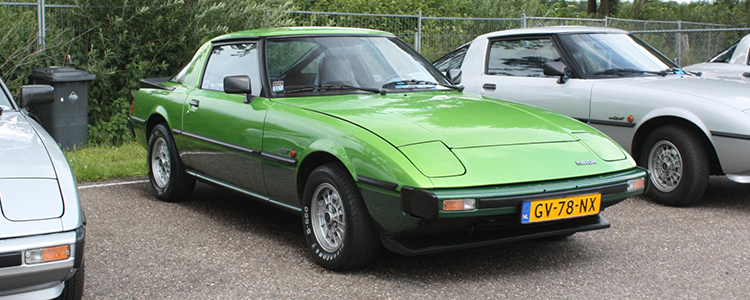
The Buyer's Read
If you're buying an SA22C, start with the shell. A rust-free Series 2 or Series 3 FB with documentation is worth more than a Series 1 with a fresh engine and bubbled rockers. The 12A rebuild is a known number, usually $3,500 to $8,000 for good work, but cutting rust out of an SA22C monocoque can run past $10,000 if it's bad and there's no ceiling on how bad it can get. Buy the cleanest shell you can afford and worry about the engine second.
The sweet spot for most US buyers is a documented 1984 to 1985 GSL-SE. That gives you the fuel-injected 13B at 135 hp, the factory LSD, four-wheel discs, and the duck-tail spoiler that defines the late FB look. These cars are still findable but the clean ones are climbing fast, and the GSL-SE-specific parts like the 13B fuel injection are harder to source than the 12A bits that cross to other Series 1 and 2 cars. If you can find one with the original engine and paperwork to match, pay the premium.
The SA22C to avoid is a cheap Series 1 car with no records and a recent repaint. Rust hides under fresh paint and the 12A doesn't tell you it's tired until it's hot. Do a warm compression test before you do anything else. If the seller won't let you do one, walk away. The other car to avoid is an FB with a non-rotary swap. The SA22C is worth the most as a rotary car, and an LS or 13B-REW swap narrows your buyer pool down to the small group that wants that specific build. The JDM-only Savanna RX-7 Turbo is the rarest variant on this side of the Pacific, but it's also the hardest to register and the hardest to source parts for, so go in knowing what you're signing up for.
Frequently Asked Questions
- What’s the difference between SA22C and FB?
- SA22C is early Gen 1; “FB” commonly refers to later updates. Focus on rust, spec, and history over badge wording.
- Which SA/FB RX-7 is most collectible?
- Generally GSL-SE and clean late cars with original trim/colors. Condition and documentation can outweigh trim level.
- What should I check first when inspecting one?
- Start with rust (sills/floors/strut towers) and compression. A clean shell is worth paying for.
- How do I tell if the rotary needs a rebuild?
- Look for hard hot starts, low power, smoke, and poor compression test results. Budget for a rebuild if numbers are weak.
- Are modified SA22C cars worth less?
- Usually yes at the top end. Tasteful period mods can be fine; swaps/widebodies often reduce buyer pool and ceiling.
- What’s the best use-case for an SA22C today?
- Best as a weekend classic and cars-and-coffee car. It’s charming, but age and parts needs make daily use harder.
- What options/features add value?
- Original paint/trim, factory wheels, A/C presence, uncut interior, and service records. Rare colors and stock stance help.
Sources & References
- Mazda RX-7 SA22C — JDM Buy Sell wiki (source article) — JDM Buy SellVerified
- Mazda RX-7 — encyclopedic overview — WikipediaVerified
- Mazda RX-7 (first generation) — dedicated SA22C/FB article — WikipediaVerified
- Mazda Wankel engine — 12A and 13B development history — WikipediaVerified
- Mazda Savanna — JDM nameplate history — WikipediaVerified
- Bring a Trailer — RX-7 first-gen auction archive — Bring a TrailerVerified
- Classic.com — Mazda RX-7 1st-gen market data — Classic.comVerified
- How the Mazda RX-7 saved the rotary engine — Road & TrackVerified
- Hagerty Valuation Tools — Mazda RX-7 (1979–85) — HagertyVerified
Sources last verified: