Key Takeaways
The FC3S ran for seven years and Mazda split it into two series. Series 4 cars came out from 1985 to 1988 with a 7,000 rpm redline. Series 5 cars ran from 1989 to 1992 with thicker rotor housings and an 8,000 rpm redline. The S5 is generally considered the better FC to own. It runs cooler, takes a tune better, and the interior is the one that aged with the least pain. The S4 is the cheaper way into an FC if you want the earlier look.
- Turbo II and clean, stock cars command the premium
- Rust + mods drive the biggest price swings
- S4 vs S5 matters: S5 generally more desirable
- Rotary health (compression) is the #1 buy check
- Track/drift builds are common but hurt collector value
- FD effect lifts FC prices as a cheaper RX-7 entry
Technical Specifications
Every FC runs a 1.3 liter 13B twin-rotor. The NA version makes 146 hp in the US and 160 PS in Japan. The 13B-T Turbo II adds an intercooler and a Hitachi turbo for 182 to 200 hp depending on year and market. The Infini cars push that to 215 PS. Manual transmission is the one to buy. The 4-speed automatic in the NA cars works fine but it's not why you bought an FC.
Engine Options
| Engine | Displacement | Power | Boost | Notes |
|---|---|---|---|---|
| 13B (NA, 6-port) | 1.3L | 160PS @ 6500rpm | N/A | JDM NA; 6-port intake |
| 13B-T (turbo, intercooled) | 1.3L | 185PS @ 6500rpm | 7.3 psi | JDM S4 turbo (estimated boost) |
| 13B-T (turbo, intercooled) | 1.3L | 205PS @ 6500rpm | 7.3 psi | JDM S5 turbo (estimated boost) |
| 13B-T (turbo, intercooled) | 1.3L | 215PS @ 6500rpm | 7.3 psi | Infini; factory-rated PS |
| 13B (NA) | 1.3L | 146hp @ 6500rpm | N/A | US spec NA; emissions calibration |
| 13B-T (turbo, intercooled) | 1.3L | 182hp @ 6500rpm | 7.3 psi | Turbo II; boost estimated |
| 13B-T (turbo, intercooled) | 1.3L | 200hp @ 6500rpm | 7.3 psi | Turbo II (late); boost estimated |
| 13B (NA) | 1.3L | 150PS @ 6500rpm | N/A | EU NA; market-dependent rating |
| 13B-T (turbo, intercooled) | 1.3L | 200PS @ 6500rpm | 7.3 psi | EU turbo; boost estimated |
Transmission Options
| Type | Ratios | Availability | Notes |
|---|---|---|---|
| 5-speed Manual | 3.483/2.015/1.391/1.000/0.719 | NA & Turbo (market-dependent) | Common FC 5MT (ratios vary by market) |
| 5-speed Manual (Turbo II) | 3.483/2.015/1.391/1.000/0.719 | Turbo II/GT-X/GT-R | Turbo-spec 5MT; ratios market-dependent |
| 4-speed Automatic | 2.800/1.540/1.000/0.700 | NA & Convertible (common) | Electronically controlled 4AT |
Livability
- Headroom
- 37.0"
- With sunroof/helmet, tall drivers may rub
- Rear Seats
- 2+2 (tight)
- Kids only; adults short trips, low roofline
- Cargo
- 7.5 cu ft
- Hatch usable but shallow; spare well helps
Variants & Trims
JDM Turbo cars were sold as the GT-X, GT-R, and GT-Limited. The NA versions were the GT and the G. The US got it simpler with the Base, GXL, and the Turbo II. Europe just called the Turbo car the RX-7 Turbo. The Infini I through IV are JDM only and came with Bilstein dampers, BBS wheels, and an LSD. The convertible launched in 1988 and was only sold with the NA 13B in every market.
| Generation | Trim | Engine | Key Features |
|---|---|---|---|
| FC (Series 4, JDM) | GT-X | 13B-T (turbo, intercooled) | Turbo, intercooler, LSD (opt), sport suspension |
| FC (Series 4, JDM) | GT-R | 13B-T (turbo, intercooled) | Turbo, intercooler, LSD, sport seats |
| FC (Series 4, JDM) | GT-Limited | 13B-T (turbo, intercooled) | Turbo, leather (opt), power equip, A/C |
| FC (Series 4, JDM) | GT | 13B (NA) | NA, lighter spec, 5MT/4AT, A/C opt |
| FC (Series 4, JDM) | G | 13B (NA) | NA, base trim, 5MT/4AT, cloth |
| FC (Series 4, JDM) | Cabriolet | 13B (NA) | Convertible, NA, 4AT common, power top |
| FC (Series 5, JDM) | GT-X | 13B-T (turbo, intercooled) | Turbo, intercooler, updated ECU, LSD (opt) |
| FC (Series 5, JDM) | GT-R | 13B-T (turbo, intercooled) | Turbo, intercooler, LSD, sport suspension |
| FC (Series 5, JDM) | GT-Limited | 13B-T (turbo, intercooled) | Turbo, power equip, A/C, leather (opt) |
| FC (Series 5, JDM) | Infini | 13B-T (turbo, intercooled) | Turbo, Bilstein, BBS, LSD, special trim |
| FC (Series 5, JDM) | GT | 13B (NA) | NA, 5MT/4AT, A/C opt, power equip opt |
| FC (Series 5, JDM) | G | 13B (NA) | NA, base trim, 5MT/4AT, cloth |
| FC (Series 5, JDM) | Cabriolet | 13B (NA) | Convertible, NA, power top, 4AT common |
| FC (North America) | RX-7 (Base) | 13B (NA) | NA, 5MT/4AT, cloth, A/C opt |
| FC (North America) | RX-7 Turbo II | 13B-T (turbo, intercooled) | Turbo, intercooler, 5MT, LSD, 4-wheel discs |
| FC (North America) | RX-7 Convertible | 13B (NA) | Convertible, NA, 5MT/4AT, power top |
| FC (Europe/UK) | RX-7 (NA) | 13B (NA) | NA, 5MT, cloth/leather (opt), ABS (opt) |
| FC (Europe/UK) | RX-7 Turbo | 13B-T (turbo, intercooled) | Turbo, intercooler, 5MT, LSD (opt), ABS (opt) |
Should You Buy a Mazda Rx 7 FC3S?
The FC is a cheap rotary RX-7 that drives better than it has any right to at the price. That's the whole pitch. What you give up is the maintenance schedule of a normal car and the freedom of not thinking about compression numbers. If you're okay with both of those, the FC is one of the best deals in 80s JDM. If you're not, buy something else.
Why You'll Love It
- Strong value vs FD RX-7 Classic RX-7 feel with lower entry cost; still rising but not FD-level.
- Balanced chassis, great steering Front-mid layout and light weight deliver communicative, playful handling.
- Turbo II tuning potential Turbo cars respond well to sensible mods; big gains with supporting upgrades.
- Iconic 80s/90s design Pop-ups and period styling have strong nostalgia demand and broad appeal.
- Parts/support community Deep rotary knowledge base; aftermarket and specialist support remain strong.
Why You Might Not
- Rotary rebuild cost risk Low compression or poor maintenance can mean a rebuild; budget accordingly.
- Heat management sensitivity Cooling and oiling must be right; neglect leads to expensive failures.
- Rust and prior crash repairs Sills, arches, strut towers, and underbody rust can be deal-breakers.
- Heavily modified market Many drift/track builds; clean OEM examples are scarce and priced higher.
- Turbo II originality premium Correct Turbo II parts/ECU/intercooling matter; swaps and missing bits hurt value.
Who Should NOT Buy This
- Anyone needing reliable daily transport
- Owners who won't do frequent checks/top-offs
- People without a rotary-savvy shop nearby
- Budget buyers who can't afford a rebuild
- Short-trip drivers (flooding and plug fouling)
- Hot-climate drivers without cooling upgrades
- Emissions-strict areas with modified cars
- Anyone expecting modern safety or NVH comfort
Common Issues & Solutions
Most FC problems trace back to the rotary itself or to age. The big one is compression loss from worn apex seals, and once that starts there's no fix that isn't a full rebuild. The other recurring headaches are overheating in traffic, the vacuum hose mess on Turbo II cars, and rust in the arches and sills. None of these are unfixable. They just stack up fast on a neglected FC.
| Issue | Cause | Solution | Est. Cost |
|---|---|---|---|
| Low compression / hard hot start | Worn apex/side seals from heat or neglect | Budget rebuild; verify cooling and tune first | $4000-9000 |
| Coolant seal failure | Overheating warps housings; old seals | Rebuild with new seals; fix cooling root cause | $4500-10000 |
| Flooding on cold start | Weak ignition, short trips, bad start technique | Refresh ignition; clear-flood procedure; tune | $300-1200 |
| Overheating in traffic | Clogged rad, missing shroud, bad fan control | New rad/thermo, proper shroud, fan wiring | $400-1500 |
| Vacuum hose nightmare (TII) | Aged hoses, wrong routing, deleted solenoids | Replace all hoses; restore routing or simplify | $150-1200 |
| Turbo smoking / low boost (TII) | Worn turbo seals/bearings; oiling issues | Rebuild/replace turbo; check restrictor/lines | $900-2500 |
| Detonation on boost (TII) | Lean from fuel issues or bad tune; heat soak | Fuel system service; conservative tune; intercool | $500-3000 |
| Ignition coil/lead failure | Heat and age; aftermarket mismatched parts | Quality coils/leads/plugs; set dwell correctly | $250-900 |
| Oil leaks everywhere | Old O-rings, front cover seals, pan gasket | Reseal front cover/pan; replace brittle O-rings | $400-1800 |
| 2nd gear grind (manual) | Worn synchro; old fluid; aggressive shifts | Fluid helps short-term; rebuild trans for fix | $150-2500 |
| Diff clunk/whine | Worn mounts, backlash, old bearings | Mounts/bushings; rebuild diff if noisy | $200-1800 |
| Rust in arches/sills | Trapped moisture; poor past repairs | Cut/weld properly; avoid filler-only fixes | $800-6000 |
| Electrical gremlins | Bad grounds, hacked wiring, old connectors | Ground refresh; repair harness; delete bad splices | $150-1500 |
| Sticking brake calipers | Old seals, corrosion, infrequent use | Rebuild calipers; new hoses; flush fluid | $300-1200 |
Differences between JDM & USDM
USDM buyers got three FC trims across the 1986–1991 model years: the naturally aspirated RX-7 (Base), the RX-7 GXL (mid-grade NA with leather and power features), and the RX-7 Turbo II (intercooled 13B-T, 5-speed only, LSD standard, 4-wheel disc brakes). A GTU trim — an NA stripped down for the SCCA Showroom Stock series — was offered for 1989 only. The JDM lineup was wider: GT-X, GT-R, GT-Limited (turbo trims), GT (NA sport), G (NA base), Cabriolet, and the four ∞ (Infini) limited editions — I (1989), II (1990), III (1991), and IV (1992) — each adding Bilstein dampers, BBS wheels, revised front lip, and trim-specific colors. The ∞ cars were never federalized for the US market and only reach North America under the 25-year import rule (Infini I became US-legal in 2014, IV in 2017). European markets received the NA and Turbo as 'RX-7 Turbo'; Australia got both NA and Turbo II badged as 'Series 4' and 'Series 5'. Right-hand drive on JDM cars, left-hand drive on all USDM/European cars except UK.
Pre-Purchase Inspection Checklist
The compression test is the one check that decides everything else. If the numbers come back weak, the rest of the inspection doesn't matter, you're buying a rebuild. The Critical items below are the deal breakers without paperwork. The High items can be priced into the offer. Don't skip the rust walk under the car, the FC hides rust in places you can only see from underneath.
Critical Priority
- Compression test Warm rotary comp test; even faces, strong numbers
- Hot start behavior Restart hot; long crank = weak seals/flooding
- Cooling system Check rad, fans, shroud; any overheating history
- Coolant seals Look for coolant loss, sweet smell, milky residue
High Priority
- Oil metering pump Verify OMP works; lines intact; no premix-only hack
- Turbo health (TII) Shaft play, smoke on boost, boost creep/spike
- Vacuum lines Cracked hoses cause bad idle/boost control issues
- Fuel system Check pump noise, filter age, injector leaks
- Ignition system Coils/leads/plugs age; misfire under load
- Trans & diff 2nd gear grind, diff whine, clunk on throttle
- Rust: sills/arches Inspect rear arches, sills, hatch channel bubbling
- Rust: strut towers Check front/rear towers for cracks/rust repairs
- Accident damage Look for apron/rail pulls, uneven gaps, overspray
- ECU/AFM tamper Check hacked wiring, piggybacks, missing sensors
Medium Priority
- Oil leaks Front cover, pan, rear main; soaked crossmember
- Driveshaft/PPF Check PPF alignment; vibration on accel/decel
- Steering rack Leaks at boots, play at wheel, pump whine
- Brakes Sticking calipers, soft pedal, old rubber lines
- Electrical grounds Corroded grounds cause weird idle/sensor issues
Generation History
FC3S Series 4 (S4) (1986-1988)
- Early FC; lighter, simpler electronics
- NA and Turbo trims; analog driving feel
- More age-related wear; many modified
FC3S Series 5 (S5) (1989-1991)
- Refreshed interior/exterior; updated systems
- Turbo II most sought-after FC variant
- Best balance of usability and purity
Sales Numbers by Year
| Year | Total | Notes |
|---|---|---|
| 1985 | 0 | JDM launch in October 1985 (Series 4); US sales began as 1986 model |
| 1986 | — | USDM launch including Turbo II; specific year-by-year FC totals not published by Mazda |
| 1988 | — | Convertible launched (NA only); Series 4 final year |
| 1989 | — | Series 5 facelift; thicker rotor housings, 8,000 rpm redline, revised aero; Infini I introduced (JDM only) |
| 1990 | — | Infini II (JDM only) |
| 1991 | — | Infini III (JDM only); final US model year |
| 1992 | — | Infini IV (JDM only); final FC production year; FD3S launched in October |
Market Data
Production Numbers & Rarity
| Generation | Years | Total Built | Notes |
|---|---|---|---|
| FC (Series 4) | 1985-1988 | estimated | Exact S4 global totals not published |
| FC (Series 5) | 1989-1991 | estimated | Exact S5 global totals not published |
| FC (all) | 1985-1991 | ~272,000 (estimated) | Commonly cited global FC production estimate |
Rarest variant: Infini
Original MSRP & Pricing
Original MSRP: $13,300 at launch in 1986. USDM launch price of the 1986 Mazda RX-7 (base, NA 13B). The 1986 Mazda RX-7 Turbo II launched at approximately $19,300. JDM Series 4 pricing was set in yen and varied by trim — GT-X opened around 2.43 million yen in 1985. The Lexus LS and German competitors quoted elsewhere are not direct rivals; the FC's price benchmark was the Porsche 944 (around $22,500 in 1986).
How It Compares
In the late 80s the FC's rivals were the Nissan 300ZX Z31 Turbo and the Toyota Supra MA70 Turbo. The FC is the lightest of the three and the most agile. The Z31 is the easiest to live with. The MA70 has the strongest collector pull today. The table below leans toward the FC's strengths on weight and handling, because that's where it actually wins.
| Feature | FC3S | Nissan 300ZX Z31 Turbo | Toyota Supra MA70 Turbo |
|---|---|---|---|
| Power output | Turbo II ~182-200 hp | 200 hp | 200 hp |
| Curb weight | ~2,700-2,900 lb | ~3,200-3,400 lb | ~3,200 lb |
| Driving feel | Light, agile, rotary revs | GT feel, stable, heavier | GT cruiser, torque bias |
| Reliability profile | Rotary upkeep critical | VG30ET robust; age issues | 7M-GTE head gasket risk |
| Collector demand | Rising; Turbo II leads | Moderate; clean turbos rising | Strong; JDM turbo premiums |
| Mod culture impact | Many drift builds; stock rare | More survivors; mild mods common | Tuning popular; OEM JDM prized |
Comparable Alternatives
If the FC ends up being too much rotary maintenance, the natural alternative is a Nissan Silvia S13 or a Toyota MR2 SW20. Both give you the analog 80s and 90s feel without the apex seal lottery. If you want the next step up in RX-7, the FD3S is the obvious upgrade, but you'll pay double or triple. The Z31 300ZX and MA70 Supra are the heavier GT alternatives from the same era.
Mazda RX-7 FD3S
Next-gen halo RX-7; pricier but strongest demand
Nissan 300ZX Z31 Turbo
Similar era turbo coupe; more GT, often cheaper to run
Toyota Supra MA70 Turbo
80s turbo icon; heavier GT feel, strong nostalgia pull
Nissan Silvia S13
Light RWD coupe; huge parts support, less rotary-specific risk
Toyota MR2 SW20
Analog 90s sports car; mid-engine feel, strong community support
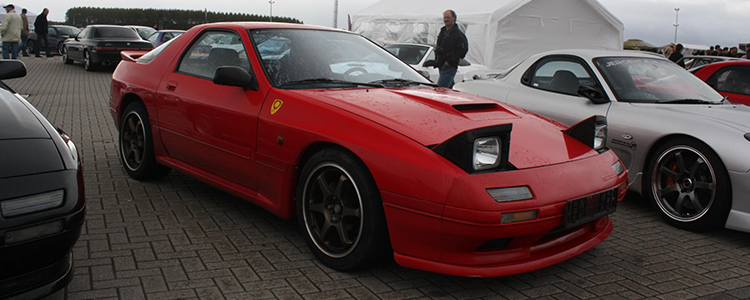
In Pictures
The Buyer's Read
If you're buying an FC3S, the safest place to start is a documented 1989 to 1991 Series 5 Turbo II with a manual and a clean rust report. That gives you the thicker rotor housings, the 8,000 rpm redline, the larger injectors, and the revised intake. It's the FC that takes a sensible boost-up tune the best. Plan on around 25 to 35 thousand for a clean stock S5 Turbo II in today's market. Cheap FCs under 10 thousand are mostly modified drift cars or NA cars with question marks on the compression numbers, and that's not where you want to start.
The number one buy check is a hot rotary compression test. Not cold, hot. A healthy 13B should read above 100 psi per face at cranking speed, and the three faces on each rotor should be even. If the numbers are uneven or below 85 psi, you're looking at a rebuild. A rebuild on a 13B-T runs 4,500 to 10,000 depending on who does the work and what supporting parts go in with it. Bake that into the offer or walk away.
The Series 4 cars are the value entry point if you want the pre-facelift look with the square tail lamps and the four-lug wheels. The S4 redlines at 7,000 rpm and the electronics are simpler, but the rotor housings are thinner and the ECU calibration is older. They're harder to tune. A clean unmolested S4 NA is a great first rotary if you have a budget for a refresh and a shop that knows the engine.
The one FC to avoid is a heavily modified drift car with no paperwork on the rebuild. The chassis is fine but the engine has usually lived a hard life, and once you start chasing the previous owner's wiring decisions and vacuum routing you're in a hole. If the build is documented and the compression numbers check out, that's a different conversation. Without the paperwork it's a parts car at parts car money.
Frequently Asked Questions
- Which FC is most valuable?
- Generally the Series 5 Turbo II (1989-1991) in stock, rust-free condition with documentation.
- What’s the #1 thing to check before buying?
- A rotary compression test (hot) plus proof of cooling/oil system maintenance.
- Are modified FCs worth less?
- Usually yes. OEM/period-correct mods can be okay, but heavy drift builds often trade at a discount.
- Common rust areas on FC3S?
- Check sills/rockers, rear arches, strut towers, spare tire well, and underbody seams.
- Turbo II vs NA: which should I buy?
- Turbo II for performance and resale; NA for simplicity and lower buy-in—condition matters most.
- What documentation adds value?
- Records for engine rebuild, cooling refresh, and oil metering/premix habits help pricing.
- Will FC prices keep rising?
- Clean, stock Turbo II cars likely stay firm; rough/modded cars are more volatile with higher risk.
Sources & References
- Original WordPress source — Mazda RX-7 FC3S buying guide — JDMBUYSELLVerified
- Mazda RX-7 — encyclopedic overview (FC generation section) — WikipediaVerified
- Mazda RX-7 (FC) — Japanese encyclopedic overview — Wikipedia (Japanese)Verified
- Mazda RX-7 FC auction results — Bring a TrailerVerified
- Mazda Wankel engine — design and development history — WikipediaVerified
- Mazda RX-7 FC auction results (multi-generation index) — Bring a TrailerVerified
- Wankel engine — operating principles and history — WikipediaVerified
- Cars & Bids RX-7 FC auction results — Cars & BidsVerified
Sources last verified: