Today, surviving CA71/CA72 cars are scarce in the export market. Most early Altos were daily-driven into the ground, scrapped under Japan's shaken inspection regime, or rotted out. Documented Works variants — especially Juna and early Works RS-X cars — are valued more for their place in the kei-performance lineage than for their driving dynamics; the F5A turbos make modest peak power and the chassis is short and twitchy by modern standards. Inspect underbody, sills and strut towers carefully; verify the export certificate matches the chassis plate; budget for an exhaust and brake rebuild on any car this age.
Buyer's guide
Suzuki Alto CA71 — Buyer's Guide & Specs
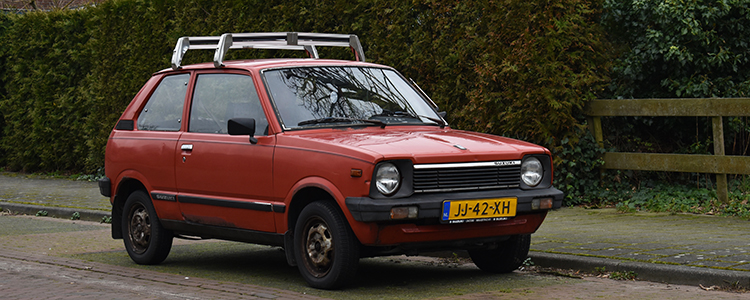
The second-generation Alto (CA71V/CA72V, 1984–1988) refined the formula introduced by the SS30: same F5A 547cc three-cylinder, same kei commercial-vehicle registration, but a more modern body, improved NVH and the first DOHC head option in 1985. The Alto Juna (1985) was the first turbocharged Alto in the model's history, and the Alto Works name made its debut on the CA72V in February 1987 — that car is the genesis point for every kei hot-hatch that followed.
Looking to buy?
Browse Suzuki Alto listings →
Key Takeaways
The Alto has been around since 1979 and every generation feels like a different car. The early SS30 and CA71 cars are tiny 550cc time capsules and pretty hard to find now. The CM and HA11 are where the Alto Works turbo lineage really lands, and the HA24 and HA36 are the modern kei Altos most buyers actually drive.
- Best value as a city runabout; ultra-low fuel/parts costs
- Alto Works/RS are the collectible trims with premiums
- Rust and neglect matter more than mileage on cheap examples
- Kei rules limit power; highway comfort is the trade-off
- Import legality: 25-year rule drives demand for JDM kei
- Auto vs manual: manuals hold value and feel less strained
Technical Specifications
Every Alto is a three-cylinder kei car. The early ones used the F5A 547cc, then the F6A 660cc came in with the 1990 kei rule change, and the K6A 660cc took over from 1998. The Works trim adds a turbo and roughly doubles the power. Manual gearboxes are mostly 5-speeds and the automatics are 3 or 4-speed depending on the year.
Engine Options
| Engine | Displacement | Power | Boost | Notes |
|---|---|---|---|---|
| F5A | 0.55L | estimated | N/A | Market/year dependent; confirm by submodel |
Transmission Options
| Type | Ratios | Availability | Notes |
|---|---|---|---|
| 5-speed Manual | varies by gen | Most gens/trims (market dep.) | Exact ratios differ by chassis/engine |
| 3-speed Automatic | varies by gen | Older gens (market dep.) | Early AT; confirm by year/submodel |
| 4-speed Automatic | varies by gen | HA23/HA24/HA25 (market dep.) | Jatco/Aisin variants by application |
| CVT | varies by gen | HA25/HA36/HA37/HA97 (market dep.) | Pulley ratio + final drive varies |
| 5-speed AGS (Automated Manual) | varies by gen | HA36 Turbo RS/Works (market dep.) | Single-clutch automated manual |
Livability
- Headroom
- 38.0"
- Tall drivers fit, but upright seating feels tight
- Rear Seats
- 2 adults short trips
- Knees tight behind tall driver; best for kids
- Cargo
- 6-12 cu ft
- Small hatch; usable with seats folded, tall load lip
Variants & Trims
Alto trims are pretty simple. Base passenger cars, commercial vans with vinyl floors and fewer seats, and the Works hot-hatch with the turbo. The Mighty Boy from the SS40 era is a kei pickup truck spin-off and worth knowing about if you want something weirder. Most of the price difference between trims comes down to whether it's a Works or not.
| Generation | Trim | Engine | Key Features |
|---|---|---|---|
| CA71 (2nd gen, Japan) | Alto (base) | F5A 0.55L I3 NA | Kei hatch, improved NVH, light weight |
| CA71 (2nd gen, Japan) | Alto (Van/Commercial) | F5A 0.55L I3 NA | Commercial grade, vinyl trim, utility focus |
Should You Buy a Suzuki Alto CA71?
The Alto is one of those cars where the trade-offs are obvious from the spec sheet. You're getting cheap, light, and easy to live with. What you give up is highway comfort and any kind of power. If that sounds like your kind of car you'll love it.
Why You'll Love It
- Extremely low running costs High mpg, small tires/brakes, simple service; ideal for budget ownership.
- City-friendly size Tiny footprint, tight turning circle, easy parking; great for dense areas.
- Simple, durable kei hardware Many trims use proven small engines; basic layouts keep repairs straightforward.
- Strong JDM kei enthusiast support Aftermarket for Works/RS; community knowledge helps sourcing and maintenance.
- Surprisingly fun in turbo trims Alto Works/RS deliver lively boost in a light shell; great backroad pace.
- Import novelty with practicality Kei charm plus real usability; good conversation piece without supercar costs.
Why You Might Not
- Rust and corrosion risk Older JDM kei often rust at sills/arches/underbody; repairs can exceed value.
- Highway comfort limitations Short wheelbase, light weight, and gearing make long trips noisy and tiring.
- Safety and crash standards vary Older generations lack modern airbags/structure; buyers must accept trade-offs.
- Parts availability by generation Early gens and Works-specific bits can be scarce outside Japan; plan ahead.
- Many cars are heavily used Fleet/commuter life means worn interiors, tired suspension, deferred service.
- Automatic/CVT can feel strained Small displacement plus auto gearing reduces performance; manuals age better.
Who Should NOT Buy This
- Anyone needing highway passing power
- Drivers doing 75+ mph daily in windy areas
- People who refuse frequent maintenance
- Buyers without access to small-car specialists
- Those needing strong crash safety vs modern cars
- Anyone needing 4 adults comfortably
- Tall drivers needing lots of legroom
- People who hate cabin noise and vibration
- Owners in rust-belt without undercoating plans
- Anyone expecting cheap automatic/CVT repairs
- Buyers needing towing capability
- People needing large cargo or stroller space
- Those who can't tolerate slow A/C in extreme heat
- Anyone who won't verify import/title paperwork
- Drivers wanting modern infotainment and safety tech
- People who can't source parts or wait for shipping
- Owners who won't budget for suspension refresh
- Anyone who ignores warning lights and keeps driving
Common Issues & Solutions
The Alto is a simple car and most of what goes wrong is age, not engineering. Rust is the big one, especially on the sills and rear arches. The Works turbo cars need their oil changes done on time or the F6A turbo bearings cook themselves. Suspension bushings and exhaust hangers wear out on any Alto past 25 years old.
| Issue | Cause | Solution | Est. Cost |
|---|---|---|---|
| Rust in sills/underbody | Thin paint, trapped moisture, salted roads | Inspect/repair weld patches; undercoat; avoid rot | $800-4000 |
| Strut tower rust/cracks | Corrosion + pothole loads on thin metal | Immediate repair; plate/weld; align afterwards | $1200-4500 |
| Rear wheel arch rust | Mud traps at lip; poor drainage | Cut/replace arch sections; treat cavities | $600-2500 |
| Water leaks into cabin | Cowl drains clogged; door/hatch seals aged | Clear drains; replace seals; dry carpets fully | $150-900 |
| Overheating in traffic | Fan motor/relay failure or clogged radiator | Test fan circuit; replace fan/radiator; bleed | $250-900 |
| Radiator plastic tank crack | Age heat-cycles; brittle plastic end tanks | Replace radiator/cap; refresh hoses if swollen | $200-650 |
| Thermostat stuck | Cheap coolant, corrosion, age | Replace thermostat and gasket; flush coolant | $120-350 |
| Head gasket failure | Chronic overheating or neglected coolant | Machine head, new gasket/bolts; fix root cause | $900-2200 |
| Oil consumption/smoke | Worn rings/valve seals; long oil intervals | Compression test; rebuild or engine swap | $1200-3500 |
| Timing belt overdue (some) | Unknown history; skipped interval | Replace belt, tensioner, water pump, seals | $450-1100 |
| Timing chain rattle (some) | Stretched chain/tensioner wear from dirty oil | Replace chain kit; verify oil pressure | $700-1600 |
| Rough idle/stalling | Dirty throttle body/IAC; vacuum leaks | Clean TB/IAC; smoke test; replace cracked hoses | $120-600 |
| Misfire under load | Worn plugs, coils/leads, weak fuel pressure | Tune-up; test coils; fuel pressure test/pump | $120-900 |
| O2 sensor aging | High mileage; contamination from oil burning | Replace upstream O2; check for exhaust leaks | $150-450 |
| Catalytic converter clog | Oil burning/misfire overheats cat | Fix misfire; replace cat; verify backpressure | $500-1800 |
| Manual 2nd gear grind | Synchro wear; wrong/old gear oil | Change oil; if persists rebuild gearbox | $120-1800 |
| Clutch slip/shudder | Worn disc/pressure plate; oil contamination | Replace clutch kit; resurface flywheel; fix leaks | $500-1200 |
| CVT shudder/failure | Neglected fluid; overheating; belt/pulley wear | Fluid service early; rebuild/replace if slipping | $900-3500 |
| 4AT shift flare (if auto) | Worn solenoids/clutches; old ATF | ATF service; solenoid body; rebuild if burnt | $250-2800 |
| CV joint clicking | Torn boots; grease loss; joint wear | Replace axle or reboot early; align after | $200-650 |
| Wheel bearing hum | Water intrusion; pothole impacts | Replace hub/bearing; torque to spec | $250-700 |
| Steering rack leak/clunk | Worn inner joints/seals; torn boots | Replace rack or rebuild; align; replace tie rods | $600-1600 |
| Suspension bushing wear | Age, heat, cheap rubber; rough roads | Replace control arms/bushes; alignment | $300-1200 |
| Brake line corrosion | Road salt; poor underbody coating | Replace hard lines; flush fluid; inspect all | $400-1500 |
| Caliper slide seizure | No grease service; torn boots | Service slides; replace calipers if pitted | $150-600 |
| ABS sensor faults | Broken wiring at hubs; rusted tone rings | Repair harness; replace sensor; clean tone ring | $150-650 |
| A/C weak or not cold | Condenser leak; compressor wear; O-rings | Leak test; replace parts; evac/recharge properly | $200-1200 |
| Blower resistor failure | Heat stress; debris in blower | Replace resistor; clean blower and cabin intake | $80-250 |
| Window regulator failure | Cable fray; dry tracks; motor strain | Replace regulator; lube tracks; check seals | $150-450 |
| Charging system weak | Alternator wear; bad grounds; small battery | Load test; replace alternator; clean grounds | $200-650 |
| Fuel pump weak/no start | Age; running low fuel overheats pump | Test pressure; replace pump and strainer | $250-800 |
| Exhaust leaks/rust | Thin exhaust steel; short trips condensation | Replace sections; check hangers; new gaskets | $200-900 |
| Interior rattles | Lightweight trim; broken clips | Replace clips/felt tape; tighten seat/trim bolts | $20-250 |
Differences between JDM & USDM
The Suzuki Alto has never been federalised for the United States. The car sold in dozens of other markets — as the Suzuki Alto in Europe, the Maruti Alto in India (where it became one of the best-selling cars in the world), the Suzuki Mehran in Pakistan, and badge-engineered as the Holden Barina and Pontiac Firefly in Australia and Canada — but North American buyers can only access the JDM Alto under the federal 25-year rule (or, in Canada, the 15-year rule that opens the door to HA22S Works cars now). The export-market Marutis built in India share the SS80 and successor platforms but were tuned for different fuel quality, emissions and crash standards, and they are not interchangeable with JDM cars on parts. Gray-market Alto Works cars are the high-value imports; base JDM Altos are the cheap kei-novelty entry point at the $3,000–$6,000 floor.
Pre-Purchase Inspection Checklist
Walk this list with the seller, not in front of them. The Critical items mean walking away if there's no paperwork. The High items can usually be priced into the deal. The Alto is small enough that 20 minutes with a flashlight under the car will tell you most of what you need to know.
Critical Priority
- VIN/Chassis Plate Match VIN on body/plate/title; look for tamper
- Import/Title Status Verify legal import, title type, liens, back fees
- Frame/Underbody Inspect rails/floor for rust perforation or bends
- Strut Towers Check front/rear towers for cracking or rust
- Exhaust Smoke Blue on rev = rings/valve seals; white sweet = HG
- Auto/CVT Behavior Check flare, shudder, delayed engagement, whine
- Brake Lines Inspect hard lines for rust; flex hoses for cracks
- Fuel Smell/Leaks Check tank neck, lines, injector seals for seepage
- Seatbelt Function Check retractors/pretensioner lights; safety critical
- Airbag Light Ensure SRS light proves out; no tape-over tricks
High Priority
- Odometer Credibility Check auction sheets/service stickers for rollback
- Accident Evidence Check core support seams, overspray, uneven gaps
- Sills/Rocker Panels Probe pinch welds/rockers; bubbling = hidden rot
- Rear Wheel Arches Look inside lip for rust; check filler/paint match
- Spare Tire Well Lift carpet; check standing water, rust, seam sealer
- Cooling System Check radiator tanks, hoses, cap; look for stains
- Coolant Condition Oil in coolant or rusty coolant = neglect/head risk
- Cold Start Behavior Listen for chain rattle/tappet noise; watch smoke
- Compression/Leakdown Test if possible; low cyl points to rings/valves
- Timing Belt/Chain Confirm service history; belt age unknown = replace
- Manual Gearbox Check 2nd synchro grind; feel for notchiness
- ATF/CVT Fluid Check level/color/burnt smell; ask for change proof
- Clutch Operation High bite/slip in 3rd gear pull; check pedal feel
- Driveshaft/CV Boots Look for torn boots/grease sling; click on turns
- Steering Rack Check for leaks, torn boots, clunk over bumps
- Power Steering EPS light or heavy steering; scan for codes
- ABS Warning Check ABS light bulb works; scan for wheel sensors
- Scan for Codes OBD scan if supported; check pending codes too
- Cooling Fan Confirm fan cycles; overheating in traffic if not
- Interior Water Leaks Check wet carpets; musty smell; inspect under mats
- Braking From Speed Hard stop test; ABS function; no steering shake
- Service Records Look for oil changes, coolant, trans fluid, belts
Medium Priority
- Windshield Cowl Check for leaf clog; water leaks into cabin/ECU
- Door Bottoms Check drain holes; rust from trapped water
- Hatch/Trunk Seals Check seal tears; water ingress and mold smell
- Oil Leaks Check valve cover, timing cover, oil pan, rear main
- Idle Quality Hunting idle suggests vacuum leak/dirty throttle/IAC
- Engine Mounts Excess vibration/clunk on shift indicates mounts
- Wheel Bearings Listen for hum; check play at 12/6 o'clock
- Suspension Bushings Check control arm, trailing arm, sway links for play
- Shocks/Struts Bounce test; look for oil seep and uneven tire wear
- Brake Feel Pulsation = warped rotors; pull = caliper/hoses
- Tires Check date codes; mismatched tires affect stability
- Battery/Charging Test alternator output; dim lights at idle = weak
- Grounds/Corrosion Check battery terminals/grounds; weird faults result
- Air Conditioning Check cold vent temp; compressor noise; leaks at lines
- Heater Output Weak heat suggests stuck thermostat or clogged core
- Fuel Pump Noise Loud whine indicates tired pump; check pressure
- Window Regulators Slow/stuck windows; listen for cable crunch
- Instrument Cluster Check dead pixels/needles; verify speedo accuracy
- Test Drive NVH Listen for clunks, rattles, driveline vibration
- Highway Stability Check wander; alignment or worn bushings common
Low Priority
- Accessory Belt Check cracking/squeal; inspect tensioner play
- Door Locks/Key Check central locking; worn keys/ignition barrels
- Lights & Lenses Check hazed lamps, water in lenses, all bulbs work
- Wiper System Check intermittent works; washer pump and jets
- Spare/Jack Tools Confirm jack, wrench, tow hook present
Generation History
SS30/40 (1st gen) (1979-1984)
- Kei hatch; ultra-light, simple carb engines
- Early Alto identity: cheap, efficient transport
- Now niche-collectible; parts scarcity rising
CA71/72 (2nd gen) (1984-1988)
- More modern body; better packaging
- F5A/F6A era; basic, durable kei hardware
- Survivors rare; rust is primary issue
CL11/21 (3rd gen) (1988-1994)
- Big kei boom; more trims and special editions
- F6A turbo appears in sporty variants
- Strong JDM nostalgia; values firming
HA11/21/22 (4th gen) (1994-1998)
- Popular JDM kei import target
- Alto Works/RS-Z: turbo, manual, sport image
- Watch for rust, swapped engines, hard use
HA12/23 (5th gen) (1998-2004)
- K6A engine era; better refinement and economy
- Works/RS trims vary by market; some NA sport
- Sweet spot for import: usable + still simple
HA24 (6th gen) (2004-2009)
- More safety/comfort; still light and efficient
- Great daily kei; automatics common
- Lower collector interest vs Works-era cars
HA25/35 (7th gen) (2009-2014)
- More global focus; improved NVH and safety
- CVT/auto prevalence; economy-first tuning
- Values tied to condition, not rarity
HA36 (8th gen) (2014-2021 (kei); 2014- (global))
- Modern Alto; very low running costs
- Alto Works (HA36S): modern turbo kei hot hatch
- Global Alto differs; specs vary by region
Market Data
Production Numbers & Rarity
| Generation | Years | Total Built | Notes |
|---|---|---|---|
| SS30/SS40 (1st gen) | 1979-1984 | estimated | Global totals not consolidated; Japan-heavy |
| CA71 (2nd gen) | 1984-1988 | estimated | Production varies by market and body type |
| CL11/21/22 (3rd gen) | 1988-1994 | estimated | Multiple derivatives; totals not centralized |
| CN11/21/22/31/32 (4th gen) | 1994-1998 | estimated | Kei + commercial mix; totals not published |
| HA11/12/21/22 (5th gen) | 1998-2004 | estimated | Includes Works; exact split by grade unknown |
| HA23S/HA23V (6th gen) | 2004-2009 | estimated | Passenger+van; Japan totals not fully disclosed |
| HA24S/HA24V (7th gen) | 2009-2014 | estimated | Passenger+van; market-dependent production |
| HA25S/HA25V (8th gen) | 2014-2018 | estimated | Short-cycle gen; totals not consolidated |
| HA36S/HA36V (9th gen) | 2014-2021 | estimated | Includes Turbo RS/Works; rare sport variants |
| HA37S/HA97S (10th gen) | 2021-present | estimated | Ongoing production; totals not final |
Original MSRP & Pricing
Original MSRP: $1,900 at launch in 1979. USD equivalent of the ¥470,000 launch price for the first-generation SS30/SS40 Alto (May 1979). The WP source cites the $1,900 figure verbatim. By contrast, the contemporary Honda Civic (1979) listed at roughly $3,900 USD — the Alto undercut every competing passenger car in Japan by close to half.
How It Compares
Among the kei hatches, the Alto is the cheapest to run and the easiest to find parts for. The Daihatsu Mira is its closest rival on price and packaging. The Subaru Vivio runs a smaller four-cylinder and feels a touch more refined. The Mitsubishi Minica rounds out the segment but has the thinnest parts support.
| Feature | CA71 | Daihatsu Mira L200 | Honda Today JA4 |
|---|---|---|---|
| Class/segment | Kei car / supermini | Kei car | Kei car |
| Typical power | NA ~40-55hp; turbo 64hp | NA ~40-55hp; turbo 64hp | NA ~50-58hp |
| Performance halo | Alto Works (turbo) | Mira TR-XX Avanzato | Vivio RX-R (supercharged) |
| Engine family | F6A/K6A 0.66L I3 | JB-EL/EF 0.66L I3 | EN07 0.66L I4 |
| Drivetrain layouts | FWD; some 4WD trims | FWD; some 4WD trims | FWD; some 4WD trims |
| Transmission options | 5MT common; 3/4AT/CVT | 5MT; 3/4AT | 5MT; 3/4AT |
| Weight/feel | Very light; nimble | Light; slightly more planted | Light; revvier I4 feel |
| Tuning support | Strong for Works/RS | Strong for TR-XX | Moderate; niche parts |
| Collector demand | High for Works; base modest | High for Avanzato | Niche but rising |
| Interior space | Good for kei; upright | Similar; slightly tighter rear | Similar; boxier packaging |
| Ride comfort | Firm/short wheelbase | Slightly softer commuter tune | Varies; TR-XX is firmer |
| Reliability profile | Good if maintained; age issues | Similar; watch turbo wear | Good; supercharger upkeep |
| Rust susceptibility | Common on older imports | Similar; underbody checks | Similar; arches/sills |
Comparable Alternatives
If the Alto isn't the right car, the Suzuki Cappuccino is the sportier two-seat option with the same F6A turbo. The Daihatsu Mira is the closest cross-shopped kei hatch. The Honda Beat and Mazda AZ-1 are the convertible kei sports cars and cost a lot more.
Daihatsu Mira TR-XX
Closest rival kei hot hatch; strong TR-XX/Avanzato cult
Subaru Vivio RX-R
Kei performance icon; supercharged character and AWD options
Honda Today JA4
Similar kei simplicity; cheap entry; great city usability
Suzuki Cappuccino
If you want Suzuki kei fun; RWD roadster, higher collector demand
Suzuki Wagon R (kei)
More space and comfort; similar running costs and parts ecosystem
In Pictures
The Buyer's Read
If you're buying an Alto, the first question is whether you want a Works or a base car. The base Alto is cheap, slow, and perfect as a city runabout or a first JDM import. The Alto Works is a different proposition. You're buying it for the F6A or K6A turbo and the 5-speed manual, and prices have already moved up because the kei hot-hatch scene caught on.
The sweet spot for a Works is the HA21S or HA22S from 1994 to 1998. F6A turbo, 5-speed manual, light enough that the 64 horsepower kei limit doesn't feel slow. The K6A turbo cars that came after are just as good mechanically and have slightly better build quality, but the HA11 generation has the strongest enthusiast following right now. A documented one-owner Works with the auction sheet intact is worth the premium over a cheaper rust-belt car.
If you just want a cheap Alto to drive around town, the HA24 and HA36 are the practical picks. They start at around $5,000 for a clean import and parts are easy. The earlier CM and HA11 base cars are cheaper still but you'll spend the difference on bushings, exhaust, and brake parts to get them daily-driver ready.
Skip anything with rust in the sills, the rear arches, or the strut towers. Alto sheet metal is thin and a rusty Alto is a parts car, not a project. Skip anything with a hacked-up turbo system on the Works cars. Aftermarket intercoolers and oversized turbos on a stock F6A bottom end are how you find out the engine doesn't like being pushed past 80 horsepower.
The one Alto to avoid is a cheap SS30 or CA71 without paperwork. The chassis itself is fine but parts are almost impossible to find outside Japan and most of these cars need everything done at once. Leave those to collectors who already have a parts car or two.
Frequently Asked Questions
- Which Suzuki Alto is the most collectible?
- The Alto Works (turbo, manual) is most sought-after. Clean, unmodified cars with documentation bring the biggest premiums.
- What are typical prices for an Alto in today’s market?
- Base Altos are usually $3k–$10k; clean JDM imports often $8k–$15k. Works/rare trims can reach $15k–$30k+.
- What should I inspect before buying an imported Alto?
- Check rust, prior accident repair, cooling system, turbo play (Works), and verify auction sheet/export docs if available.
- Is the Alto Works fast?
- It’s not fast by modern standards, but 64hp in a very light car feels lively. The fun is momentum, boost, and agility.
- Are parts easy to find in the US?
- Service items are manageable, but model-specific trim and Works parts can be harder. Plan for Japan sourcing and longer lead times.
- Manual or automatic: which is better?
- Manual is preferred for drivability and value retention. Older autos/CVTs can feel sluggish and are costlier to overhaul.
- What are common mechanical issues?
- Age-related leaks, tired suspension, cooling neglect, and turbo wear on Works. The biggest killer is rust, not engines.
- When is a Suzuki Alto US-legal under the 25-year rule?
- It depends on build year. As a rule, a 1998 Alto became legal in 2023, and a 2004 Alto becomes legal in 2029.
Sources & References
- Suzuki Alto — encyclopedic overview — WikipediaVerified
- Suzuki Alto Works — performance-variant history — WikipediaVerified
- Suzuki Mighty Boy — Alto-derived kei pickup (1983-1988) — WikipediaVerified
- Kei car — Japanese regulatory class history — WikipediaVerified
- Maruti Alto — Indian export-market overview — WikipediaVerified
- Suzuki Alto — current Japanese-market lineup page — Suzuki Motor Corporation (Japan)Verified
- Suzuki Alto — Japanese encyclopedic overview — Wikipedia (Japanese)Verified
- Suzuki global lineup — corporate model index — Suzuki Motor CorporationVerified
Sources last verified: