Buyer's guide
Subaru Forester
The Subaru Forester launched in 1997 as Subaru's answer to a question nobody else was asking: what if a wagon was an SUV? Built on the Impreza platform, the first-generation SF kept the boxer-four AWD layout and the rallying DNA of the WRX STi underneath, then bolted on more ground clearance and a tall, boxy body that made it look more like a Jeep Cherokee competitor than a station wagon. In Japan, the base car ran the 2.0L EJ20 naturally aspirated flat-four; export markets got the 2.5L EJ25. From 1998, the JDM-only S/tb turbo arrived with the EJ20T, and the SF5 STi version followed — a turbo Forester that shared key hardware with the WRX STi but sat taller, carried more cargo, and gave Subaru fanatics a wagon-shaped weapon with kayak rails. The lineage continued with the SG (2002–2008), which introduced the XT turbo internationally and crowned the JDM range with a 2004 Forester STi running an EJ255 turbo, 6-speed manual, DCCD, and Brembo brakes — none of which reached the US market. By the time the SH arrived in 2008, the frameless windows were gone, and the Forester had grown into a compact SUV. The early SF and SG cars are why the nameplate has a cult — a WRX you can put kayaks on.
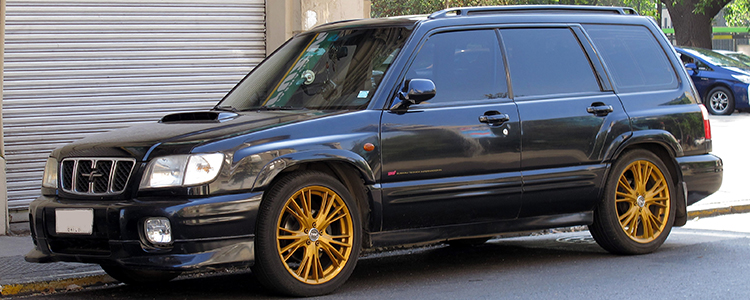
SF5 STi — the wagon that beat WRX times on paper
The Forester STi was a JDM-only build dropped into the SF chassis in 1998 with the EJ20K turbo flat-four — the same family of STi-tuned EJ20 hardware that powered the Impreza STi of the same era. Subaru paired it with a 5-speed manual, AWD, Brembo brakes, and a hood scoop feeding the top-mount intercooler. The body was the same tall wagon shell as a base Forester L, which is why most of the wider enthusiast world ignored it for years: it looked like a Subaru you'd see at a ski lodge, not a track car. The truth was different. Sharing internals with the WRX STi's drivetrain and running roughly the same weight, the SF STi delivered Impreza-grade performance from a body that could also carry mountain bikes. Subaru exported the turbo SF in some markets as the S/tb and S/Turbo, but never sold the STi badge on the Forester in the United States — that variant stayed home in Japan, which is exactly what makes it import-target material now that the 25-year rule has opened the early SF5 STi cars to US importation.
SG Forester STi vs Cross Sports — what the export market missed
Subaru widened the Forester's JDM-only performance lineup in the SG generation. The 2004 SG Forester STi got an EJ255 turbo with output reported close to 300 horsepower, the 6-speed manual from the Impreza WRX STi with DCCD center differential control, repositioned struts, larger anti-roll bars, sport springs, 18-inch wheels, Brembo brake calipers, a lighter aluminum hood with a functional scoop, and Impreza WRX STi bucket seats. None of it crossed the Pacific. The export market got the SG XT — same EJ255 turbo, but in a 230-horsepower tune mated to a 4-speed automatic or 5-speed manual, with 17-inch wheels, HID headlights, and a MOMO steering wheel. Subaru also sold a JDM-only Forester Cross Sports trim, derived from the XT styling but running the EJ20 making 230 horsepower paired exclusively to a 4-speed automatic — a confused middle ground for buyers who wanted the look without the turbo upkeep. None of the JDM Cross Sports or SG STi cars were exported to the US when new; the SG STi remains the rarest factory-Forester variant outside Japan.
Quick read
Key takeaways
- Best value: well-kept 2014-2018 2.5i/XT with records
- Watch-outs: early NA head gaskets; later CVT service
- Rust matters: rear subframe/strut towers in salt states
- XT turbo: quickest, priciest; more upkeep than 2.5i
- Resale strong: AWD + safety keep demand high
- Mods/abuse: avoid tuned turbos without proof of care
Constants
Common across all Forester generations
- Symmetrical all-wheel drive standard across all generations
- Horizontally opposed (boxer) four-cylinder engine in all production variants
- Five-door wagon/crossover body style throughout production
- Platform shared with Subaru Impreza across SF, SG, and SH generations
- Right-hand drive available in all generations
Chassis history
Generation timeline
The Forester has run from 1997 to today, and the early generations are the ones that matter for JDM buyers. The SF from 1997 to 2002 is where the SF5 STi and the S/tb turbo live. The SG from 2002 to 2008 is where the JDM-only 2004 Forester STi shows up. The SH and SJ are when the Forester stopped being a wagon and started being an SUV, so they're useful as daily drivers but they're not the cars you import from Japan.
Fourth generation — SJ (2013–2018)
Buyer's call
Should you buy a Subaru Forester?
The Forester is the WRX you can put kayaks on. You get the same boxer-four AWD layout and the rally bones, but in a tall wagon shell that can carry mountain bikes and ski gear. The trade-off is that you're working with old Subaru cooling systems and old Subaru head gaskets, and a Forester that hasn't been looked after will eat money fast.
Why you'll love it
- Excellent real-world AWD Symmetrical AWD + ground clearance make it a snow-state favorite; strong traction with good tires.
- Strong safety reputation High crash-test performance; EyeSight-equipped cars command premiums and sell faster.
- Practical packaging Boxy cargo area, low load floor, good visibility; easy daily + outdoor use.
- Resale value and liquidity High demand in used market; clean titles and service records bring top-of-range money.
- Simple NA trims are durable Well-maintained 2.5i models can be long-lived; fewer turbo heat/boost-related issues.
- Enthusiast appeal (XT) XT turbos offer strong torque; desirable to enthusiasts, especially unmodified examples.
Why you might not
- Head gasket risk (older NA) Gen 1-3 EJ25 NA can develop external leaks; repair cost varies with rust and shop rates.
- CVT maintenance sensitivity Neglected CVT fluid/overheating can shorten life; towing and big tires raise risk.
- Oil consumption concerns Some FB25-era cars show oil use; buyers should verify level habits and service history.
- Rust in salt climates Rear subframe, brake lines, strut towers can rust; impacts safety and repairability.
- Turbo upkeep and abuse risk XT models often modified; poor tunes can cause ringland/knock issues and costly repairs.
- Road noise/ride (older gens) Earlier generations can be loud and floaty; worn bushings amplify noise and vibration.
Who should not buy this
- Anyone who won't check oil every fill-up
- Buyers expecting Toyota-level powertrain longevity
- Rust-belt buyers without undercoating budget
- People who ignore tire matching and rotations
- Towers/haulers who plan heavy towing with CVT
- Anyone who can't afford a $6k CVT replacement
- Short-trip drivers who skip warm-ups/maintenance
- Buyers who won't pay for pre-purchase leakdown
- People who need 3-across child seats regularly
- Those who hate wind noise and economy-car NVH
- Owners without a good Subaru-specialist shop
- DIYers without tools for boxer engine packaging
- Anyone wanting cheap mods without reliability hits
- People in CARB states buying JDM swaps/engines
- Buyers who can't tolerate occasional electronics quirks
- Those who won't fix water leaks/mold immediately
Reliability
Common issues & solutions
The Forester has the same issues every old Subaru has. The naturally aspirated EJ25 cars eat head gaskets if the cooling system gets neglected. The EJ20T and EJ255 turbo cars take damage when they get tuned badly or run on cheap fuel. Rust at the rear subframe and strut towers is what kills Foresters in salt states. None of these are deal breakers if you find a Forester with paperwork.
| Issue | Cause | Solution | Est. cost |
|---|---|---|---|
| EJ head gasket external leak | OEM gasket design + heat cycles | MLS gaskets, machine heads, new bolts, reseal | $1800-3500 |
| EJ timing belt overdue failure | Skipped service; idler/water pump seize | Full belt kit + pump; replace cam/crank seals | $900-1600 |
| FB oil consumption | Ring pack design + long OCI + blow-by | Short OCI, PCV service; engine rebuild if severe | $150-6500 |
| Cam carrier oil leak (FB) | Sealant failure at cam carrier seams | Reseal cam carriers; often engine-out for access | $1200-2800 |
| Valve cover gasket leaks | Gaskets harden; PCV pressure increases seep | Replace gaskets/tube seals; service PCV | $350-900 |
| Rod bearing failure | Low oil from consumption/leaks or neglect | Replace engine long block; address root cause | $4500-9000 |
| Cooling system overheat | Radiator cracks, air pockets, stuck thermostat | Replace radiator/thermostat; proper bleed | $450-1200 |
| Radiator end tank crack | Plastic tanks age/heat; common on older years | Replace radiator cap/hoses as needed | $350-850 |
| Heater core leak | Corrosion or age; coolant neglected | Replace heater core; flush system | $900-1800 |
| Catalytic converter failure | Oil burning contaminates cat; age/heat | Fix oil use; replace cat with quality unit | $900-2500 |
| CVT valve body failure | Solenoid wear/contamination; heat | Replace valve body; fluid service and relearn | $1200-2200 |
| CVT chain/pulley wear | Overheat, dirty fluid, towing/abuse | Replace CVT assembly; add cooler if used hard | $4500-8500 |
| CVT torque converter shudder | Lockup clutch wear; fluid breakdown | Fluid exchange; TC or trans replacement if bad | $350-6500 |
| Torque bind (older AT) | Duty C solenoid/clutch pack wear | Replace solenoid/clutches; sometimes trans swap | $900-3500 |
| Center diff bind (manual) | Viscous coupling wear from tire mismatch | Replace viscous coupling; match tires always | $900-1800 |
| Wheel bearing failure | Water intrusion + load; common rear on some years | Replace hub/bearing; check axle torque | $450-900 |
| Front CV axle boot tear | Age/heat; aftermarket axles fail early | Reboot OEM or replace with OEM-quality axle | $250-700 |
| Rear trailing arm bushing wear | Age; salt accelerates bushing separation | Replace bushings/arms; align afterward | $450-1200 |
| Front LCA rear bushing tear | Hydraulic bushing cracks; potholes | Replace LCA or bushing; align | $500-1200 |
| Steering rack leak/clunk | Seal wear; inner tie rod play | Replace rack/inner rods; flush fluid | $900-2200 |
| Brake caliper slide seizure | Salt + lack of lube; torn boots | Service slides; replace calipers if pitted | $250-900 |
| Brake line corrosion rupture | Rust belt scaling; trapped moisture under clips | Replace lines; inspect all hard lines and hoses | $800-2000 |
| Rear subframe rust perforation | Salt exposure; poor undercoating maintenance | Replace subframe; treat rust; avoid severe rot | $1500-3500 |
| Strut tower rust perforation | Seam sealer failure + trapped moisture | Weld repair; often not worth it if advanced | $1200-4000 |
| Sunroof drain leaks | Clogged drains; disconnected tubes | Clear drains; reseat tubes; dry interior fully | $150-600 |
| Hatch/spare well water leak | Body vents/seals shrink; seam cracks | Reseal vents/seams; replace hatch seal if needed | $150-700 |
| Airbag/SRS light faults | Seat wiring, clockspring, module codes | Scan SRS; repair wiring/clockspring; clear codes | $250-1200 |
| EyeSight camera faults | Windshield replacement, low voltage, misalign | OEM glass + calibration; fix battery/charging | $400-1800 |
| Infotainment freezing/reboot | Head unit software/hardware failure | Update firmware; replace head unit if persistent | $0-1200 |
| AC compressor failure | Clutch wear or internal seizure; debris in system | Replace compressor+drier; flush; evac/recharge | $900-1800 |
| Window regulator failure | Cable fray; plastic guides break | Replace regulator assembly | $250-600 |
| Door lock actuator failure | Motor wear; cold weather worsens | Replace actuator/latch assembly | $200-550 |
| TPMS sensor battery dead | Age 7-10 years typical lifespan | Replace sensors; program/learn IDs | $200-500 |
Market
Differences between JDM & USDM
The Forester nameplate split markedly between JDM and USDM through the SF and SG generations, then converged from the SH onward. JDM-only variants the US never received: SF5 S/tb turbo (1997–2002, EJ20T), SF5 STi (1998 on, EJ20K turbo, 5MT, Brembo, hood scoop), SG Cross Sports (EJ20, 4AT-only), and the SG Forester STi (2004, EJ255 turbo, 6MT with DCCD, 18-inch wheels, Brembo, aluminum hood, WRX STi seats — the SG STi is the holy-grail JDM Forester). The USDM Forester only received an STi-badged trim starting in 2014 with the SJ-era 2.0XT and aftermarket-style trims; no factory "Forester STi" badge ever shipped on a US-market car. The export markets did get the SG XT (EJ255 turbo, 230 hp, automatic or 5MT, 17-inch wheels, HID, MOMO wheel) — close to a JDM XT in spec — but not the STi. For import buyers, the SF5 STi became 25-year-rule legal in 2023; the SG STi opens up in 2029. Pre-1998 SF turbo S/tb cars are already importable. Right-hand drive throughout.
Specs
Technical specifications
Every JDM Forester worth importing runs an EJ20T or EJ20K turbo flat-four. The SF5 STi uses the EJ20K with the 5-speed manual and Brembo brakes. The SG Forester STi uses the EJ255 with the 6-speed manual and DCCD. The export-market SG XT runs the same EJ255 turbo but in a softer 230 hp tune with a 4-speed automatic or 5-speed manual. The transmission you want is a manual, on any of them.
Engine options
| Chassis | Engine | Displacement | Power | Boost | Notes |
|---|---|---|---|---|---|
| SF | EJ20G | 2.0L | estimated | estimated | Turbo; early JDM spec varies by year |
| SF | EJ20K | 2.0L | estimated | estimated | STi-tuned turbo; output varies by market |
| SF | EJ205 | 2.0L | estimated | estimated | Turbo; later SF/JDM/ROW variants |
| SF | EJ22 | 2.2L | estimated | N/A | NA; market-specific (early US/ROW) |
| SF | EJ25D | 2.5L | estimated | N/A | DOHC NA; early 2.5L applications |
| SG | EJ251 | 2.5L | estimated | N/A | SOHC NA; early SG 2.5X |
| SG | EJ253 | 2.5L | estimated | N/A | SOHC NA; i-AVLS on later years |
| SG | EJ255 | 2.5L | estimated | estimated | Turbo; XT and JDM STi variants |
| SH | EJ253 | 2.5L | estimated | N/A | NA; i-AVLS; output varies by market |
| SH | EJ255 | 2.5L | estimated | estimated | Turbo; 2.5XT; market/year dependent |
| SH/SJ/SK (select mkts) | EE20 | 2.0L | estimated | Turbo | Boxer diesel; outputs vary by calibration |
| SJ | FB25 | 2.5L | estimated | N/A | NA; chain-driven DOHC; AVCS |
| SJ | FA20DIT | 2.0L | 250hp @ 5600rpm | estimated | Turbo DI; USDM rating; torque varies |
| SK | FB25D | 2.5L | estimated | N/A | NA DI (some mkts); output varies by year |
| SK (select mkts) | FB20/FB25 + MHEV | 2.0L/2.5L | estimated | N/A | e-BOXER mild hybrid; system output varies |
| SL | FB25D (market-dependent) | 2.5L | estimated | N/A | Latest gen; final ratings vary by market |
Transmission options
| Type | Ratios | Availability | Notes |
|---|---|---|---|
| 5-speed Manual | estimated | SF/SG/SH (select trims/markets) | AWD; final drive varies by market/year |
| 6-speed Manual | estimated | SH/SJ diesel (select mkts) | Diesel applications; ratios vary by market |
| 4-speed Automatic | estimated | SF/SG/SH (select trims/markets) | 4EAT; AWD; final drive varies |
| 5-speed Automatic | estimated | select markets/years | 5EAT on some turbo/market applications |
| CVT (Lineartronic) | estimated | SJ/SK/SL (most trims) | Chain CVT; AWD; some with paddle steps |
| 6-speed Manual (STi) | estimated | SG Forester STi (JDM) | DCCD-equipped; performance AWD tuning |
Lineup
Variants & trims
The JDM-only Forester variants are the SF5 S/tb and S/Turbo, the SF5 STi, the SG Cross Sports, and the 2004 SG Forester STi. The US never got any of them with a factory STi badge. The closest US-market Forester is the SG XT, which is the same EJ255 turbo in a softer tune. The SF5 STi opened up for US import in 2023, and the SG Forester STi opens up in 2029.
| Generation | Trim | Engine | Key features |
|---|---|---|---|
| SF (1st gen, 1997-2002) | Forester (Base) | EJ20/EJ25 (market-dependent) | AWD, 5MT/4AT, dual-range (select mkts) |
| SF (1st gen, 1997-2002) | Forester L | EJ22/EJ25 (market-dependent) | AWD, 5MT/4AT, upgraded interior |
| SF (1st gen, 1997-2002) | Forester S | EJ25 (market-dependent) | AWD, 5MT/4AT, sport trim, alloys |
| SF (1st gen, 1997-2002) | Forester S/Turbo | EJ20G/EJ205 (market-dependent) | Turbo, AWD, 5MT/4AT, hood scoop |
| SF (1st gen, 1997-2002) | Forester S/tb (JDM) | EJ20G/EJ205 | Turbo, AWD, 5MT/4AT, intercooler |
| SF (1st gen, 1997-2002) | Forester STi (JDM) | EJ20K | STi-tuned, turbo, AWD, 5MT, Brembo |
| SG (2nd gen, 2002-2008) | 2.5X | EJ251/EJ253 | AWD, 5MT/4AT, raised ride height |
| SG (2nd gen, 2002-2008) | 2.5XS | EJ253 | AWD, 5MT/4AT, sport suspension, alloys |
| SG (2nd gen, 2002-2008) | XT | EJ255 | Turbo, AWD, 5MT/4AT, hood scoop |
| SG (2nd gen, 2002-2008) | XT Limited | EJ255 | Turbo, AWD, leather, premium audio |
| SG (2nd gen, 2002-2008) | Cross Sports (JDM) | EJ20/EJ25 (market-dependent) | Aero kit, AWD, sport interior |
| SG (2nd gen, 2002-2008) | STi (JDM) | EJ255 | STi 6MT, Brembo, DCCD, sport chassis |
| SH (3rd gen, 2008-2013) | 2.5X | EJ253 | AWD, 5MT/4AT, new platform, larger body |
| SH (3rd gen, 2008-2013) | 2.5X Premium | EJ253 | AWD, 4AT, panoramic roof (some mkts) |
| SH (3rd gen, 2008-2013) | 2.5X Limited | EJ253 | AWD, leather, premium audio, 4AT |
| SH (3rd gen, 2008-2013) | 2.5XT | EJ255 | Turbo, AWD, 4AT, hood scoop |
| SH (3rd gen, 2008-2013) | 2.5XT Premium | EJ255 | Turbo, AWD, 4AT, upgraded interior |
| SH (3rd gen, 2008-2013) | 2.5XT Limited | EJ255 | Turbo, AWD, leather, 4AT |
| SH (3rd gen, 2008-2013) | 2.0D (select mkts) | EE20 | Boxer diesel, AWD, 6MT, high torque |
| SJ (4th gen, 2013-2018) | 2.5i | FB25 | AWD, 6MT/CVT, new FB engine |
| SJ (4th gen, 2013-2018) | 2.5i Premium | FB25 | AWD, CVT, panoramic roof (some mkts) |
| SJ (4th gen, 2013-2018) | 2.5i Limited | FB25 | AWD, CVT, leather, EyeSight (some) |
| SJ (4th gen, 2013-2018) | 2.5i Touring | FB25 | AWD, CVT, top trim, EyeSight (some) |
| SJ (4th gen, 2013-2018) | 2.0XT | FA20DIT | Turbo, AWD, CVT, direct injection |
| SJ (4th gen, 2013-2018) | 2.0XT Premium | FA20DIT | Turbo, AWD, CVT, sport features |
| SJ (4th gen, 2013-2018) | 2.0XT Touring | FA20DIT | Turbo, AWD, CVT, top trim, EyeSight |
| SJ (4th gen, 2013-2018) | 2.0D (select mkts) | EE20 | Boxer diesel, AWD, 6MT/CVT (market) |
| SK (5th gen, 2018-2024) | Base | FB25D | AWD, CVT, EyeSight (market-dependent) |
| SK (5th gen, 2018-2024) | Premium | FB25D | AWD, CVT, upgraded interior, EyeSight |
| SK (5th gen, 2018-2024) | Sport | FB25D | AWD, CVT, sport trim, SI-Drive (some) |
| SK (5th gen, 2018-2024) | Limited | FB25D | AWD, CVT, leather, EyeSight |
| SK (5th gen, 2018-2024) | Touring | FB25D | AWD, CVT, top trim, DriverFocus (some) |
| SK (5th gen, 2018-2024) | Wilderness | FB25D | AWD, CVT, lower gearing, AT tires |
| SK (5th gen, 2018-2024) | e-BOXER (select mkts) | FB20/FB25 + hybrid | MHEV, AWD, CVT, regen assist |
| SL (6th gen, 2025- ) | Base | FB25D (market-dependent) | AWD, CVT, EyeSight suite |
| SL (6th gen, 2025- ) | Premium | FB25D (market-dependent) | AWD, CVT, upgraded interior |
| SL (6th gen, 2025- ) | Sport | FB25D (market-dependent) | AWD, CVT, sport trim, larger wheels |
| SL (6th gen, 2025- ) | Limited | FB25D (market-dependent) | AWD, CVT, leather, premium audio |
| SL (6th gen, 2025- ) | Touring | FB25D (market-dependent) | AWD, CVT, top trim, driver assist |
| SL (6th gen, 2025- ) | Hybrid (select mkts) | Hybrid (market-dependent) | Hybrid, AWD, CVT, improved economy |
Pricing
Average prices & original MSRP
Today's market range: $1,500 to $45,000 (median ~$18,500). Source: JDMBuySell / USS Auction.
Forester prices remain firm due to AWD demand and safety tech. 2019-2024 used values are sticky; older rust-free XTs and clean 5MTs carry niche premiums. Expect mild softening as new supply rises, but top-condition cars stay strong.
Inspect
Pre-purchase inspection checklist
Walk this list with the seller, not in front of them. The Critical items mean walking away if there's no paperwork backing them up. The High items can usually be priced into the deal. Pay close attention to the cooling system, the head gasket history, and any sign that a turbo Forester has been tuned badly or run hard without the right fuel.
Critical priority
- VIN/Title Run VIN; check salvage/flood/odometer flags
- Rust: Rear Subframe Probe rear subframe; flaking/holes = walk away
- Rust: Strut Towers Check rear strut tops for bubbling/seam rust
- Rust: Brake Lines Check hard lines under driver for heavy scaling
- Rust: Fuel Lines Inspect fuel lines near rear subframe for corrosion
- Head Gaskets (EJ) Look for external coolant/oil seep at block seam
- Cold Start Knock Listen for rod knock vs piston slap on cold start
- Timing Belt (EJ) Verify belt/water pump idlers done; no proof=due
- Thermostat/Overheat Test drive: watch temp stability; no spikes
- Coolant Bubbles Warm idle: bubbles in overflow suggest HG issues
- Exhaust Smoke Blue on decel/idle = rings/valve seals
- CVT Fluid Condition Check for burnt smell; verify service history
- CVT Drive Feel Test: shudder, flare, delayed engagement, whine
- Center Diff Bind Tight turns: hopping/binding indicates AWD issues
- Airbag Light Ensure SRS light proves out; scan for codes
- Tires Match All 4 same brand/size/tread; mismatch kills AWD
- Compression/Leakdown If oil use/knock: do leakdown before buying
High priority
- Service Records Verify oil changes; gaps suggest ring/bearing wear
- Recalls/TSBs Confirm airbag/CVT/valve spring recalls completed
- Rust: Rocker Panels Inspect pinch welds/rockers for crushing and rot
- Undercarriage Impacts Look for bent control arms, crushed exhaust, dents
- Accident Structure Check apron rails/core support for welds/creases
- Windshield/ADAS EyeSight cars: check glass OEM and calibration
- Oil Consumption (FB) Ask qt/1k mi; check tailpipe soot and low oil
- Timing Chain (FB) Listen for chain rattle; check oil level/quality
- Cooling System Check radiator tanks, hoses, overflow for oil film
- Oil Leaks Check cam carriers, valve covers, rear main area
- Spark Plugs/Coils Misfire under load; scan for P030x history
- Catalyst Efficiency Scan for P0420; check for rattling cat substrate
- CVT Cooler Lines Inspect for leaks at fittings and radiator area
- 4EAT/5EAT ATF Check ATF color; harsh shifts or bind on turns
- Manual Clutch Check slip in 4th/5th; chatter, high pedal
- Wheel Bearings Road test: growl that changes with steering input
- Front CV Axles Check torn boots; click on full lock turns
- Suspension Bushings Check rear trailing arm and front LCA bush tears
- Steering Rack Check for leaks/play; clunk over bumps
- Brakes/Calipers Check seized slide pins, uneven pad wear, pulsing
- ABS/VDC Lights Scan codes; wheel speed sensor wiring corrosion
- Heater Core Smell Sweet smell/fogging indicates coolant leak inside
- Sunroof Drains Check wet headliner/A-pillar; clogged drains leak
- Interior Dampness Lift mats; check for mold, wet carpet, corrosion
- EyeSight Functions Test lane/ACC; check for camera faults in scan
- Test Drive Heat Soak Drive 30+ min; check CVT temp behavior and smells
- OBD Readiness Check monitors set; recent reset may hide codes
Medium priority
- PCV System Check PCV valve/hoses; sludge indicates neglect
- Rear Diff Leaks Inspect pinion/side seals; check fluid level
- Struts/Springs Look for leaks, broken coils, uneven ride height
- Power Steering (older) Whine/leaks at pump and lines; check fluid
- Battery/Charging Test alternator output; low voltage causes weird DTCs
- Parasitic Draw Check for dead battery history; test draw if possible
- HVAC Operation Test heat/AC; blend door noise; compressor cycling
- AC Compressor Listen for clutch chatter; check vent temps
- Tailgate Water Leaks Check spare well for water; hatch seal/vents leak
- Window Regulators Slow/stuck windows; listen for cable crunch
- Alignment Wear Check inner tire wear; indicates bushing/strut issues
Low priority
- Seat Heaters Test both levels; elements fail and burn spots
- Door Locks/Keyless Test actuators; intermittent lock/unlock common
- Infotainment/BT Test BT calls, USB, CarPlay/AA if equipped
- TPMS Verify sensors read; dead sensors add cost
Cross-shop
Comparable alternatives
If the Forester doesn't end up being the right car, the natural alternatives are the Subaru Impreza WRX or WRX STi if you want the same drivetrain in a smaller body, or a Subaru Legacy GT wagon if you want something a little more grown up. The Mitsubishi Lancer Evolution wagon is the closest rival but it's much rarer and much more expensive.
Toyota RAV4 (XA50)
Hybrid mpg, strong reliability, high resale; AWD available
Honda CR-V (Gen 5)
Roomy, efficient; on-demand AWD; strong parts support
Mazda CX-5 (KF)
Best on-road feel; optional turbo; upscale interior
VW Tiguan (Mk2)
Euro driving feel, 3-row option; AWD available; watch upkeep
Subaru Outback (BS/BT)
More cargo + comfort; similar AWD ethos; often pricier
Compare
How it compares
The Forester sits between the Impreza WRX and the small SUVs of its era. Against the Mitsubishi Lancer Evolution wagon, the Forester is more usable as a daily and easier to source parts for. Against a CR-V or a RAV4 of the same year, the Forester gives up cargo space but wins on snow, gravel, and any surface that isn't pavement. The factory STi versions of the Forester are the only ones that compete on pure performance.
| Feature | Subaru Forester | Honda CR-V (Gen 5) | Toyota RAV4 (XA50) |
|---|---|---|---|
| AWD system | Full-time Symmetrical AWD | On-demand AWD | On-demand AWD |
| Ground clearance | Up to ~8.7 in (varies) | ~8.2 in | ~8.4 in |
| Base engine | 2.5L flat-4 (NA) | 1.5T I4 (Gen 5) | 2.5L I4 (NA/Hybrid) |
| Performance trim | XT turbo (older gens) | 2.0T option (some yrs) | Turbo option (some yrs) |
| Transmission | CVT (most 2014+) | CVT/AT (by year) | 8AT/Hybrid eCVT |
| Fuel economy focus | Good; not class best | Very strong hybrid mpg | Strong hybrid mpg |
| Off-pavement aids | X-Mode (most trims) | Trail modes (trim-based) | Terrain modes (trim-based) |
| Cabin space | Boxy, efficient | Roomy rear seat | Competitive cargo |
| Reliability profile | Good; watch HG/CVT | Strong; turbo+CVT care | Strong; hybrid complexity |
| Winter resale demand | Very high in snow states | High | High |
| Enthusiast market | XT + older 5MT niche | Limited | Moderate (turbo trims) |
| Towing capability | Modest; trim/year varies | Similar; varies by year | Often higher in some trims |
Gallery
In pictures
Drivetrain
Engine references
Editorial
The buyer's read
If you're buying a Forester, the question to answer first is which Forester. A clean SG XT with documented service history and an unmolested tune is the practical pick for most people. It's the closest thing to a WRX wagon you can get without importing anything, and parts are easy to find in North America. Skip anything under $5,000 unless you're buying it for parts. A cheap Forester almost always means a head gasket job is coming, and the head gasket job alone will cost you more than the car did.
If you want the JDM stuff, the SF5 STi is the one that's already importable. It opened up under the 25-year rule in 2023. The EJ20K turbo, the 5-speed manual, the Brembo brakes, the hood scoop, and the shared hardware with the Impreza WRX STi of the same era make it a real performance car in a wagon body. The catch is that almost all of the good SF5 STi cars are still in Japan, and importing one costs more than buying a clean US-market SG XT. If you can wait until 2029, the SG Forester STi is the bigger prize. The EJ255 turbo, the 6-speed manual with DCCD, the Brembo brakes, the aluminum hood, and the WRX STi bucket seats make it the rarest factory Forester variant ever built.
The one Forester to avoid is a turbo car without paperwork. A tuned EJ20T or EJ255 that's been run on cheap fuel or a bad map can have ringland or knock damage that doesn't show up on a cold start. If the seller can't tell you what map is on the car or who tuned it, walk away. The naturally aspirated 2.5L cars are easier to vet, and a well-kept SF5 Forester L or SG 2.5X is a perfectly good daily driver as long as the head gaskets have been done or the cooling system has been maintained.
FAQ
Frequently asked questions
- Which Forester years are best to buy used?
- Value sweet spot is often 2014-2018 with records. For newer, 2019-2024 offers best safety/ride but higher prices.
- Do Foresters have head gasket problems?
- Mainly older EJ25 NA (Gen 1-3). Later FB25/FA20 are less known for HG leaks; still inspect for seepage.
- How reliable is the Subaru CVT?
- Generally good if maintained, but neglect hurts. Prioritize fluid service history, no shudder, and no overheating/towing abuse.
- Is the Forester XT worth it?
- Yes for performance, but budget for higher upkeep. Avoid heavily modified cars; seek stock tune and frequent oil changes.
- What rust areas should I inspect?
- Check rear subframe, brake lines, strut towers, and rocker seams. Rust can turn a cheap Forester into a write-off.
- What mileage is too high for a Forester?
- Condition beats miles. A well-serviced 150k+ can be fine; lack of records at 80k-120k is a bigger red flag.
- What maintenance is most important?
- Key items: timing belt (EJ-era), CVT fluid, coolant, diff fluids, and suspension bushings. Verify receipts, not promises.
- Why are used Foresters so expensive?
- Demand is boosted by AWD, safety tech, and winter-region popularity. Clean-title, rust-free examples trade at a premium.
Citations
Sources & references
- Subaru Forester — encyclopedic overview — WikipediaVerified
- Subaru Forester — used-car review and common problems — Samarins (used-car research site)Verified
- Subaru EJ engine — family history, EJ20T, EJ20K, EJ25, EJ255 — WikipediaVerified
- Bring a Trailer — Subaru Forester sold results — Bring a TrailerVerified
- IIHS crash test ratings — Subaru Forester — Insurance Institute for Highway SafetyVerified
- Subaru owner resources and maintenance schedules — Subaru of AmericaVerified
- Subaru Forester — model overview and specs reference — CarBuzzVerified
Sources last verified: