All FK10 cars are mechanically identical: same engine state-of-tune (around 75–76 PS at 6,000 rpm), same transmission, same interior layout. The four launch colours (Lapis Grey, Emerald Green, Pale Aqua, Topaz Mist) are the only factory differentiator, and colour proportions across the 20,073-car build are unevenly distributed. Buyers grade FK10 cars on rust-free shells, dry interiors, original soft-top fabric, correct chrome trim, and documented service history — particularly timing chain replacement and cooling system overhaul. Because the model is a single-year run with no factory variation, condition and provenance carry essentially all of the price differential.
Buyer's guide
Nissan Figaro FK10 — Buyer's Guide & Specs
The FK10 chassis code identifies every Nissan Figaro. There are no sub-variants, no facelifts, and no multi-year runs — production was concentrated in 1991, with deliveries continuing into 1992 for late-batch lottery winners. The platform is the K10 Micra/March, modified for the convertible body and fitted with the MA10ET 1.0-litre SOHC turbo from the March Super Turbo, a 3-speed automatic transaxle, front McPherson struts, a rear four-link coil-spring axle, front ventilated discs and rear drums.
Looking to buy?
Browse Nissan Figaro listings →
Key Takeaways
- Design-led collectible; performance is secondary
- Rust & water leaks are the biggest value killers
- Original top/trim drives top-tier pricing
- Auto-only; buy on condition, not mileage
- Parts support is good via UK/Japan specialists
- US 25-year eligibility supports steady demand
Technical Specifications
Every Figaro is the same car underneath. MA10ET 1.0 turbo making about 75 PS, 3-speed automatic, front-wheel drive, K10 chassis. There's no manual option and no NA version. The MA10ET is the same engine as the Nissan March Super Turbo, which is useful when you go looking for parts.
Engine Options
| Engine | Displacement | Power | Boost | Notes |
|---|---|---|---|---|
| MA10ET | 1.0L | 76 PS @ 6000rpm (55.9 kW) | 0.6 bar (8.7 psi) | SOHC 8V, EFI, turbo, intercooled |
| MA10ET | 1.0L | 75 hp @ 6000rpm | 0.6 bar (8.7 psi) | Alt rating; market-dependent rounding |
Transmission Options
| Type | Ratios | Availability | Notes |
|---|---|---|---|
| 3-speed Automatic (3AT) | 2.861/1.562/1.000 | All Figaro trims | Jatco 3AT; lock-up not fitted |
Livability
- Headroom
- 37.0"
- Top up reduces space; tall drivers feel cramped
- Rear Seats
- 2+2 (very small)
- Rear is for bags/kids only; adults won't fit
- Cargo
- 6-8 cu ft
- Trunk small; top down reduces usable space
Variants & Trims
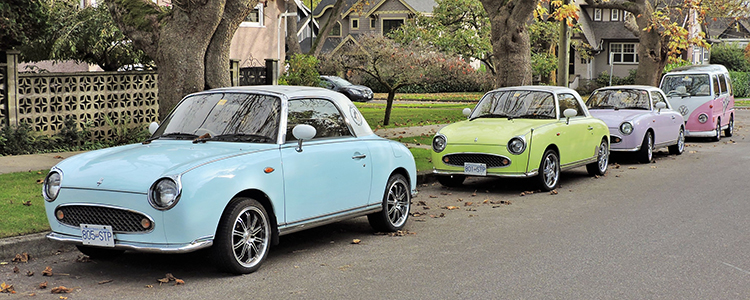
The only factory variation is paint. Lapis Grey for winter, Emerald Green for spring, Pale Aqua for summer, and Topaz Mist for autumn. Mechanically and trim-wise every Figaro is identical, so color and originality of paint matter more on a Figaro than they do on almost any other JDM car.
| Generation | Trim | Engine | Key Features |
|---|---|---|---|
| Figaro (FK10) | Figaro (Base) | MA10ET 987cc I4 Turbo | 3AT, power top, leather seats, A/C, power windows |
| Figaro (FK10) | Figaro (Emerald) | MA10ET 987cc I4 Turbo | Limited color, 3AT, power top, leather, A/C |
| Figaro (FK10) | Figaro (Pale Aqua) | MA10ET 987cc I4 Turbo | Limited color, 3AT, power top, leather, A/C |
| Figaro (FK10) | Figaro (Topaz Mist) | MA10ET 987cc I4 Turbo | Limited color, 3AT, power top, leather, A/C |
| Figaro (FK10) | Figaro (Lapis Grey) | MA10ET 987cc I4 Turbo | Limited color, 3AT, power top, leather, A/C |
Should You Buy a Nissan Figaro FK10?
The Figaro is a car you buy with your eyes, and that shapes both sides of the ledger. The good stuff is the look, the chrome, the open roof, and the fact that the K10 mechanicals underneath are simple and well understood. The trade is rust, leaks, and a 75 PS turbo that was never built to chase a freeway.
Why You'll Love It
- Iconic Pike Factory styling Instantly recognizable retro design; strong event and social media appeal boosts liquidity.
- Approachable ownership experience Simple K10-based mechanicals; many service items shared with March/Micra ecosystem.
- Strong specialist support network UK/Japan specialists supply trim, tops, and mechanical parts; guides and clubs are active.
- City-friendly size and manners Compact footprint, light steering, easy parking; ideal for urban classic use.
- Automatic, easy-to-drive classic 3-speed auto suits casual cruising; broadens buyer pool beyond manual-only enthusiasts.
- Collectible narrative and scarcity Limited production story and Pike lineage (Be-1/Pao/S-Cargo) support long-term demand.
- Good value retention when sorted Well-restored, rust-free cars tend to hold value; buyers pay for documented work.
Why You Might Not
- Rust is pervasive and expensive Sills, floors, arches, windshield frame; proper metalwork quickly exceeds cheap buy-in.
- Convertible leaks and water damage Aging seals and top fabric cause wet carpets, mold, and hidden corrosion; inspect thoroughly.
- Performance is modest 1.0 turbo and 3AT are for cruising; not a sports car, highway passing can feel strained.
- Aging plastics and trim scarcity Interior bits, chrome, and unique trim can be costly; NOS is limited and repro varies.
- Cooling and turbo age issues Radiators, hoses, and turbo oiling neglect can cause overheating or smoke; maintenance critical.
- 3-speed auto limits refinement Higher revs at speed and fewer ratios; some buyers dislike the dated driving feel.
- Paint and chrome restoration costs Correct color matching and brightwork re-plating are pricey; cheap resprays hurt value.
Who Should NOT Buy This
- Anyone needing reliable daily transport
- Drivers over 6'1" wanting top-up comfort
- People without indoor storage/garage
- Buyers who can't handle rust repair costs
- Anyone in road-salt regions without undercoating
- Owners expecting modern crash safety
- People who hate chasing water leaks
- Those needing real rear seats for adults
- Anyone lacking a JDM/UK parts supply plan
- Buyers without a specialist mechanic nearby
- People who won't do preventative maintenance
- Anyone expecting strong highway power
- Drivers wanting quiet cabin at 60-70 mph
- Anyone with strict emissions testing requirements
- People who can't tolerate 30+ year-old wiring
- Buyers who won't budget for top/seal work
- Anyone expecting cheap insurance/parts everywhere
- Those who park outside under trees year-round
- People who dislike frequent small fixes
- Anyone expecting tight, modern handling/brakes
Common Issues & Solutions
The Figaro is mechanically a Micra with a turbo, so the engine isn't the part that breaks. Rust and water leaks are what take Figaros off the road. The soft top seals shrink, water gets in, and the sills and floors quietly rot under the carpet while the car still drives fine.
| Issue | Cause | Solution | Est. Cost |
|---|---|---|---|
| Sill/rocker rust-through | Trapped moisture; blocked drains; poor repairs | Cut/replace metal; treat cavities; reopen drains | $2000-7000 |
| Floorpan corrosion | Top/windscreen leaks soaking carpets for years | Weld patches; reseal; fix leak sources first | $1500-6000 |
| Rear arch rust | Mud traps at lip; thin factory protection | Arch repair panels; rustproof inner/outer lips | $1200-4500 |
| Windscreen surround rust | Aged seal lets water sit under trim | Remove glass; repair metal; new seal; repaint | $1500-5000 |
| Spare well rot | Water ingress from seals/drains; standing water | Repair well; clear drains; reseal tail lamps | $800-3000 |
| Convertible top leaks | Shrunk seals; misaligned frame; clogged drains | Adjust frame; replace seals; clear drains; test | $400-2500 |
| Top frame binding/bent links | Forced operation; corrosion at pivots | Rebuild pivots; replace bent arms; align frame | $600-2500 |
| Rear window cloudy/cracked | Aged vinyl; folded when cold; UV damage | Replace window panel or full top skin | $300-1800 |
| Timing chain rattle | Stretched chain; worn guides/tensioner | Replace chain kit; inspect sprockets; set timing | $900-2200 |
| Turbo oil seal smoke | Worn turbo bearings; poor oiling; heat soak | Rebuild/replace turbo; clean oil feed/return | $900-2500 |
| Boost leaks/surging | Cracked vacuum/boost hoses; loose clamps | Replace all hoses; pressure test intake tract | $150-600 |
| Overheating in traffic | Clogged radiator; weak fan; old thermostat | New radiator/thermostat; verify fan circuit | $400-1200 |
| Head gasket failure | Past overheating; detonation on old fuel system | Head skim/test; gasket; fix cooling and tune | $1200-3500 |
| Oil leaks (multiple) | Aged seals: cam cover, front seal, turbo lines | Reseal; replace turbo line washers; clean PCV | $300-1500 |
| Fuel pump failure | Age; running low fuel; varnish from storage | Replace pump and sock; flush tank/lines | $300-900 |
| Injector seal leaks | Hardened O-rings; ethanol exposure | Replace injector seals; inspect rail and hoses | $200-600 |
| MAF sensor faults | Aged hot-wire; vibration; wiring corrosion | Clean connector; replace MAF; repair harness | $250-900 |
| O2 sensor lazy/rich | Old sensor; exhaust leaks upstream | Replace O2; fix leaks; verify fuel pressure | $200-600 |
| Distributor misfire | Worn cap/rotor; moisture; old leads | Tune-up: cap/rotor/leads/plugs; check coil | $150-500 |
| Auto trans shift flare | Worn clutches; old ATF; valve body wear | Service ATF/filter; rebuild if persistent | $250-3000 |
| Delayed D/R engagement | Low ATF; internal seal wear; clogged filter | Correct fluid; service; rebuild if no change | $200-3000 |
| CV boot splits | Age and heat; low ride height stress | Replace boots or complete axle assemblies | $250-900 |
| Seized brake calipers | Moisture; infrequent use; old brake fluid | Rebuild/replace calipers; flush fluid; new hoses | $400-1400 |
| Rusty brake hard lines | Road salt; neglected underbody protection | Replace lines; inspect proportioning valve | $500-1800 |
| Steering rack play/leak | Worn inner joints; torn boots; seal wear | Rebuild/replace rack; align; replace tie rods | $600-1800 |
| Suspension bushing wear | Age; oil contamination; cracked rubber | Replace control arm bushings; check ball joints | $500-2000 |
| Alternator weak output | Worn brushes/regulator; belt slip | Rebuild/replace alternator; new belt; clean grounds | $250-700 |
| Ground-related gremlins | Corroded grounds; prior alarm/immobilizer hacks | Restore grounds; remove bad splices; re-loom | $150-1200 |
| AC not cold | R12 conversions, leaks, tired compressor | Leak test; replace drier; convert properly; recharge | $400-1800 |
| Heater core leak | Corrosion; old coolant; electrolysis | Replace heater core; flush system; new coolant | $700-1800 |
| Water in cabin | Top seals, cowl drains, windscreen seal failure | Fix seals/drains; dry interior; treat rust early | $200-2500 |
| Interior trim cracking | UV and age; brittle plastics; poor storage | Source used parts; careful restoration; UV protect | $200-2000 |
Differences between JDM & USDM
The Figaro was never sold outside Japan. There is no USDM, EDM, or AUDM variant — every car is a single-year JDM build with right-hand drive, JDM-spec interior, JDM odometer in kilometres, and the JDM-specification MA10ET tuned for 75–76 PS. The United Kingdom developed an early gray-market import scene in the 1990s when private importers found a regulatory work-around, which is why the UK has the largest enthusiast base outside Japan and the strongest specialist parts supply. The United States opened to general Figaro imports in 2016 under the federal 25-year rule (1991 + 25 = 2016), making it one of the earliest JDM-only retro cars to clear the import barrier. Canada had been importing them since 2006 under its 15-year rule. There is no LHD conversion programme of any note; the steering rack, dashboard, pedal box, and wiper sweep are all RHD-specific.
Pre-Purchase Inspection Checklist
Walk the Figaro looking for rust and water first, mechanicals second. Pull the carpets back, look in the spare well, feel along the sills, and put a hose on the top with the doors closed. The Critical items are mostly about the shell. If the metal's gone, the rest doesn't matter.
Critical Priority
- Front chassis rails Check for rust, kinks, poor crash repairs
- Front crossmember Probe for rot near mounts; look for patches
- Sills/rockers Inspect seams for bubbling; jack points crush
- Floorpans Lift carpets; check under sound deadening
- Rear subframe mounts Check mount areas for rust cracking/soft metal
- Exhaust smoke Blue on boost/decel = turbo seals or rings
- Coolant condition Look for rust/milk; check overflow for oil
- Overheat history Ask for proof; check warped head symptoms
- Compression test Verify even cylinders; low = rings/valves
- Fuel smell/leaks Check tank neck, lines, injector seals
- Brakes Check seized calipers, soft pedal, rusty lines
- VIN/ID plates Verify chassis plate; match paperwork/import
High Priority
- Rear arches Check lip rust inside arch; feel for filler
- Rear quarter panels Look for bubbling at lower quarter behind door
- Spare wheel well Check for standing water, rot, seam sealer lift
- Battery tray area Look for acid corrosion and hidden rust holes
- A-pillars Inspect base for rust; check windscreen seal
- Windscreen surround Look for bubbling under rubber; leaks on wash
- Door bottoms Check drains open; rust at hem and corners
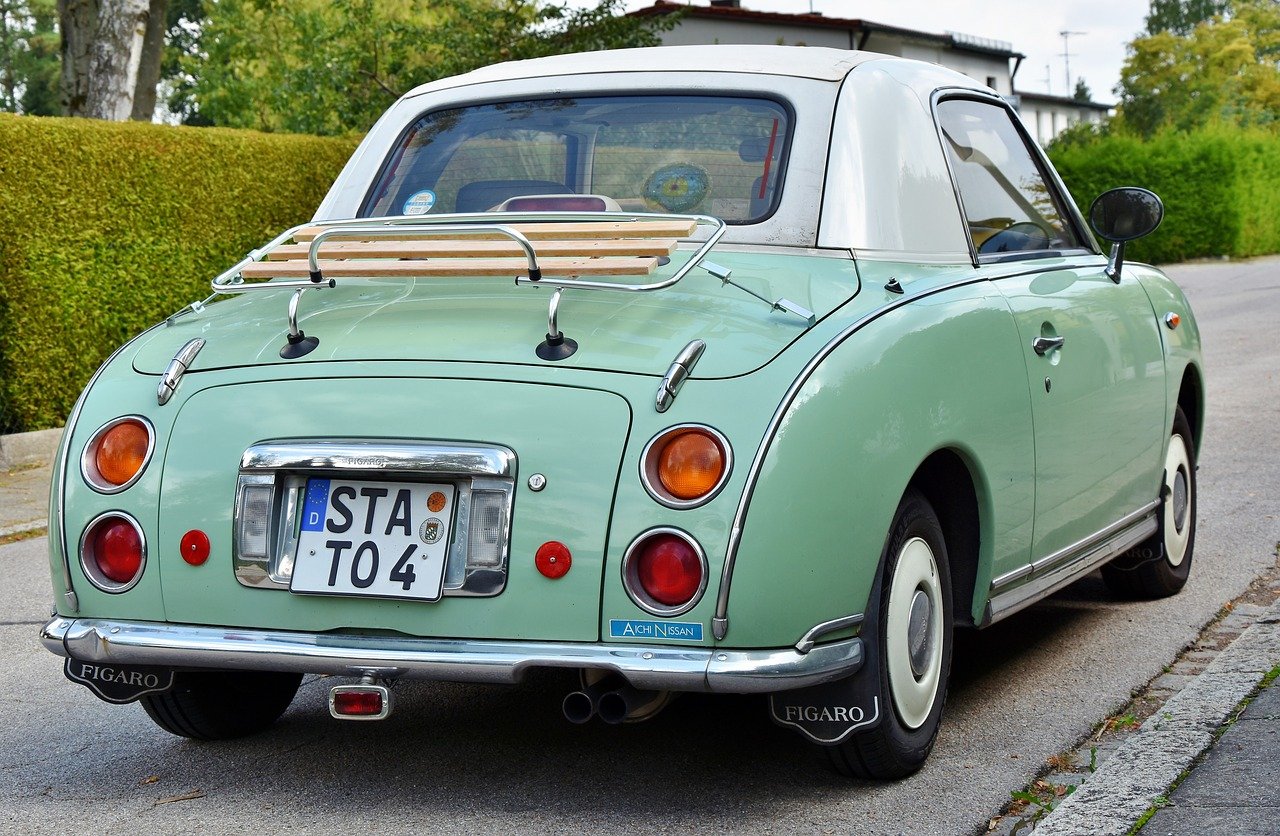
- Soft top fabric Check tears, shrinking, cloudy rear window
- Soft top frame Operate fully; check binding, bent links, play
- Soft top seals Check header/side seals for cracks and gaps
- Water leak test Hose test A-pillars, header, rear deck drains
- Cowl drains Ensure drains clear; water should exit quickly
- Rear deck drains Check convertible well drains not blocked
- Engine cold start Listen for timing chain rattle; idle stability
- Turbo operation Check boost builds smoothly; no siren whine
- Oil leaks Check cam cover, turbo feed/return, front seal
- Cooling system Check radiator end tanks, hoses, heater valve
- Fuel pump noise Loud whine = tired pump; check pressure
- Auto trans shifts Check flare, harsh 2-3, delayed engagement
- ATF condition Should be red, not burnt; check level hot
- CV joints/boots Check split boots; click on full lock
- Steering rack Check play, torn boots, fluid leaks if PS
- Brake master cyl Check seep at booster; pedal sinking test
- Charging system Check 13.8-14.4V; dim lights = alternator
- ECU codes Pull codes; check for knock/O2/MAF faults
- Ignition system Check cap/rotor, leads; misfire under boost
- Heater function Check hot output; sweet smell = heater core
- Interior dampness Check under mats for wet; mold smell
- Seat mounts Check rusted bolts/floor; seat rocking
- Service records Look for timing chain, cooling, ATF history
Medium Priority
- Firewall seams Check seam sealer splits; water ingress signs
- Hatch/trunk seams Inspect lower seam rust; water trails inside
- Vacuum hoses Check brittle lines; boost leaks cause surging
- Idle control Hunt/stall with AC = IACV dirty or leaks
- Wheel bearings Listen for growl; check play at 12/6 o'clock
- Front struts Check leaks, sag, top mounts clunking
- Rear shocks Check leaks; bounce test; uneven tire wear
- ABS (if fitted) Confirm light cycles; test on gravel for pulse
- Tires Check age cracks; correct size; uneven wear
- Battery/grounds Check ground straps; voltage drop under load
- MAF sensor Check for hesitation; tap test; inspect wiring
- O2 sensor Check fuel trims; rich smell; poor mpg
- AC function Check cold at idle; compressor noise; leaks
- Gauges Temp gauge must be stable; fuel gauge accuracy
- Parts sourcing Confirm local support for MA10ET/auto/trim
Low Priority
- Wheels Check bends; corrosion at bead causing leaks
- Blower motor Check all speeds; squeal = worn bearings
- Wipers/washer Check intermittent; washer pump and jets
- Lights Check pop-up? (N/A) ensure all lamps work
Generation History
Figaro (FK10) (1991)
- Pike Factory limited-run retro convertible
- MA10ET 1.0 turbo; 3AT; FWD
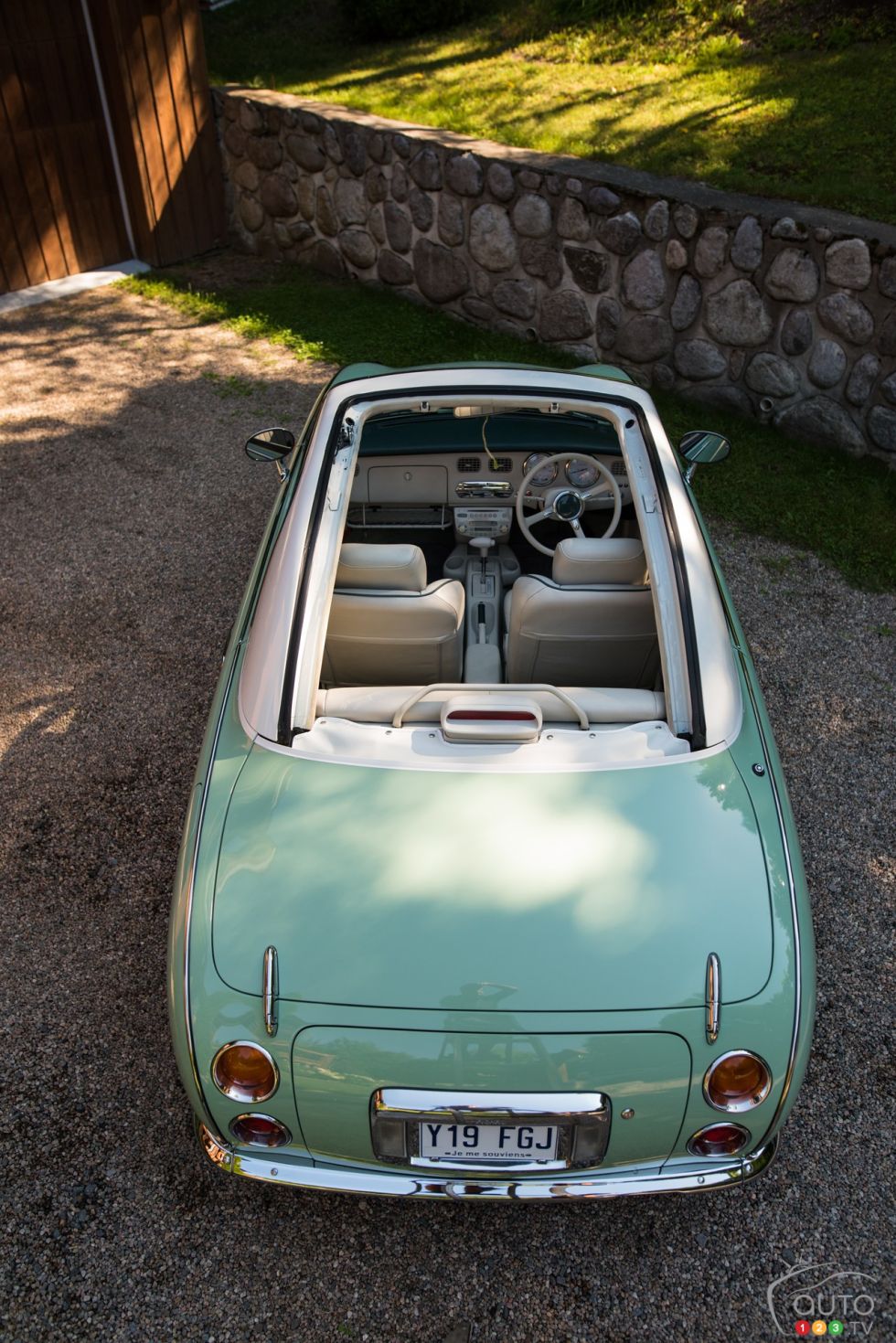
- Canvas power top; leather-look interior
- Four factory colors tied to seasons
- Based on Micra/March K10 underpinnings
- Strong UK import scene; growing US interest
Sales Numbers by Year
| Year | Domestic | Notes |
|---|---|---|
| 1991 | 20,073 | Single-model-year run; allocated by lottery in three batches (8,000 + 6,000 + 6,000). All cars JDM; no export production. |
Market Data
Production Numbers & Rarity
| Generation | Years | Total Built | Notes |
|---|---|---|---|
| Figaro (FK10) | 1991 | 20,073 | Pike Factory limited run; Japan domestic market |
Rarest variant: Figaro Emerald
Original MSRP & Pricing
Original MSRP: JPY1,870,000 at launch in 1991. Reported JDM list price around ¥1.87M at 1991 launch. JDMBuySell editorial cites an inflation- and exchange-rate-adjusted figure near US$31,500 in 2026 dollars, with a contemporary US-equivalent of roughly $14,000. Yen MSRP varies across secondary sources; the figure here is the most commonly cited JDM list price and is not corroborated by an official Nissan price sheet in the source set.
How It Compares
The Figaro doesn't really have direct rivals. The closest cars are its Pike Factory siblings, which share the K10 underpinnings but aren't convertibles, and the kei roadsters like the Honda Beat and Suzuki Cappuccino, which are smaller, faster, and a completely different vibe. The Figaro wins on style and presence and loses on driving feel.
| Feature | FK10 | Nissan Pao PK10 | Nissan Be-1 BK10 |
|---|---|---|---|
| Body/roof | 2dr convertible, soft top | 2dr coupe, fixed roof | 2dr hatch, fixed roof |
| Engine | 1.0L turbo I4 (MA10ET) | 1.0L NA I4 (MA10S) | 1.0L NA I4 (MA10S) |
| Power output | ≈75 hp (JDM rating) | ≈52 hp (JDM rating) | ≈52 hp (JDM rating) |
| Transmission | 3-speed automatic only | 3AT or 5MT (varies) | 3AT or 5MT (varies) |
| Drivetrain | FWD | FWD | FWD |
| Character | Retro luxury cruiser vibe | Retro utilitarian chic | Minimalist retro hatch |
| Rarity/collectibility | High; Pike halo model | High; Pike cult following | High; earliest Pike car |
| Rust sensitivity | High (convertible leaks) | High (K10-era shells) | High (K10-era shells) |
| Daily usability | Good in city; noisy at speed | Good; more cargo utility | Good; simplest to run |
| Interior vibe | Leather-look, chrome accents | Canvas/utility aesthetic | Simple, airy retro cabin |
| Open-top alternative | True convertible | T-top/convertible (varies) | Targa/convertible (varies) |
| Performance feel | Light, modest, relaxed | Revvy, sporty kei roadster | Turbo, playful kei roadster |
| Market buyer overlap | Style-first collectors | Driving-first collectors | Driving-first collectors |
| Maintenance complexity | Moderate; turbo + top | Moderate; kei parts + age | Moderate; turbo + age |
| Parts availability | Good via UK/Japan specialists | Good via kei specialists | Good via kei specialists |
| Cabin space | 2+ small; comfy for 2 | Strict 2-seater | Strict 2-seater |
| Value driver | Condition/originality story | Mileage, mods, originality | Mileage, rust, originality |
Comparable Alternatives
If the Figaro doesn't fit, the other Pike Factory cars are the natural next stop. The Pao is a fixed roof and simpler to own. The Be-1 is even simpler. If you want something that drives better and isn't tied to the Pike look, a Mazda MX-5 NA gives you the convertible experience with parts you can get anywhere.
Nissan Pao PK10
Same Pike ethos; simpler NA engine; more practical hatch
Nissan Be-1 BK10
Earliest Pike car; simpler ownership; similar charm
Suzuki Cappuccino
Small JDM convertible; more driver-focused; strong support
Honda Beat PP1
Iconic kei roadster; high-rev fun; strong collector base
Mazda MX-5 NA
Classic convertible with better dynamics; easier parts in US
In Pictures
The Buyer's Read
If you're buying a Figaro, buy the shell. A clean rust-free Figaro with original paint and a dry interior is worth paying for, and a rough Figaro at half the price will cost you more by the time it's done. The first thing to check is the sills, the floors under the carpet, the rear arches, and the metal around the windscreen. The second thing to check is whether the top has been leaking, because a Figaro that's sat with wet carpets for a few seasons has rust you can't see from the outside.
The MA10ET turbo is the same engine as the Nissan March Super Turbo, which means parts aren't a problem. Watch for blue smoke on boost, which is the turbo seals, and listen for timing chain rattle on cold start. The 3-speed automatic is the only gearbox the Figaro came with, and there's no manual conversion that's worth doing. If the auto shifts cleanly and engages without delay, leave it alone.
Color matters on a Figaro more than it does on most cars. The four factory colors are Lapis Grey, Emerald Green, Pale Aqua, and Topaz Mist, and a Figaro that's been resprayed in a non-original color or with a poor color match loses real money. Check the paint inside the door jambs and under the bonnet to see if it matches the outside.
The UK has the biggest specialist scene because Figaros were imported there in the 1990s, well before the US 25-year rule opened in 2016. That's where the parts and the expertise sit. If you're in the US, plan on shipping trim and top parts from the UK or from Japan. Mechanical parts are easier because the K10 platform is everywhere.
The Figaro you want is a documented car with a rust-free shell, a recently replaced top, an original interior, and the timing chain done. Pay for that car. Skip the cheap ones.
Frequently Asked Questions
- What is a Nissan Figaro and why is it collectible?
- A 1991 Nissan Pike Factory retro convertible. Collectible for design, limited-run story, and originality-driven values.
- What should I check first when buying a Figaro?
- Prioritize rust, water leaks, and evidence of proper metal repair. A cheap rusty car is usually the most expensive.
- Where do Figaros rust the most?
- Sills, floor pans, rear arches, lower doors, and around the windscreen frame; leaks accelerate hidden corrosion.
- Are parts still available for the Figaro?
- Yes. Mechanical items are K10-related; Figaro-specific trim/top parts are best via UK/Japan specialists and clubs.
- How reliable is the MA10ET turbo engine?
- Generally solid if maintained. Watch cooling system, oil leaks, and turbo smoke; neglected cars overheat and wear fast.
- Is the Figaro fast or fun to drive?
- It’s more charming than fast. The 3-speed auto and 1.0 turbo suit cruising; buy it for style, not performance.
- What makes one Figaro worth more than another?
- Rust-free shell, dry interior, correct color/trim, quality paint, and documented servicing. Originality beats mods in value.
- When is the Nissan Figaro legal to import to the US?
- It’s already eligible: the Figaro is 1991, so it has been 25-year import legal since 2016 (state rules still apply).
Sources & References
- Nissan Figaro — model overview, production, lottery allocation — WikipediaVerified
- Aichi Kikai (Aichi Machine Industry) — Pike Factory contract manufacturer — WikipediaVerified
- Nissan Be-1 — first Pike Factory model (1987) — WikipediaVerified
- Nissan Pao — second Pike Factory model (1989) — WikipediaVerified
- The Adorable Nissan Figaro — model profile — HagertyVerified
- Figaro Owners Club — UK enthusiast community and parts directory — Figaro Owners ClubVerified
- Nissan Figaro — used buyer's review — Honest John ClassicsVerified
- What are the problems with owning a Figaro? — The Nissan Figaro ShopVerified
- Historic auction results: Nissan Figaro — Bring a TrailerVerified
- Nissan Figaro — rust-free retro chic with celebrity style — The IndependentVerified
- 日産・フィガロ — Japanese encyclopedic overview — Wikipedia (Japanese)Verified
- gtr-registry.com — FK10 Figaro registry page — GTR RegistryLink dead
Sources last verified: