Buyer's guide
Nissan Cedric
The Nissan Cedric is a JDM-only executive sedan that ran from 1960 until 2004, never officially sold in North America and reaching export markets only as the rebadged Datsun 200C/220C/240C/260C/280C/300C. Production began in 1960 as one of Japan's first home-grown luxury sedans, alongside the Toyota Crown — and the two cars defined the segment for the next four decades. After Nissan merged with Prince Motors in 1966, the Prince Gloria became the Nissan Gloria, sold as a sportier sibling on the same platform. Across ten generations (30, 130, 230, 330, 430, Y30, Y31, Y32, Y33, Y34) the Cedric evolved from L-series inline-six economy luxury into the VG-then-VQ V6 flagship of the late 1990s, with diesel LD28 and RD28 options for commercial and taxi-fleet use. The Y34 retired the nameplate in 2004, replaced by the Nissan Fuga, while the Y31 commercial sedan continued in production for taxi service through 2015. Today the Cedric is undervalued relative to the Toyota Crown and overshadowed by the more famous Skyline and Chaser — exactly why it deserves a second look from VIP-build collectors and 25-year-rule importers.
How the Cedric became Nissan's quiet flagship
Nissan launched the Cedric in 1960 as a direct competitor to the Toyota Crown, naming it after the protagonist of the 1886 Frances Hodgson Burnett novel Little Lord Fauntleroy — a deliberately British-sounding name that signalled upmarket aspiration. The 30-series and 130-series cars shared mechanicals with the Datsun Bluebird and were sold abroad under the Datsun 1900/2000/2300 badges. The 1966 Prince Motors merger reshaped the lineup: the Prince Gloria became the Nissan Gloria and slid into a sportier tuning of the same platform, while the Cedric kept the comfort-first brief. By the Y30 generation (1983-1987), Nissan had moved to the VG V6 — its first mass-production V6 — and added Super Sonic Suspension on Brougham and Brougham VIP trims, an electronically adjustable damper system that gave a cheaper alternative to Toyota Crown air suspension. The Y31 (1987-1991) layered on hands-free phones, colour TV, JBL audio, and Autech's VG20DET-powered V20 Turbo Brougham at around 230 hp. By the Y33 and Y34 (1995-2004), the VQ V6 had taken over, the Gran Turismo line carried the VQ30DET turbo, and the ATTESA E-TS AWD system from the Skyline GT-R appeared on selected trims.
Why the Cedric stays under-the-radar in 2026
Three things hold Cedric values below the Toyota Crown despite similar engineering: lower brand recognition outside Japan, RB-engine envy (the Cedric never received the RB26 — only the Y34 40th Anniversary edition got the RB25DET), and the legacy of taxi-fleet use that means many surviving JDM cars carry 200,000-plus km and ex-commercial wear patterns. The upside for buyers is that clean, low-mileage Y33 and Y34 cars still trade for less than a comparable-spec Crown S150 or Aristo, while offering the same VQ V6 smoothness and the same Gloria/Cima/Laurel parts crossover. Common faults across the V6 generations cluster in four areas: coil pack failure (often triggered by overheating from oil starvation), high oil consumption on aged VG and VQ engines, pre-catalytic converter disintegration that can damage the engine, and aged interior wiring causing intermittent electrical faults. Drum rear brakes on early-generation cars and tight wheel-arch clearances on lowered VIP builds are the other recurring complaints.
Quick read
Key takeaways
- Best value: clean Y32/Y33 turbo or VQ models
- Top collectible: Y34 Gran Turismo/Ultima trims
- Watch for: rust, tired autos, neglected cooling
- VIP demand supports prices for stock, clean cars
- Parts shared with Gloria/Laurel ease upkeep
- Avoid ex-taxi/auction grade 3 cars if possible
Constants
Common across all Cedric generations
- JDM-market executive sedan; badge-engineered sibling of the Nissan Gloria
- Front-engine, rear-wheel-drive layout across the imported generations
- VG-series V6 petrol engines, including turbocharged variants, in most trims
- Offered in private, executive, and taxi/livery specifications
- Right-hand drive throughout all JDM production
Chassis history
Generation timeline
The Cedric ran from 1960 right through to 2004 as Nissan's JDM-only luxury sedan, and you can think of the run in two halves. The early L-series cars are charming but parts-thin. From the Y30 in 1983 onwards the Cedric got V6 power, and the Y31 through Y34 are the ones most people are actually buying today.
Y31 (1987–1991; taxi/livery production continued later)
Y32 (1991–1995)
Y33 (1995–1999)
Buyer's call
Should you buy a Nissan Cedric?
The Cedric is one of those cars where you're trading rarity for parts headaches. You get a smooth V6, real luxury for the money, and a sedan almost nobody else has. You also get drum brakes on older cars, a low ride height that scrapes everything, and a parts hunt every time you need anything trim-specific.
Why you'll love it
- Strong VIP platform Long wheelbase feel, comfort tuning, and big-body presence suit VIP builds or stock cruising.
- Smooth Nissan sixes VQ/VG/RB options deliver refined torque; excellent highway manners and daily usability.
- Parts interchange Shares components with Gloria/Laurel/Cima in eras; used parts networks help keep costs down.
- Undervalued vs rivals Often cheaper than Crown/Aristo equivalents for similar luxury, making it a value JDM sedan.
- Comfort and features Many trims offer power seats, climate control, soft ride, and strong NVH for the money.
- Tuner and swap support Common Nissan drivetrains mean aftermarket support; manual swaps exist though not cheap.
Why you might not
- Many are high mileage Ex-fleet and commuter use means worn bushings, tired autos, and deferred maintenance are common.
- Rust and underbody wear Older gens and coastal Japan cars can rust at sills, arches, and subframes; inspect thoroughly.
- Automatic-only reality Most are automatics; manual conversions are possible but add cost and can hurt originality value.
- Complex aging electronics Climate control, soft-close, and power accessories can fail; diagnosis can be time-consuming.
- Trim scarcity on older cars Y30/Y31 exterior/interior trim can be hard to source; repaint and restoration costs climb fast.
- Import compliance costs US buyers face shipping, brokerage, and baseline service; clean examples cost more landed.
Who should not buy this
- Anyone needing modern crash safety
- People who can't DIY or lack a JDM specialist
- Buyers needing easy OEM parts at local stores
- Rust-belt residents without indoor storage
- Anyone needing perfect A/C and electronics
- Drivers wanting set-and-forget reliability
- People who hate chasing vacuum/boost leaks
- Owners without budget for cooling refresh
- Those who must pass strict emissions testing
- Anyone expecting modern fuel economy
- People who can't tolerate old-car squeaks/rattles
- Buyers who won't do preventative maintenance
- Anyone scared of wiring/previous owner hacks
- People needing strong resale liquidity
- Those who want tight handling without suspension work
- Anyone who can't wait on parts shipping delays
- Drivers who need Apple CarPlay/modern infotainment
- People who park outside in heavy rain/snow
- Anyone buying a heavily modified turbo example
- Those who can't afford a trans rebuild if needed
Reliability
Common issues & solutions
The Cedric is mechanically tough as long as you stay on top of basic service. Most of the trouble comes from age and neglect, not the engineering. The VG and VQ V6s burn oil if you don't keep an eye on it. Coil packs and spark plugs fail together and take each other out. The pre-cats break apart on neglected cars and get sucked back into the engine, which is the one failure that ends a Cedric quickly.
| Issue | Cause | Solution | Est. cost |
|---|---|---|---|
| Severe underbody rust | Salt exposure; clogged drains; poor past repairs | Walk away; proper cut/weld is only real fix | $2000-12000 |
| Front strut tower rust | Water traps in fender seams; old seam sealer | Cut/plate repair; treat seams; repaint properly | $1500-6000 |
| Trunk water intrusion | Shrunk tail light seals; seam sealer cracks | Reseal lights/seams; repair rust in spare well | $150-1500 |
| Overheating in traffic | Clogged radiator; weak fan clutch; air in system | New rad, thermostat, cap; bleed; fan clutch | $400-1200 |
| Head gasket failure | Past overheating; detonation on turbo models | Gasket set, machine head, refresh cooling system | $1800-4500 |
| Oil leaks (front seals) | Aged crank/cam seals; timing cover RTV failure | Reseal front; do timing service at same time | $700-1800 |
| Rear main seal leak | Age/hard seal; crankcase pressure from bad PCV | Replace seal; service PCV; inspect clutch/TC | $900-2200 |
| Turbo smoke / oiling | Worn turbo seals; restricted oil return; blow-by | Rebuild/replace turbo; fix return; add catch can | $800-2500 |
| Boost creep/spike | Tired wastegate; wrong boost controller setup | Service actuator; proper boost control; tune ECU | $300-1500 |
| Detonation on boost | Old fuel pump; clogged filter; no tune for mods | Fuel system refresh; wideband; conservative tune | $600-2500 |
| Vacuum leaks/idle hunt | Cracked hoses; intake gaskets; brittle PCV lines | Smoke test; replace hoses/gaskets; clean IACV | $150-800 |
| IACV sticking | Carbon buildup; coolant leak into valve on some | Clean/replace IACV; refresh coolant hoses | $200-700 |
| MAF sensor failure | Age; oiled filters; wiring fatigue | OEM MAF; repair connector; avoid cheap remans | $200-600 |
| Ignition misfire under load | Coils/igniter aging; cracked plug boots; bad grounds | Replace coils/igniter; new plugs; clean grounds | $250-1200 |
| Fuel pump weak/whine | Old pump; varnish from storage; clogged sock | Replace pump/sock; new filter; clean tank if rusty | $250-900 |
| Injector failure/leak | Ethanol exposure; varnish; internal coil failure | Flow test; replace set; new seals; clean rail | $400-1800 |
| Auto trans slipping/flaring | Worn clutches; overheated ATF; neglected service | Rebuild or good used unit; add cooler; flush lines | $2000-4500 |
| Auto delayed engagement | Valve body wear; low line pressure; worn seals | Pressure test; valve body service or rebuild | $600-2500 |
| Manual 2nd gear grind | Synchro wear; wrong fluid; aggressive driving | Correct fluid; rebuild trans if persistent | $120-2200 |
| Clutch slip/shudder | Worn disc; oil contamination; warped flywheel | Clutch kit; resurface/replace flywheel; fix leaks | $700-1800 |
| Driveshaft vibration | Center support bearing torn; U-joint wear | Replace CSB/U-joints; balance shaft | $300-900 |
| Diff whine/leaks | Low oil; worn bearings; pinion seal hard | Reseal; refill; rebuild if noisy | $200-1800 |
| Rear subframe clunk | Subframe bushings collapsed; diff mount torn | Replace bushings/mounts; align rear | $600-1800 |
| Front end wander | Control arm bushings; idler/pitman wear; alignment | Replace worn joints/bushings; full alignment | $400-1500 |
| Air suspension sag | Leaking struts/bags; cracked air lines; tired compressor | Repair leaks; rebuild compressor; many convert to coils | $600-3500 |
| Air suspension warning | Height sensors corroded; relay issues; leaks | Test sensors/relays; fix leaks; recalibrate | $200-1200 |
| Seized brake calipers | Old fluid; torn boots; corrosion on slide pins | Rebuild/replace calipers; flush fluid; new hoses | $300-1200 |
| ABS light on | Wheel sensors; cracked tone rings; brittle wiring | Scan ABS; replace sensor/repair wiring; clean rings | $150-900 |
| Brake hard line corrosion | Road salt; trapped dirt on clips | Replace lines with NiCopp; full bleed | $400-1500 |
| Power steering leaks | Old rack/box seals; high-pressure hose cracks | Replace hose; rebuild rack/box; flush system | $250-1600 |
| A/C weak or warm | Low refrigerant; condenser leaks; tired compressor | Leak test; replace failed parts; evacuate/recharge | $250-1500 |
| Heater core leak | Corrosion; old coolant; electrolysis | Replace core; flush system; new hoses/clamps | $600-1600 |
| Window regulator failure | Worn cables/gears; dried tracks; weak motors | Replace regulator; lube tracks; check switches | $200-700 |
| Central lock failures | Weak actuators; cracked door harness wires | Replace actuators; repair harness at door jamb | $150-600 |
| Cluster/gauge glitches | Aged solder joints; capacitors; poor grounds | Reflow/recap cluster; clean grounds; repair harness | $150-700 |
| ECU capacitor leakage | Aging electrolytic caps on older Nissan ECUs | ECU recap/repair; inspect board traces | $150-600 |
| Brittle engine harness | Heat cycling; oil contamination; age | Repair sections or replace harness; protect routing | $300-1800 |
| Fuel tank rust/contam | Long storage; condensation; bad filler neck seal | Clean/coat tank or replace; new lines/filter | $400-1600 |
| Exhaust manifold cracks | Heat stress; turbo backpressure; missing supports | Replace manifold; add supports; check studs | $400-1800 |
| Broken exhaust studs | Corrosion; repeated heat cycles | Extract studs; helicoil if needed; new gaskets | $300-1200 |
| O2 sensor/cat failure | Age; rich running; oil burning | Fix root cause; replace O2/cat as required | $200-1800 |
Market
Differences between JDM & USDM
The Nissan Cedric was never officially sold in North America. There is no US-spec or Canada-spec equivalent — the closest export-market analogue is the Datsun 200C/220C/240C/260C/280C/300C, sold in Europe, Australia, and parts of Asia during the 230, 330, and 430 generations, after which the export presence largely ended. From the Y30 (1983) onward the car was JDM-only. As a result, every Cedric in the United States is a grey-market import under the 25-year FMVSS exemption: 1999 Y34 cars became legal in 2024, 2000 cars in 2025, and the final 2004 cars become eligible in 2029. Mechanical parts cross with the Nissan Gloria (effectively the same car), Cima, Laurel, and 350Z/Fairlady Z (shared VQ-series V6), so drivetrain support is workable. JDM-only items — exterior trim, interior plastics, climate control panels, Bose audio modules, and the Autech V20 Turbo Brougham-specific air suspension — are harder to source and often require breaking another Cedric or Gloria for parts.
Specs
Technical specifications
Engines run the full Nissan catalog. Early Cedrics use L-series inline sixes, the Y30 through Y32 use the VG V6 family, and the Y33 and Y34 use the VQ V6. The turbo cars are where it gets interesting. The Y31 Gran Turismo gets the VG20DET, the Y32 Ultima gets the VG30DETT twin turbo, and the Y33 and Y34 Ultima trims get the VQ30DET. The Y34 40th Anniversary car is the only Cedric ever fitted with an RB engine, the RB25DET.
Engine options
| Chassis | Engine | Displacement | Power | Boost | Notes |
|---|---|---|---|---|---|
| 230 | L20 | 2.0L | estimated | N/A | Exact JIS net varies by year/market |
| 230 | L26 | 2.6L | estimated | N/A | Exact JIS net varies by year/market |
| 230 | L28 | 2.8L | estimated | N/A | Exact JIS net varies by year/market |
| 330 | L20 | 2.0L | estimated | N/A | Exact JIS net varies by year/market |
| 330 | L26 | 2.6L | estimated | N/A | Exact JIS net varies by year/market |
| 330 | L28 | 2.8L | estimated | N/A | Exact JIS net varies by year/market |
| 430 | L20B | 2.0L | estimated | N/A | Exact JIS net varies by year/market |
| 430 | L20 | 2.0L | estimated | N/A | Exact JIS net varies by year/market |
| 430 | L28 | 2.8L | estimated | N/A | Exact JIS net varies by year/market |
| 430 | LD28 | 2.8L | estimated | N/A | Diesel; exact output varies by year |
| Y30 | VG20E | 2.0L | estimated | N/A | SOHC V6; exact JIS net varies |
| Y30 | VG30E | 3.0L | estimated | N/A | SOHC V6; exact JIS net varies |
| Y30 | VG30ET | 3.0L | estimated | estimated | Turbo V6; boost/output vary by spec |
| Y30 | RD28 | 2.8L | estimated | N/A | Diesel; exact output varies by year |
| Y31 | VG20E | 2.0L | estimated | N/A | SOHC V6; exact JIS net varies |
| Y31 | VG30E | 3.0L | estimated | N/A | SOHC V6; exact JIS net varies |
| Y31 | VG20DET | 2.0L | estimated | estimated | Turbo V6; output varies by year |
| Y31 | RD28 | 2.8L | estimated | N/A | Diesel; exact output varies by year |
| Y32 | VG20E | 2.0L | estimated | N/A | SOHC V6; exact JIS net varies |
| Y32 | VG30E | 3.0L | estimated | N/A | SOHC V6; exact JIS net varies |
| Y32 | VG30DE | 3.0L | estimated | N/A | DOHC V6; exact JIS net varies |
| Y32 | VG30DETT | 3.0L | estimated | estimated | Twin turbo; output varies by spec |
| Y32 | RD28 | 2.8L | estimated | N/A | Diesel; exact output varies by year |
| Y33 | VG20E | 2.0L | estimated | N/A | SOHC V6; exact JIS net varies |
| Y33 | VQ30DE | 3.0L | estimated | N/A | DOHC V6; exact JIS net varies |
| Y33 | VQ30DET | 3.0L | estimated | estimated | Turbo VQ; output varies by year |
| Y33 | RD28 | 2.8L | estimated | N/A | Diesel; exact output varies by year |
| Y34 | VQ25DE | 2.5L | estimated | N/A | DOHC V6; exact JIS net varies |
| Y34 | VQ25DD | 2.5L | estimated | N/A | NEO Di direct injection; varies by year |
| Y34 | VQ30DD | 3.0L | estimated | N/A | NEO Di direct injection; varies by year |
| Y34 | VQ30DET | 3.0L | estimated | estimated | Turbo VQ; output varies by year |
Transmission options
| Type | Ratios | Availability | Notes |
|---|---|---|---|
| 4-speed Manual | estimated | 230/330 base trims | Exact ratios vary by gearbox code |
| 5-speed Manual | estimated | Selected 330/430 trims | Exact ratios vary by gearbox code |
| 3-speed Automatic | estimated | 230/330/430 | Early JATCO; ratios vary by year |
| 4-speed Automatic | estimated | 430/Y30/Y31/Y32 | JATCO 4AT; ratios vary by model |
| 5-speed Automatic | estimated | Y33/Y34 | JATCO 5AT; ratios vary by engine |
Lineup
Variants & trims
Cedric trims tell you what kind of car you're buying. Brougham and Brougham VIP are the soft luxury trims with velour and rear-seat comfort. Gran Turismo is the sportier trim with aero and firmer suspension. Gran Turismo Ultima is the turbo flagship. The Y34 also got the 300TX with direct injection. Anything badged Autech on a Y31 is worth a closer look because that's Nissan's in-house tuner.
| Generation | Trim | Engine | Key features |
|---|---|---|---|
| 230 (1971-1975) | Standard | L20 I6 | Bench seat, steel wheels, basic interior |
| 230 (1971-1975) | Deluxe | L20 I6 | Upgraded trim, improved upholstery, chrome accents |
| 230 (1971-1975) | Custom | L20 I6 | Higher-grade interior, additional brightwork |
| 230 (1971-1975) | Special Six | L26 I6 | L26, higher output, upscale interior |
| 230 (1971-1975) | 2800 | L28 I6 | L28, top engine, luxury-focused equipment |
| 330 (1975-1979) | Standard | L20 I6 | Bench seat, steel wheels, basic interior |
| 330 (1975-1979) | Deluxe | L20 I6 | Upgraded trim, improved upholstery, chrome accents |
| 330 (1975-1979) | Custom | L20 I6 | Higher-grade interior, additional brightwork |
| 330 (1975-1979) | 2000GL | L20 I6 | GL equipment, upgraded interior, power options |
| 330 (1975-1979) | 2600GL | L26 I6 | L26, GL equipment, higher output |
| 330 (1975-1979) | 2800GL | L28 I6 | L28, top spec, luxury equipment |
| 430 (1979-1983) | 2000 Standard | L20B I4 | Entry spec, steel wheels, basic trim |
| 430 (1979-1983) | 2000GL | L20 I6 | GL trim, upgraded interior, power options |
| 430 (1979-1983) | 2800D | LD28 I6 Diesel | Diesel economy, long-range cruising |
| 430 (1979-1983) | 2800GL | L28 I6 | L28, luxury equipment, higher output |
| 430 (1979-1983) | 2800SGL | L28 I6 | Top luxury, velour, power features |
| Y30 (1983-1987) | 2000GL | VG20E V6 | V6, GL trim, power options |
| Y30 (1983-1987) | 2000SGL | VG20E V6 | SGL luxury, upgraded interior, power features |
| Y30 (1983-1987) | 3000GL | VG30E V6 | 3.0L V6, GL trim, higher output |
| Y30 (1983-1987) | 3000SGL | VG30E V6 | 3.0L V6, SGL luxury, premium interior |
| Y30 (1983-1987) | V30 Turbo SGL | VG30ET V6 Turbo | Turbo V6, top spec, sporty luxury |
| Y30 (1983-1987) | 2800D | RD28 I6 Diesel | Diesel, economy-focused, long-range |
| Y31 (1987-1991) | Brougham | VG20E V6 | Luxury trim, velour, power features |
| Y31 (1987-1991) | Brougham VIP | VG30E V6 | VIP rear comfort, higher luxury equipment |
| Y31 (1987-1991) | Gran Turismo | VG20DET V6 Turbo | Turbo V6, sport suspension, aero styling |
| Y31 (1987-1991) | Classic | VG20E V6 | Traditional styling, luxury interior, comfort focus |
| Y31 (1987-1991) | Diesel | RD28 I6 Diesel | Diesel economy, long-range cruising |
| Y32 (1991-1995) | Brougham | VG20E V6 | Luxury trim, power features, comfort suspension |
| Y32 (1991-1995) | Brougham VIP | VG30E V6 | VIP rear comfort, upgraded interior, higher spec |
| Y32 (1991-1995) | Gran Turismo | VG30DE V6 | DOHC V6, sport suspension, aero styling |
| Y32 (1991-1995) | Gran Turismo Ultima | VG30DETT V6 Twin Turbo | TT V6, top performance, sport luxury |
| Y32 (1991-1995) | Diesel | RD28 I6 Diesel | Diesel economy, long-range cruising |
| Y33 (1995-1999) | Brougham | VG20E V6 | Luxury trim, comfort suspension, power features |
| Y33 (1995-1999) | Brougham VIP | VQ30DE V6 | VQ V6, VIP rear comfort, premium interior |
| Y33 (1995-1999) | Gran Turismo | VQ30DE V6 | Sport suspension, aero styling, VQ power |
| Y33 (1995-1999) | Gran Turismo Ultima | VQ30DET V6 Turbo | Turbo VQ, top performance, sport luxury |
| Y33 (1995-1999) | Diesel | RD28 I6 Diesel | Diesel economy, long-range cruising |
| Y34 (1999-2004) | Brougham | VQ25DE V6 | Luxury trim, comfort suspension, power features |
| Y34 (1999-2004) | Brougham VIP | VQ30DET V6 Turbo | Turbo VQ, VIP rear comfort, premium interior |
| Y34 (1999-2004) | Gran Turismo | VQ25DD V6 | Direct injection, sport suspension, aero styling |
| Y34 (1999-2004) | Gran Turismo Ultima | VQ30DET V6 Turbo | Turbo VQ, top performance, sport luxury |
| Y34 (1999-2004) | 300TX | VQ30DD V6 | Direct injection, high spec, luxury equipment |
Pricing
Average prices & original MSRP
A rough Cedric still starts around $5,000 and a clean one runs $14,000 to $20,000. Y32 cars are the cheapest entry into VG-era VIP styling. Y33 and Y34 Ultima turbos and clean 300TX direct-injection cars are climbing fastest because they're the ones now becoming 25-year legal in the US. Ex-taxi Y31s are everywhere in Japan and almost free, but they've usually had a hard life.
Today's market range: $4,500 to $35,000 (median ~$14,500). Source: JDMBuySell / USS Auction.
Prices are firming as 25-year imports expand demand, with clean Y33/Y34 rising fastest. Rough high-km cars stay cheap, but stock, low-mile, and rare turbo/trim packages command strong premiums; expect continued gradual appreciation.
Inspect
Pre-purchase inspection checklist
Walk this list with the seller, not in front of them. The Critical items are the ones to walk away from if there's no paperwork. The High items can usually be priced into the deal. Cedric-specific things to watch are the pre-cat condition on VG and VQ cars, rust at the strut towers and rear arches, and air suspension on Brougham VIP and Autech trims if it's still on factory bags.
Critical priority
- VIN/Model Code Confirm Y31/Y32/Y33; engine/trans match papers
- Import/Title Status Verify clean title, customs docs, no salvage history
- Rust: Frame/Underbody Probe rails, jacking points, seams for soft rust
- Rust: Strut Towers Check front towers for bubbling, cracks, repairs
- Cold Start Behavior Start cold; note smoke, rattles, idle stability
- Oil Pressure/Noise Listen for bottom-end knock; check hot idle tick
- Compression/Leakdown Test all cylinders; uneven = worn rings/valves
- Cooling System Check radiator tanks, hoses, fan clutch, leaks
- Overheat History Look for new rad/hoses; sniff coolant for exhaust
- Head Gasket Signs Check bubbles in rad, oily coolant, white smoke
- Fuel Smell/Leaks Check tank seams, filler neck, rubber lines, rail
- Timing Service Proof Confirm belt/chain service; check stickers/receipts
- Auto Trans Shift Check flare, harsh 2-3, delayed D/R engagement
- Brake Lines Rust Inspect hard lines at rear and under driver floor
- Mod List/Boost Level Verify tune for mods; stock ECU + boost = danger
High priority
- Rust: Rear Arches Inspect inner/outer arch lips; look for filler
- Rust: Sills/Rockers Check pinch welds, rocker ends, under trim
- Rust: Trunk Floor Lift mat; check spare well, seams, tail light leaks
- Rust: Windshield Frame Check corners for rust; leaks ruin dash/wiring
- Accident Evidence Measure gaps; check core support, apron welds
- Turbo Condition Check shaft play, oil in intake, boost response
- Boost Leaks Pressure test; cracked hoses cause lean/overboost
- Oil Leaks: Front Inspect crank seal, cam seals, timing cover seep
- Oil Leaks: Rear Check rear main, trans bellhousing, oil pan
- Injector Health Listen for dead miss; check plugs for one wet cyl
- Ignition System Check coils/igniter; misfire under load test
- ATF Condition Fluid not burnt; check pan leaks and cooler lines
- Manual Clutch/Syncros Test 2nd/3rd synchro; clutch slip in high gear
- Driveshaft/CSB Check center bearing, U-joints; vibration at 40-60
- Steering Play Check idler/pitman, rack/box leaks, on-center feel
- Front Suspension Check ball joints, bushings, strut leaks, top hats
- Rear Suspension Check subframe bushes, arms, toe links, shocks
- Brakes/ABS Check ABS light, pump run, seized calipers, lines
- Battery/Charging Check alternator output; dim lights at idle
- ECU/Diagnostics Pull codes (consult/flash); confirm no limp mode
- Wiring Hacks Look for alarm/boost controller splices, melted fuses
- Heater Core Leak Check sweet smell, fogging, wet carpet under dash
- Emissions Readiness Check O2 function/cat; import testing can be tough
- Service Records Look for timing, fluids, cooling, trans service proof
Medium priority
- Paint/Body Filler Use magnet; look for overspray on seals/bolts
- Diff Noise/Leaks Whine on decel; check pinion seal and axle seals
- Wheel Bearings Listen for hum; check play hot after test drive
- Tires/Wheel Fit Uneven wear = alignment/bushings; check rubbing
- Grounds/Corrosion Check chassis grounds; weird ECU faults often here
- A/C Operation Confirm cold at idle; check compressor noise/leaks
- Power Windows Slow windows = regulators; check switches all doors
- Seat Motors/Memory Test all directions; broken gears/limit switches
- Sunroof/Drains Check drains; wet headliner = clogged tubes
- Trunk/Rear Lights Check water ingress; tail light seals shrink
- Exhaust Condition Check rust, leaks at flex, cat rattle, hangers
Low priority
- Door Locks/Actuators Test central locking; weak actuators common
- Cluster/Backlights Check dead bulbs, intermittent gauges, dimmer
Cross-shop
Comparable alternatives
If the Cedric isn't quite right, the natural alternatives are the Nissan Gloria, which is the same car under the skin in a sportier trim, or the Toyota Crown, which is the obvious cross-shop. If you want something with more presence, look at the Nissan Cima or Nissan President. If you want the easier ownership experience, the Toyota Celsior gives you the same V8 luxury with much better parts support.
Nissan Gloria Y34
Near-identical sibling; easier trim/parts sourcing
Toyota Crown S150
Closest rival; strong comfort, huge parts support
Toyota Aristo JZS161
More performance; **2JZ-GTE** turbo potential
Nissan Cima Y33
More flagship feel; often **VQ30DET** options
Nissan Laurel C35
Smaller FR sedan; easier to park, still VIP-capable
Compare
How it compares
Among the JDM full-size luxury sedans, the Cedric sits between the Crown and the Cima. It's roomier than a Crown but not as plush as a Cima or President. The Cedric wins on engine variety, especially with the turbo and twin-turbo options that the Crown and Celsior never got. It loses on parts availability outside Japan, which is the trade-off you're making.
| Feature | Nissan Cedric | Toyota Crown S150 | Toyota Aristo JZS161 |
|---|---|---|---|
| Market positioning | Executive/VIP sedan | Executive/VIP sedan | Sport-lux sedan |
| Typical engines | VQ25/VQ30, VG, RB | 1JZ/2JZ, 1UZ | 2JZ-GTE/2JZ-GE |
| Power (common trims) | 190-280 hp (varies) | 200-260 hp (varies) | 230-280 hp |
| Turbo availability | Some VG/VQ turbo trims | Limited; some 1JZ | Yes: 2JZ-GTE |
| Drivetrain layout | Mostly FR; some 4WD | FR; some 4WD | FR |
| Transmission | Mostly 4AT/5AT | Mostly 4AT/5AT | 4AT/5AT |
| Ride/handling bias | Comfort-first | Comfort-first | Sportier tuning |
| Interior vibe | VIP plush, understated | Traditional luxury | Sport-lux, modern |
| Parts availability | Good via Nissan shared parts | Very good | Good; turbo parts pricier |
| Typical buyer risk | High-km, ex-fleet wear | High-km taxis exist too | Modified/boosted wear |
| Value vs prestige | High value, lower prestige | Higher prestige | Higher performance cachet |
| VIP scene popularity | Very strong (Y31-Y34) | Very strong | Strong but sport-leaning |
| Collector upside | Rising for clean Y34 | Stable; top trims rising | High; turbo premium |
Gallery
In pictures
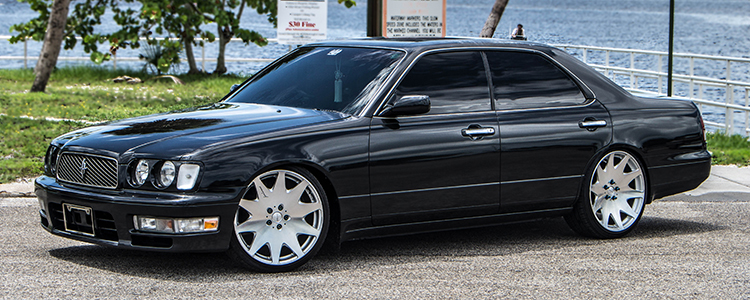
Editorial
The buyer's read
If you're buying a Cedric today, the sweet spot is a documented Y33 Gran Turismo with the VQ30DE or, if you've got the budget, the VQ30DET turbo in the Ultima. The Y33 gives you a modern engine, a body that still looks current, and the option of ATTESA E-TS all-wheel drive on selected trims, which is the same system as the Skyline GT-R and the Stagea. That's a strong package for the money. Skip anything under $7,000 unless you're buying it for parts. A cheap Cedric almost always means deferred maintenance, and the parts hunt outside Japan is real.
If you want the cleanest-looking turbo Cedric, the Y34 Gran Turismo Ultima is the one. The VQ30DET makes proper power and the Y34 styling has aged better than most JDM sedans of its era. Just know that you're buying a car with direct injection on some trims, an early CVT on others, and a Bose audio system that's getting old. Budget a few thousand on top of the purchase price over the first couple of years and you'll be fine. The 40th Anniversary RB25DET car is a unicorn worth chasing if you can find one with paperwork.
The Cedrics to be careful with are ex-taxi Y31s and rough Y30s. The Y31 sedan stayed in taxi production until 2015, so the market is flooded with high-mileage worn-out examples, and an ex-taxi Cedric is a different car from a private-use one even if the body looks the same. A clean Y30 with a VG30ET turbo and full service records is a great car, but those are getting rare. An undocumented Y30 with a tired auto and rust at the strut towers is a money pit. Pay for the inspection. Buy on paperwork first, condition second, mileage third.
FAQ
Frequently asked questions
- Which Cedric generation is best for importing and daily use?
- Most buyers target Y33 (1995-1999) or Y34 (1999-2004) for modern comfort and parts support.
- Are Nissan Cedrics rear-wheel drive?
- Most are FR (rear-wheel drive), but some trims/years offered 4WD depending on market and engine.
- What engines should I look for or avoid?
- VQ25/VQ30 are smooth and common. Turbo trims are fun but need proof of maintenance and stock boost control.
- What are the biggest reliability issues?
- Expect aging cooling, worn bushings, and tired automatic transmissions on high-km cars; buy on condition.
- How do Cedric prices compare to Toyota Crown?
- Cedric is usually cheaper than Crown for similar spec, but top-condition Y34 and rare trims are closing the gap.
- Is a manual transmission Cedric available?
- Most are automatic. Manuals are rare; swaps exist but cost adds up and can reduce originality for collectors.
- What should I check before buying at auction/import?
- Verify auction grade, rust photos, service history, and underbody. Avoid heavy mods and ex-taxi wear patterns.
- When is the Y34 Cedric legal to import to the US?
- Under the 25-year rule, 1999 cars become legal in 2024; 2000 in 2025, and so on through 2004.
Citations
Sources & references
- Nissan Cedric — encyclopedic overview — WikipediaVerified
- 日産・セドリック — Japanese encyclopedic overview — Wikipedia (Japanese)Verified
- Nissan Gloria — sibling platform reference — WikipediaVerified
- Nissan VQ engine family — used in Y33/Y34 Cedric — WikipediaVerified
- Nissan VG engine family — used in Y30/Y31/Y32 Cedric — WikipediaVerified
- Nissan L engine family — used in 230/330/430 Cedric — WikipediaVerified
- Nissan RD engine family — RD28 diesel used in Y30-Y33 Cedric — WikipediaVerified
- Nissan Fuga — direct Cedric/Gloria successor from 2004 — WikipediaVerified
- Goo-net Exchange — Nissan Cedric Japanese used-market listings — Goo-net ExchangeVerified
- Nissan Cedric: The Ultimate Guide (2026) — JDMBuySellVerified
Sources last verified: